
Monday, September 28, 2009
Gotta Love Kindergartners
Today Mrs. Alvarado went around to make sure that each of her kindergartners had their first and last name on their paper. When she got to Peyton, she said, "Peyton, I don't see your name on your paper." He quickly replied, "It's there. It's just invisible!" Gotta LOVE kindergartners!

Thursday, September 24, 2009
Performance Pay
Performance Pay is one of those ideas that I have endorsed over the years. I do believe that t eachers who go above and beyond should be rewarded for their work, but in order for Performance Pay to work it has to be fair. TLN did an excellent report "Performance Pay for Teachers" that was written by 18 highly accomplished teachers suggesting ways that performance pay could be used to make that crucial difference.
 eachers who go above and beyond should be rewarded for their work, but in order for Performance Pay to work it has to be fair. TLN did an excellent report "Performance Pay for Teachers" that was written by 18 highly accomplished teachers suggesting ways that performance pay could be used to make that crucial difference.
Unfortunately very few of their models can be found in our county's program. Our system was a collaboration between the county and our Union and is approved by our state. Extra money, a one time $2330 minus taxes, is paid to the top 25% of teachers in our county. As I understand it, teachers are placed in different "silos" depending on what they teach and then the top 25% in each silo  receive the extra compensation. While the system is designed around student achievement and teacher performance evaluation, unfortunately that means the weight is on a single day of testing. FCAT, our state test is used for teachers where it is possible. Other assessments, such as the DIBELS for K-2 teachers or county-made Music, PE, Art pre- and post-tests, are used in the elementary school and I'm sure any number of other assessments so that every teacher can put their name in the pot. That every teacher has a shot at the bonus is one of the positives.
 receive the extra compensation. While the system is designed around student achievement and teacher performance evaluation, unfortunately that means the weight is on a single day of testing. FCAT, our state test is used for teachers where it is possible. Other assessments, such as the DIBELS for K-2 teachers or county-made Music, PE, Art pre- and post-tests, are used in the elementary school and I'm sure any number of other assessments so that every teacher can put their name in the pot. That every teacher has a shot at the bonus is one of the positives.
With only 25% of teachers compensated county-wide, I'm glad to say that about 50% of the teachers at my school will receive the bonus. We are an A school and one of the few in our county that met AYP. However, these are some true, but strange circumstances.
1) We have a first grade classroom where two teachers team taught the same group of students all day. One took two months maternity leave during the year. The teacher that took maternity leave got performance pay. Her team teacher, that was with her side-by-side including teaching the class during the maternity leave, did not get the compensation.
2) We have two kindergarten teachers who team taught side-by-side the same group of students for the entire year. One got performance pay. The other did not.
3) Our second grade teachers are departmentalized. That means that one teacher teaches the Language Arts and her co-teacher teaches Math/Science/Social Studies. Each teacher has a homeroom and they switch classes mid day. Because most 2nd grades in my county are not departmentalized, there is not a silo for 2nd grade math teachers, so our 2nd grade Math teachers got their performance pay depending on how their homeroom did on the Language Arts DIBELS - no Math involved! Mind you, they never teach a single period of Language Arts but their performance pay depends on what is taught by someone else. If you are the Language Arts teacher in 2nd grade, your performance pay depends on your homeroom. In other words it only depends on what you do with half your students. I guess the other half don't count!
4) Or take this final example. Two fourth grade math teachers teach side-by-side. They have two sections of Math. One section includes a homeroom for each of them. Because of the way the class size amendment information has to be inputted into the computer, they each have a list of their own students in their homeroom, although they never have the homerooms divided for Math instruction. They always teach together. Two other homerooms (headed by two Language Arts teachers) make up their other section. So when performance pay is distributed, the Language Arts teachers and one of the math teachers gets performance pay and the other Math teacher didn't. Understand that these two Math teachers have worked with the exact same children in a room together all year, but because the children were required to be divided in the computer, one homeroom made the mark and the other didn't! One teacher gets the money, the other doesn't!
Does this sound as ridiculous to you as it does to me? Can you see where this could be divisive? Let's face it, the economy is tough. Teachers are not exempt from the financial stresses that are seen throughout our country. We have teachers whose homes are in foreclosure, whose husbands have lost there jobs, and money, especially right now, can be a dividing issue. Of course, really nice things happen too. I overheard the teacher in the first instance say to her partner that if they couldn't figure out how to get the money for both of them, then she would split hers. Such a generous gesture, but how ridiculous that they would even need to have that conversation. I am sure the first two will appeal, but if history is any indicator, it won't make any difference (if it does, I'll post a comment). They will be told there simply is no more money. It's all been given out.
One of the most disturbing trends over the years in my small sampling at my own school is fewer inclusion classes and Special Education teachers getting the bonus than the regular population teachers. That's not to say that none of the inclusion teachers ever get the extra money but it seems to be a lower percentage. I am bothered about how this will effect our inclusion teachers over time. Will they begin to feel that all the extra effort that they give in taking the most difficult children in our school is not worth it?
I decided to try to help figure out how compensation for Special Education teachers was designed so that our Special Education teachers could see why they are falling short (4 of the 7 are Nationally Board Certified). If at least 25% of Special Education teachers were getting better results than we were, I wanted to know how we could improve, but it was one brick wall after another. First of all the list is not published so you can't go to the high performers to search for strategies to improve your own student achievement. When I e-mailed our Special Education Department for information, thinking that there must be someone looking at high achievers and how to replicate their work, I received no response at all. And when I tried to question the process (Which children counted for me? If a child was in both Survey periods in my school but did not transfer to my class until the end of the second survey period, did that child count for me? Did all of the special education kids count for the general education teacher? How about those students who were on special standards? Who else was in my silo? Was I just considered with other inclusion classes or also with self-contained classes? Were all special Education teachers, regardless of what they teach, lumped together? and the list goes on), I was sent from person to person and really never got accurate answers. For the most part, it really seemed like they didn't know the answers, which begs the question, "Does anyone have their finger on the big picture?" When I went to the Union I was sent generic answers that basically said "see the web site." I yearn for a system of performance pay that would be an incentive to improve student achievement, instead of a mysterious system where teachers say, "I have no idea why I got it," and "I have no idea why I didn't get it." Transparency would go a long way.
With all that said, I am glad that some of our teachers will get a bonus because I believe that teachers certainly deserve it, but this is such a flawed system that you have to begin to ask, "Is it really worth it?" There are so many better ways to distribute performance pay, but our pay is so entwined in the political process, I wonder if it's possible to ever get it right? Our children deserve better!
P.S. - If any of my facts are incorrect, it is because the system is so cloaked in mystery and misinformation that it is difficult to get accurate facts. If I have misquoted in any way, I would be more than happy to write a retraction.
Wednesday, September 23, 2009
Five Year Olds Authors in September
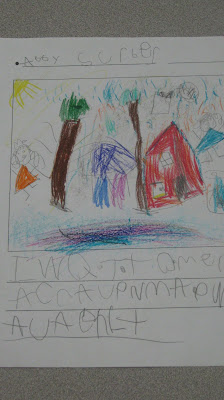
 I LOVE Kindergarten writing this time of year. Some children are just drawing pictures. Some of the pictures are just stick figures while others include many details and a rainbow of colors. The children are just beginning to understand that they can use letters to write some of the stories that they are able to tell in such detail. They are labeling their pictures -some with a single letter. Others are s-t-r-e-t-c-h-i-n-g out words and writing all of the sounds they here. Today a child even asked for a third piece of paper to continue her story. Some of the children write in straight lines that look like a long string of letters and others write their letters all over the paper. I think the reason I love writing this time of year is because I also know what it will look like at the end of the year and these baseline pieces will be a great reminder of where it all started.


Sunday, September 20, 2009
Bloggers Cafe

 About a year ago, our Instructional Technologist Melanie Holtsman, attended Google Teacher Academy in NYC to become a Google Certified Teacher. She brought back lots and lots of ideas from her adventure. One of those ideas was to establish a Bloggers Cafe as a professional learning area in the midst of our office space. We added comfortable seating and wireless availability. Today lots of formal and informal learning takes place in this new space.
Another idea that Melanie saw and loved was the way Google geeks jump on scooters to maneuver around the building, although she hasn't quite figured out a way to embrace that idea! However still another idea she was able to adapt was the use of white boards for doodling. Melanie had white boards added around a column in our blogging space and now there's room for all sorts of fun and inspiration. This week someone suggested that we add funny tidbits from the first month of school that we've overheard children say! My personal favorites are, "dry erase markers taste wet, not dry!" and "Everything evil is a constipated teletubbie!" We've also doodled about our guesses for the new theme this year (by the way, nobody guessed it!), our favorite movies of all time, our favorite opening day moment, fun things we did over the summer break... No telling what we will be doodling about new week!
Saturday, September 19, 2009
Joys in Life
 One of the things that makes Chets Creek such a fun and special place to work is that we enjoy being together and we celebrate together. We really are an extended family. Today the Kindergarten Team had a surprise celebration for Barbara Ellis, last year's "Chets Creek Employee of the Year," because tomorrow is Barbara's 65th birthday!!! Barbara came to us about seven years ago after her husband retired and they returned from overseas. Barbara's daughter and daughter-in-law, Debby Cothern and Michelle Ellis, both teach at Chets and at the time her grandchildren were students at the Creek. Barbara had been a paraprofessional before her husband left to work overseas and so after they returned she joined the Chets Creek team, partially to be near her daughters and grands. She didn't really need to work, but she loved the work. Her daughter and daughter-in-law co-teach and there have been years when Barbara worked in their room! Now however, the grandchildren have graduated from elementary school, but we are so fortunate that Barbara has stayed with us. She's one of reasons that Chets Creek is so strong. Not only is Barbara efficient and organized - not only is she kind and caring, but she's just experienced about life. She's your mother, your grandmother if you're a little one, your best friend. We are a better school because Barbara chooses to spend her time with us. Here's to the next twenty years! May they be even better than the last twenty - if that's possible!!
Chets Creek is full of moments like this. Earlier this week we celebrated the upcoming wedding of Kinder teacher Laura Stewart with a bridal shower given by the grade level. This morning we offered our families a chance to eat breakfast together at a Pancake Breakfast sponsored by the Dads of Chets Creek. At lunch we celebrated with a tailgate party, showing our spirit by dressing according to our loyalties, sponsored by our Social Committee. This is a place that teaches children by example. We teach children to live together as a community by celebrating the small moments in their lives and in our lives. We teach children to value and uplift each other. Don't get me wrong- we have the same challenges that other big schools have today. A child lost her mother this week after a long battle with cancer. Another child confided unimaginable stories of abuse to a teacher. A parent tried to bully his way through Administration by demanding a face-to-face meeting with another parent because the other child said something he perceived as offensive to his child. The list goes on and on of unspeakable hurt and anger. Certainly we could go on and on about the troubles with society today, but we choose instead to continue to reinforce to our children through our examples what healthy, nurturing relationships look like and feel like. We want our children to grab hold of life and soar. That is what people like Barbara Ellis stand for at Chets Creek. May we continue to imprint those life lessons on the generations to come. May we continue to be that shining light in the storm. May we always embrace this part of our mission as educators.
Friday, September 18, 2009
STARS
 STARS stands for Students Are Reading Silently and that's what students do in the mornings before school begins. As children begin to come into the building in the mornings their classes have an assigned place to sit in the hallway. Also in the hallway is a wagon full of good books. The child can bring a book from home, put their library book in their back pack or choose from the books provided in the wagon, but the goal is for every child to read. Patrols and teacher assistants monitor the hallways.
Today was the first day for our youngest readers to sit in the hallway and read. Until now they have been in the Dining Room. Now, however, they have had mini-lessons on how to "read" a book by looking at the pictures and they are ready to join the rest of the school in this early morning routine.
Tuesday, September 15, 2009
Saddle Up for Skills Block
 Skills Block is the foundation of the early weeks in Kindergarten. This standard-based bulletin board showcases the multiplicity of work that is going on in the Kindergarten classes.
Skills Block starts with a warm-up. It is usually a review of an activity from the day before such as clapping syllables, rhyming, beginning sounds, recognizing letters and sound, etc.
 Nursery rhymes are the backbone of our program in phonemic awareness. Students work on skills such as hearing beginning sounds, blending, and segmenting that will help them hear the individual sounds as they write words and will help them blend sounds as they read words.
 "Star Names" is our phonics program where we use the names of the students to introduce the class to letters and sounds. The children LOVE this activity and can't wait until it is their turn to be the star student! The teachers sing songs and chants with the letters of each name, cut the letters apart and put them back together, interview the student and write sentences, etc. This program will continue until each child has had a turn being the star.
 Each day the teacher chooses one student to lead the ABC activities. The student chant and sing the letters and the sounds each day.
 Skills Centers or "Table Work" as it is called in some classrooms, offer the children a chance to work independently on the skills they are learning. In this classroom the children spend 10 minutes each day working through one of six centers that are meant to practice the current skills.
This is a great bulletin board for Open House, which will be later this week, to help parents "see" all of the activities that children are doing each morning! This is truly a peek into the classroom.
Monday, September 14, 2009
Ropin' in Kindergarten Writers
 It's time for the first standard-based bulletin board of the kindergarten year. The Mall-ards
  carry through with their Honky Tonk theme by "Ropin' in Kindergarten Writers." They feature the work of three of their writers. In each story, the writer first told his story over three pages with the beginning on the first page, the middle on the second page, and the end on the third page. Next the writer drew pictures over several days staying inside the small moment of the story. He also used letters to write some of the words that he wanted to write. In the example below the author wrote about finding a conch in the puddles under the pier on the first page. On the next page he draws about climbing a sand hill and on the final page he draws about telling his dad to hurry up and get under the canopy. This young author had no trouble telling the story he draws in his pictures. What a great honky tonk bulletin board that offers a window into the instruction in this classroom!

Sunday, September 13, 2009
Roaring Retellings
 One of my favorite "Star Books" is The Three Billy Goats Gruff. This standard-based bulletin board from Mrs. Alvarado's class actually shows the exact text from the book and then the teacher's dictation of three children reading that same section of the book. Using the scale developed by Elizabeth Sulzby and refined by Lucy Calkins, Mrs. Alvarado assesses each passage. The assessment helps her know what the next step is in conferring with each child. In the case where the child's retelling begins to sound so much like the story language in the book that it sounds like the child is reading instead of just retelling the story, the teacher knows that the child is ready for conventional reading.
Rockin' Retellings
 "Rockin' Retellings" is a standard-based bulletin board from Julia Lewis' Kindergarten class that chronicles the work that we do to support oral retellings. On this bulletin board the teacher shows four different activities that the children did to help them with retelling "Caps for Sale."
This first example shows a child that has drawn the story "Caps for Sale" in pictures. The child is practicing retelling by drawing the sequence of the story.

In this example the children have learned a song with motions that describe the sequence of events in the story, "Caps for Sale." Moving through this sequential order will help the student as he retells the story later by looking at the pictures in the book.

In this example the children play the parts of the major characters, the peddler and the monkeys. As the children play the parts of the story, they practice the dialogue and story language in the book.

In this final example the teacher actually recorded the oral retelling of a student as she looked at the pictures and told the story of "Caps for Sale" during her independent reading time. All of this extra work on oral retelling will pay off in spades as the children write retellings later in the year. Stay tuned as this group moves through the year!
Tuesday, September 8, 2009
A Sense of Belonging
 Jennifer Allen makes me want to pack up and move to Maine! I am not a cold weather gal, but her new book A Sense of Belonging, is a new resoucre packed with suggestions for sustaining and retaining new teachers. I would love to live in a state that not only spouts the statistics but actually does something about them. "17% of educators leave teaching after one year, 30% after two years, 40% after three years and hearly half after five years." We know this to be true so Jennifer Allen, Literacy Coach, presents many possibilities for intensive, sustained professional development for the new teachers at her school: observing the coach, teaching how to administer and analyze assessments, offering in-class support, meeting as a group of new teachers, observing peers, using student work to guide instruction, offering on-going professional development on curriculum planning, and study groups. She presents each idea with "tried and true" experience and suggestions. Some of the ideas are not possible in our situation and many we already have embedded in our weekly Teacher Meetings but the validity of each makes me want to figure out a way to make sure each happens in my own school setting.
For instance, she suggests making sure that new teachers are allowed to observe their peers. In her case, the stumbling block early on was teachers opening up their rooms for the observations. In our case, our school is very open. Teachers welcome observers and they have many. We have always allowed new teachers to spend a day observing teachers of their choice. Just last week, new teacher Mary Beth asked to observe four different teachers on her grade level. She wanted to see Carrie's Skills Block, Tenean and Danielle's Readers' Workshop, Laurie's Writers' Workshop and Deb and Michelle's Math Workshop. She was proactive and knew what she wanted to see and who she wanted to watch. She just sent an e-mail after her day observing: "I cannot thank you enough for today. It was a WONDERFUL learning experience. Each teacher was so helpful and professional. Carrie even changed her schedule for me and let me video tape her doing her sound cards. Now I will have time to reflect on all I saw over the long weekend." While that's a good start, one of our frustrations has been that we want teachers to see more demonstration lessons and we'd like for them to have some choice so they can guide their own learning - much like Mary Beth did.
One of the things that Jennifer suggests is that teachers go in a group so that they can debrief with teachers who have seen the same lesson. As I am trying to see how this would look in my school, I am thinking that we could offer once a month demonstration lessons. We would schedule a demonstration lesson. Guided reading comes up every year as something teachers want to know more about, so suppose we schedule a primary observation so a teacher could see three guided reading groups - one in K, one in 1st grade, and one in 2nd, back-to-back. While this is designed for new teachers, any teacher that is interested could sign up for the opportunity to visit. They would have a guiding sheet that would ask them to list things they wondered about and then ways they could use what they see in their own classroom. Their committment would be to meet with the group after school for a half hour and debrief what they had seen or maybe that could even be worked into the half day. To take best advantage of the subs we would have to get, we would offer a similar opportunity in the intermediate school in the afternoon. In this way teachers could choose the topics that they wanted to know more about. Now this has possibilities!
Monday, September 7, 2009
14 Cows for America:Book-of-the-Month September 2009

Once again, our Principal presented a Book-of-the-month that kept the faculty on the edge of their seats! The faculty walked into the Media Center as a video played to activate schema for this book presentation.
Then the Principal appeared via Skype! She wasn't even at school! She was in South Carolina and was Skyped in for the presentation. She explained why she had chosen this particular book to honor September 11 and the sacrifice that has been made by so many. Then she read the book to us that had been prerecorded. This same recording will be used throughout the day of September 11 so that our children can also see why this book was chosen and hear the Principal read it.
Of course, we always have to learn a new strategy through the Book-of-the-month and this book was no different. The Principal introduced a strategy from Kelly Gallagher's Deeper Reading. She taught us an advanced strategy using metaphors. Not only did groups, divided into grade levels, come up with touching metaphors, but they thought deeply about using such an advanced strategy with their readers and writers. Once again, it was a book to remember. For more information about the book and presentation, check out the Chets Creek Book-of-Month wiki.

 made by so many. Then she read the book to us that had been prerecorded. This same recording will be used throughout the day of September 11 so that our children can also see why this book was chosen and hear the Principal read it.
Of course, we always have to learn a new strategy through the Book-of-the-month and this book was no different. The Principal introduced a strategy from Kelly Gallagher's Deeper Reading. She taught us an advanced strategy using metaphors. Not only did groups, divided into grade levels, come up with touching metaphors, but they thought deeply about using such an advanced strategy with their readers and writers. Once again, it was a book to remember. For more information about the book and presentation, check out the Chets Creek Book-of-Month wiki.
Saturday, September 5, 2009
Jack and Jill

As part of our Skills Block we put a priority on phonemic awareness in these early days of Kindergarten. To bring phonemic awareness alive, I wrote a Nursery Rhyme Unit several years ago. It includes nursery rhyme activities, and suggests teaching a rhyme a week, but uses the words from the rhymes to practice phonemic awareness. For instance, this week while we are learning the Jack and Jill nursery rhyme,
- the students are blending words from the rhyme (/J/ /ack/ Jack, /w/ /ent/ went, /h/ /ill/ hill),
- identifying the first sound that they hear (What is the first sound you hear in Jack? /J/ What is the first sound in fetch? /f/),
- What other words rhyme with hill? (Jill, grill, thrill...)
- What are the rhyming words in the nursery rhyme? (hill-Jill, down-crown).
So the meat of the lesson in phonemic awarenes is in between the comprehension of the nursery rhyme. To comprehend this rhyme we act it out, use motions to sing it to a tune, draw the rhyme's beginning, middle and end, draw pictures of all the nouns in the rhyme, etc.
Thursday, September 3, 2009
Readers' Workshop - Star Books
Readers' Workshop begins the first day of school. Teachers begin by reading "Star Books" which are books that we have chosen because of their strong narrative elements (characters, setting, events, problem and solution). The list of books that we use, along with resources can be found on our Kindergarten wiki. We read these books every day, reading four new titles each month.
Mini-lessons. As part of our mini-lessons we identify the characters and the setting of each new book. We decide what the problem is and how the problem is solved. We talk about and draw the beginning, the middle and the end of each story. We also act out the stories, helping the children learn prosody by creating voices for the different parts. One the children's favorite early books is The Three Billy Goats Gruff. The children especially like being the troll and using their mean, tough voice! Over the course of the week each child in the class will have a chance to be one of the characters.
Mini-lessons. As part of our mini-lessons we identify the characters and the setting of each new book. We decide what the problem is and how the problem is solved. We
 talk about and draw the beginning, the middle and the end of each story. We also act out the stories, helping the children learn prosody by creating voices for the different parts. One the children's favorite early books is The Three Billy Goats Gruff. The children especially like being the troll and using their mean, tough voice! Over the course of the week each child in the class will have a chance to be one of the characters.
 Wednesday, September 2, 2009
She's the Apple of My Eye

I have mentored new teachers for the past ten years while I have been a Literacy Coach at Chets Creek. It's part of my job as a Coach and also as a National Board Certified Teacher but it is also a part of my heart. The older I get the more I realize that I have an obligation - a moral reponsibility - to share what I have learned. In fact, it's one of the reasons I felt so compelled to begin this blog. I have always felt like I am part of an amazing school that is different from the norm in so many ways and that we must share what we learn, that we must be transparent and honest, and that we are called to use what we know to train up a new generation of teachers. Maybe it's a little sappy to think about legacy but I do feel like we are forging a path for others to follow and eventually lead.
This year, I have the opportunity to mentor my own daughter as she joins the profession for her very first year. When I approached her about writing a "she said/ he said" sort of blog as a teacher and mentor but also as a mother and daughter, Courtney never hesitated. We have begun that path and I hope you will take a moment and visit our blog, will leave a message for Courtney supporting her first attempts at blogging, and will recommend the blog to any beginning teachers that you might know.
This is a journey that truly touches my heart! Join me!
Subscribe to:
Posts (Atom)