Friday, May 8, 2009

Finding Doubles

First grade teachers asked second grade teachers to come into a Teacher Meeting a couple of weeks ago and let them know what things they really need to work on for the last nine weeks of first grade. One of the things that second grade teachers identified was that children coming into second grade needed to have fluency with doubles (e.g., 2+2=4, 3+3=6). They wanted to make sure that the children know the doubles and know them quickly. That led our Standards Coach, Suzanne Shall, to teaching us four new Math games at the next Teacher Meeting to meet the expectations of the second grade teachers.

"Finding Doubles" is a game taken from Catherine Towmey Fosnot's Games for Early Number Sense. According to the rules two can play. The game has a "board" that can be a piece of paper with even numbers. A deck of number cards is turned down. A player takes the top card and doubles the number. On the game board, the player covers the double with a chip. Then the other player draws and they continue until all the even numbers are covered. Once a number is covered, it can't be covered again. The winner is the one with the most numbers covered. Watch students play the game.

How can you make this game more difficult? Another task that second grade teachers wanted children to work on was doubles, plus or minus one. In other words they wanted children to know that 6+6= 12 and then minus 1 is 11 and plus 1 is 13. The way to make "Finding Doubles" more difficult is to use the same number cards but change the game board adding numbers from 3 to 21. Then as each player turns over a card, he can choose to cover the double, add or take away one so that he can cover numbers that aren't already covered on the game board.


Thursday, May 7, 2009

K-1 Collaboration

Today a group of kindergarten and first grade looping teachers met together to work on continuity between kindergarten and first grade. Each of these teachers, four currently in kindergarten and four currently in first grade, loop back and forth between kindergarten and first so they have intimate knowledge of both grade levels. They started the morning talking about our Reading assessment where we monitor all of the big five reading areas.

Next they looked at the Pacing Guides for kindergarten and first grade. This is our guideline for teachers, a look across the curriculum for each week of the school year. They discussed the Guide that we have had in effect for many years and that we rework every year. We look at what works and what doesn't in each year, how to tie our Pacing Guide into the county's newly adopted Houghton Mifflin Reading Program and the county learning schedule in reading and writing. The teachers spent several hours editing a Pacing Guide that works for our kids at Chets Creek!


After lunch two second grade teachers joined the group as we discussed persuasive writing K-2. As I have written before, the state has added persuasive writing to our writing schedule but without a lot of direction. This group of teachers talked about the standards and goals for each grade and reviewed all of the county materials and the resources we have found through our work. They came up with a global idea of what a final product would look like for each grade level and then divided to write a rubric for each grade. They selected children's books for each grade and then outlined lessons that will be written over the summer and added to our wikis.

It was such a productive day - a day of collaboration. I think it makes each of us feel good when we have heard the voices of our colleagues and addressed issues. I feel so fortunate to work with a leadership group that values time for teachers to work together and to spend time with teachers who enjoy the work and believe that when they work together they come up with a better product that works for kids!

Tuesday, May 5, 2009

The Old House: Book of the Month May 2009

It was our last book-of-the-month for this year - a new book, The Old House, written by one of our favorite authors, Pamela Duncan Edwards, and favorite illustrator, Henry Cole. Pamela and Henry have visited Chets Creek a couple of times and have forged a long lasting relationship with the school. In fact, our media specialist, KK Cherney, and our Principal, Susan Phillips, will be joining them next week for a presentation at the International Reading Association in Minnesota where they will be presenting a symposium together on using books-of-the-month in elementary schools. You can actually follow Susan and KK's journey at IRA as they blog live!

As usual, Susan started the professional development book-of-the-month by reading the children's book out loud.  She read the delightful story as the faculty followed along. Artists Kristy Sappington and Karen Willet had drawn the old house as a backdrop behind Susan and then unrolled the second backdrop of the happy house as Susan concluded the story! Next Susan asked the teachers to close their eyes and think about a house or a special place that made a difference in their own life. She was asking the teachers to respond to the story and pictures in the book. After the visualization, teachers were asked to draw their special place and then to write about it! It's amazing how teachers fall right into the roles of their students with the "I can't draw" or "I don't know what to write!" It's a great exercise for teachers to put themselves in their students' place! Of course, after a few moans teachers busily got to work using crayons and markers to sketch and draw as they responded with poems and stories and quick writes. Some of their pictures and words will be available on our book-of-the-month wiki. The purpose was to archive the adult work to let our children know that writing and responding to books is a lifetime skill - not just something that children do at school. Books and pictures evoke all kinds of feelings and memories, and they always will. What a delightful way to celebrate reading!

Friday, May 1, 2009

Mother-Daughter Dynamos!

Debby and Barbara Ellis with Principal Phillips
Last night our county celebrated its Teacher of the Year with a lovely dinner and ceremony. At Chets Creek we celebrated our Teacher of the Year Debby Cothern and her mother, Barbara Ellis, our Employee of the Year! It's the first time we've ever celebrated a mother daughter team and what FUN! The tables were decorated with beautiful flowers and pictures of Barbara and Debby's life. The children had painted pictures as placemats. Each of the grade level teams did a skit and both the PTA and Faculty presented them with gifts. Next we watched a slide show of Barbara, beginning with her baby years, her marriage and the birth of her son and twins, Debby and Donna. We watched Debby move from a toddler through the birth of her own beautiful children - all this while we enjoyed breakfast. All of their family was there - their personal family and their Chets Creek family!

Debby has been a longtime kindergarten and first grade looping teacher. It's hard to think of Debby without her teammate, her best friend and sister-in-law, Michelle Ellis. Debby and Michelle are legendary at Chets Creek. They are a team that has hosted thousands of visitors over the years. They did some of our first live lessons and videoed lessons. They have single-handedly raised the level of what we expect on standard-based bulletin boards. Today they are on our Leadership Team and lead the Kindergarten Team. They are smart, talented, distinguished young women. They are a credit to their families and to our Chets Creek Family.

Barbara came to Chets Creek as a paraprofessional and has worked in Debby and Michelle's room! She has also had her grandchildren in the rooms where she has worked, but she in no way stands in the shadow of her very distinguished daughters. She is a competent and talented in her own right and is the much loved "Grandma Barbara."

How much our lives are enriched by having the Ellis family in our midst!


Thursday, April 23, 2009

Second Language Learners

Tonight I had the honor of attending our county's celebration of second language learners. To my thrill one of the general education students in my first grade classroom was honored as the "Chets Creek Second Language Learner of the Year." She is Armenian and I remember so well her journey into our school. Actually, who could forget! She entered shyly almost hidden behind her mother's dress. I don't know who looked more frightened, our little kindergartner or her mom! I think we peeled her off her mom that first day and for many days after that. She was terrified. When I would sit with the class at lunchtime, I would often find her in tears. She would be worried about a host of things, but most often that her mom would not be there at the end of the day. Those were such tearful times and there were mornings when I wondered if we would ever have a day without tears. I can only imagine her fears as she walked into that classroom each day understanding so little of the language and what was going on. I think of how brave her mom was to leave her. She too understood little of our language and customs and yet, she somehow found the courage to trust.

It's hard to reconcile those images with the happy, outgoing little first grader I see today. When I sit with her today at lunch she chatters endlessly (I barely get a word in!) She chatters about her family and her friends. She is a great little reader and has assimilated into our class culture in a way that is very Americanized.

She is only one of the 262 students we have this year at Chets Creek who entered with families that speak a second language and qualify for some level of second language support. That is about 18% of our total population. We support families who speak 21 different languages! We are so very fortunate to have an assistant assigned to our school who works with our students and who understands both the student and family needs. My student is only one of the many success stories that we see every day. We are fortunate to have this type of diversity in our school. In my own classroom, my own mini-United Nations, we have students whose parents are first generation from the Sudan, Mexico, Korea, and Poland in addition to Armenia.

In fact we have a kindergarten bulletin board up in the building right now that demonstrates a young student's growth over time in both English and Japanese. While reading a book that was written in both English and Japanese to their class, kindergarten teachers Debbie Cothern and Michelle Ellis realized that one of their students could not only read the English version, but actually read the Japanese version of the book as well!
As they investigated further, the student explained that she is learning to read and write in both languages. Their board shows her growth over time first in Japanese and then in English!
The world is getting smaller every day!

Wednesday, April 22, 2009

Our Little Seeds Have Bloomed

The TDRs display the work over time of two different students on this final bulletin board of the year. Reading across the board is one student's work and then under his work, is another student's work over time.Parker begins first grade full of things he wants to write about. He uses some sight words and uses invented spelling for words that he doesn't know by sight. His work is easy to read because he has made the letter sound connection and easily hears sounds in words. He opens the piece establishing the context and then writes three pages describing a series of events. His ending provides closure for the piece. Parker also demonstrates that he is learning some conventions. Even early in the year you can find a sense of humor in his work. In this first piece he writes about liking being alone in his room which is funny in his family of three sisters!By mid-year Parker has written many engaging pieces. The piece above is an example of a nonfiction work where he writes all about computers including instructions for getting on the computer. He obviously knows lots about technology. He uses a series of questions to drive the piece. Parker demonstrates that he knows lots about nonfiction writing and includes many nonfiction conventions. His language conventions and spelling have greatly improved but it is his writing fluency that demonstrates the most obvious progress.

Parker's final piece, which was written in early March, is a response to literature written during the Kevin Henkes author study. Parker has a complete retelling of Lilly's Purple Plastic Purse. I think it is probably one of Parker's favorite stories because it's the one that his mother read to his class. Parker's spelling and use of sight words has really improved along with his use of conventions. He even used dialogue in the retelling, along with quotation marks! Parker is developing his own voice in his writing but it is the ten pages that he writes that is most impressive.
Parker is a wonderful example of what can be accomplished when a student writes daily in a Writers' Workshop and is exposed to mini-lessons that teach him all about genres and writer's craft.

Tuesday, April 21, 2009

"Watch" How Time Will Tell!

It's time for the last standard-based bulletin board of the year. Most teachers have posted "work over time." The Mallards have looked at writing over time and have posted work over the Kindergarten and first grade year of a single student. The first piece, which is a writing log, looks at how the child's writing changed with a sample from kindergarten each month of the year. The growth is obvious as the student moves from a drawing that tells a story in August to a long written piece by the end of the year that shows a growing sight word bank, beginning punctuation and writing stamina.
The first piece written in early first grade is a small moment, "When I Went Ice Skating." The author writes a series of mini-events and shows that she has learned to edit her own work (using a green pencil). In October the student completed a Question/ Answer pattern book, "Swimming Fun," that introduced a unit on nonfiction writing.
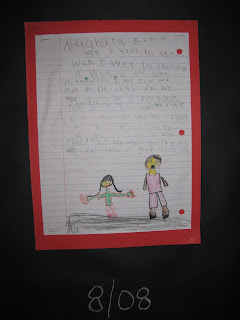
The December piece is a report about the student's family. It includes a Table of Contents, comparison, a "how to"/ procedural piece and a narrative about a vacation. The piece shows that the student has been exposed to and has internalized the nonfiction conventions.

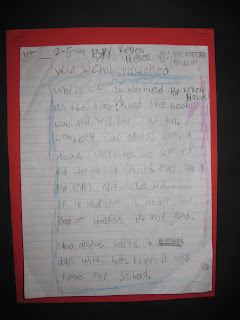
In February the young author wrote a response to the book, Wemberly Worried, during an author study of Kevin Henkes. This is one of many responses that the student wrote during the author study. The work meets the standard as it includes an opening, a detailed retelling and a closing.


The final piece is a letter written during our persuasive writing unit. This young writer wrote to the lifeguards at the beach asking them to come out a little earlier so she can have some fun!


It is always amazing at the progress that children make from the day they enter kindergarten until they end first grade. This bulletin board certainly displays that well and shows a young writer that is well on her way!