Showing posts with label Assessment. Show all posts

Wednesday, January 20, 2016

Happy Birthday Chets Creek!


Chets Creek adds a candle for each year.
All 18 candles are displayed in the school's lobby.
This year's "The Greatest School on Earth" (right)
was painted by talented  Art teacher, Jen Snead.
Happy Birthday!  Today Chets Creek is 18 years old!    I was watching a video of years past in the lobby with a 5th grader this morning and he said, "Wow!  Do you know I wasn't even born then?"  It was quite sobering to think that every child we are educating today at the Creek wasn't born when the first group of children came over with "Mrs. Fizzle" from three different elementary schools to form that first class in the middle of the school year.  That first group of children are grown now and we have even had second generation children entering Chets Creek. Incredible!

Chets Creek began to build a reputation from those very first days.  I can remember however, that we had very few teachers interviewing at Chets in those early years.  There were rumors that we worked too hard, that teachers were required to work on Saturdays and Sundays, and that the Principal sat in the parking lot with a camera and checked cars coming in and out to make sure teachers came on time and didn't leave early!  Have no idea how those rumors got started but they were so ridiculous.  Instead we were busy building a learning community.  Teachers who didn't feel comfortable being transparent and opening their classroom to others generally self-selected out.  Soon test scores began to verify what we already knew - that something quite extraordinary was happening at this new school. Now we generally have teachers interviewing that say they really want to come to Chets as their first choice because of our reputation with on-going professional development.

Notice the detail in this year's candle
with a nod to the Principal's championship team,
 Clemson Tigers.
After five years the county promoted our founding Principal.  I'm sure people wondered if Chets would be able to maintain - was the school's success due to a single charismatic leader? Some internally may have wondered that too!  Thankfully the county promoted a teacher from within who was familiar with, and had had a pivotal role in, establishing the culture and community.  She was able to continue what had been started - business as usual - which is as hard as establishing the initial foundation. While many schools that opened around the same time that we did have had six, seven, even eight principals in these 18 years, we have had only two.  That stability has been our strength.

As test scores came in this year, Chets Creek ranked second in our large county (behind the gifted magnet) and 36st in the state, but what has been built here is so much more than test scores. We have established a true learning community where children, as well as adults, work together and lean on each other for support. Regardless of the winds of change, we have stood steadfast in what we believe is right for children.  Because we have always had strong test scores, thank goodness, we have been allowed much autonomy in charting our own course.

For 18 year Chets Creek has maintained a solid reputation as an outstanding school, inside and out. What a celebration!  Happy Birthday, Chets Creek.  Just as teacher leaders have continued to exceed the expectations, may they continue to rise to exceed the expectations for the next 18 years!

Saturday, December 12, 2015

The Grinch Comes to Chets

I have often been called a Pollyanna, because I usually see the glass half full.   It's true that I have spent most of my professional life climbing mountains and basking in the view on the mountaintop, but this week I seem to be spending my days walking in the Valley of Discontent.  I haven't spent much of my time here over the past fifteen years because I teach at a school where teachers are mostly sheltered from politics, and the focus at Chets has been on living in a state of gratitude, striving for continual self-improvement with a mantra of children first.  It's not just an idea.  It's the culture.  It's a lifestyle.

After Thanksgiving we come back to three weeks before the winter holiday.  I usually love December's short month.  It is usually a time of holiday joy and good cheer.  We have a hilariously fun Book Exchange and enjoy the "Twelve Days of Cookies." Classes prepare a "Season of Giving" project so they can practice giving instead of just getting.   Holiday music can be heard in the hallways and 2nd graders prepare a holiday play for all to enjoy. Teachers finish up units of study and make sure they have a handle on where the children are before they leave and make goals for what they want to accomplish in the new year.  You can watch the children's hearts leap with excitement as we move closer to the break and their eyes begin to twinkle... except this year...   This year is different.  This year the Grinch came to Chets Creek... in the form of TESTING!

This type of mandated over testing (in Reading, Writing, Math AND Science!)  is like a suffocating fog that so masks the view that it is hard to see anything clearly.  It's just too much for the children.  Even Rudolph's bright red nose couldn't light the way through this clog of frustration.  Changing the name to "scrimmages"  is just putting a wolf in sheep's clothing!  It's still TESTING and in its worst form!  The idea to get some data so that we are ready to hit the ground running when we come back in the new year seems like such a good idea... In fact, it's one we have embraced for years.  It's one we prepare for way in advance at the school level,  but this year the county's new mandated implementation has been short sighted, last minute and disorganized. A perfect dream may start at the top but as it reaches the reality at the bottom, it's more like the perfect storm. I could go on and on and on and on... about all the problems, but it wouldn't solve anything now.  The worst part is that we have wasted one of the most beautiful times of the year with our children and this time can't be made up. It's gone forever...

We will continue testing through early next week, because we have no choice.  Wonder how many children are really going to have writing prompts, numbers and science experiments in their heads next week instead of the sugarplums that are usually dancing this time of year? We will NOT let the Grinch steal the joy of this Christmas season! Of course,  we have to work with that which we cannot change, but some way, some how we still have to make these last days special for the children we care about so much.  Maybe it's the rigor of our commitment to children and the accountability of our love that is really being tested... Hmmmmmm...

P.S. - A few days after this blog was posted, second grade teacher Christy Constande pulled some of the K-1-2 teachers together.  Since they had not been effected by the testing, she suggested that they each take a 3-4-5 class and do something holiday-ish for our students that had missed so much of the holiday joy because of testing... Every single primary class adopted an intermediate class!  And that, ladies and gentlemen, is why this IS the greatest school on earth!

Sunday, March 8, 2015

Pay for Performance

I have been so worked up over this issue for so long, that I thought when I sat down to write this blog that it would practically write itself, and yet, I have been sitting here staring at an empty page and trying to decide what it is that I really want to say.

You see, when the idea of pay for performance first came out, I applauded it.  I thought it was about time that teachers that work so hard and care so much, who put passion and commitment into their work, should be recognized.  I was sick to death of seeing poor teachers continue in our profession.  I thought it was about time that we got rid of those teachers who were just there to earn a paycheck and didn't really care about their ethical responsibility to the children in their care.  It seemed like such a logical path and such an affirmative cause.

What  I didn't fully realize is that the decision for how the system would work would be left up to politicians and people who have never walked in a teacher's shoes. We would not be like doctors who police their own profession or lawyers who regulate their own membership, but we would be the pawns in a wicked game of political power and circumstance. 

I could give you all the little details of why this system hasn't worked, from personal experience, but it doesn't really matter.  The bottom line is that the formula for being a "highly effective" teacher, which is the road to performance pay in Florida, combines a principal's evaluation with student growth scores.  The problems with that formula are so enormous that it's hard to contain in a single blog. They have tried so hard to be fair, but a principal's evaluation, no matter how hard they try, is still subjective, and the growth scores are a crap shoot in any given year.  Sure, there's a state test to determine growth scores for some teachers but is that even that fair?  You can argue that the teachers have no way to control for what their students come to school with or you could argue that students who make a perfect score often count as "not making growth" when they make a perfect score the next year, so how can those growth scores be fair?  I could spend this entire blog just talking about things that effect the scores that are out of a teacher's control!

And to complicate it even more, there is no state test for K-1 students (and for many resource and specialty teachers).  I could tell you about the year that my growth score was dependent on a state test and that the communication was so poor at the state and county level that our school never got the word of how to open the portal to test high achieving children so... because our children made so high on the pretest and then just repeated their perfect scores on the post test, they were deemed not to make progress!  Of course, that certainly is water under the bridge. However, I guess I still haven't gotten over it, because I'm bringing it up here! It's just hard to live with because it effected a large number of extraordinary teachers.  That year most of those exemplary teachers were not highly effective, although they had very high Principal evaluations.  It wasn't because they didn't teach their heart out or because their students didn't make exceptional progress. It was because of a glitch and a line of  poor communication.

Or we could take this year's announcement of last year's scores.  My kindergarten group showed amazing progress as a group and individually.  I was so proud by the end of the year.  I won't go into all the individual successes we had, but they were numerous.   Our growth score for last year was determined by a county-written test designed for pre and post testing.   The test had never been field tested.  It was a new test, designed by "somebody"  - hmmmmm...  Anybody see a problem?  This was also the year that we were told at the beginning of the year that kindergartners would be pre and post tested and monitored each nine weeks in Language Arts, Math and Science and pre and post tested in Art, Music P.E. - I don't even remember all the absurd testing that we were suppose to do.  When I first heard it, I thought it was a joke, but no, "someone" had decided that this made sense for five year olds?  About sixty days into the school year, the county finally "listened" to the outcry and came down to a more reasonable testing schedule but by then, much of the damage had been done.  We had complied with the original requirement so we had essentially lost 60 days of initial instructional time.  As the data began to arrive, it was full of mistakes.  We had students with scores over 100%, missing data, and missing students, so the data was useless.  We called... and called... and called... the Testing Office to have the obvious inaccuracies fixed.  I'll bet they flipped a coin in the testing office and the loser had to take our calls!  It would really have been comical, except it affected children and our reputations as teacher! The data was basically unreliable - and this was going to be our growth scores to determine if we were highly effective?

I shouldn't have been surprised  that when the growth scores came in, that I was called into the Principal's Office.  The Principal explained to me that I had a 1% growth score.  1%!!!!!!!  That means that exactly 1% of my kinder students made progress last year!  I had about a second of absolute panic when I thought - could I really suck that bad?  But then reality began to set in.  No... this was a class that had made incredible progress. I could go student by student and rattle off the amazing things that I had witnessed. We had worked so hard. I looped this class, so I still had most of these students as first graders.  No way! No, this was not possible...  As I began to put it together, I noticed my Principal sort of smile.  "I know," she said, "there has to be something wrong with the data."  OH MY GOSH!  A 1% growth score put me in the "Needs Improvement" category! I am a National Board Certified Teacher with over 30 years experience. I am a former Florida Teacher of the Year.  I have published 19 books for teachers and now, I was in the "Needs Improvement" category!  Really?!! Thankfully, the Principal and Assistant Principal went right to work to begin notifying the Testing Office that there had to be something wrong with the data.  It ended up that there was a large group of teachers at my school - and I later learned at other schools - that were effected.

That was October.  We had to submit an appeal and were told "someone" would look into the matter, but for months, we were to hang out, having nothing to go on but a 1% growth score.  How did we know that anybody was even looking into the problem?  What would the parents in my class think, if that news got out?  I looped this class so I still taught most of the same students.  Would the parents trust the success they had witnessed in their students or would there be that little seed of doubt?  Would they wonder?  Would it get out  that a former Florida Teacher of the Year had a 1% growth score and was an ineffective teacher?  Would my name be published in the paper?  I know all of that seems a little irrational, but I am sure that in some way, it went through the mind of every teacher involved.  It's embarrassing.  This is our life's work... Our county had allowed our reputations to be defined by a poorly written test with no history and a data system that was untested and obviously full of inadequacies and inaccuracies...

Just last week, the new scores FINALLY came back - We had waited four months - FOUR MONTHS! - and I am thrilled to say that my growth score was 95%, which does put me back in the "highly effective" category, but you know what?  Who's to say that those scores are right either?  I am suppose to learn something from this process that will make me a better teacher,  but what I've learned is that this state is not ready for pay for performance.  They don't have the structure in place to make decisions that effect a teacher's morale, pay, and reputation, because each of those things in its own way effects the children that we teach... and they deserve better.

Did the state or county learn anything from this debacle?  It doesn't look like it... because this year K-1 teachers in our county have yet another new test.  This time it's a computer-based test - for kindergartners... hmmmm... see any problems?  To start with, our school simply doesn't have the technology to support a computer-based  program of this magnitude, so the very foundation is full of holes.  We have one tech lab that supports 1300 students and with the intermediate testing schedule, we might get into the lab a handful of times a year.  I have three computers in my classroom  (for 36 students!), just recently bumped up to six, but what instruction do I want my students to miss while they get on the computer?  I already have students come in before and after school and give up my planning time to help accommodate, but it's still not enough.  Of course, students can get on the programs at home, but that just widens the divide between the haves and the have nots!  The students that need the most instruction are the very ones that don't have computers at home.  But none of that  really matters, I guess, because once again, my ability to teach will be judged on the scores from a computer-based program - that even the designers of the program say was never its purpose...

Pay for performance can still be a good idea , but it's an idea that we are obviously not ready for... It's time has NOT come...

Monday, November 17, 2014

Off the Clock

When I walked out of school today, it was already dark.  That's not so unusual, but what is it that keeps teachers at school so late?  Today I was working with a Math Coach ( actually she's the AP- we don't have a Math Coach - but she knows more than any Math Coach I've ever worked with!) and two other teachers, writing new Math Unit Assessments.  With new standards and new state assessments, and a new Math computer program, come the need for new aligned assessments.  No one is doing this work for us.  So, if we want our first graders to get the foundation they need to be ready for the rigor of more complex math, it has to start with us.  We can't wait a few years, until children have failed, to start asking why are they failing.  We need to scaffold instruction now so that never happens.  This is not work that can wait.

I am so fortunate to be in a school where there is a cohort of teachers who don't mind doing this work... and it is "work."  There is nothing easy about it.  It takes time and lots of that time is off the clock.  But the benefit... the benefit is why we are hashing out what the big ideas are in the next math unit and what the question stems should look like if they are to be aligned with the new FSA specs, and the new Math computer program language (i-Ready).  We are all learning from each other. It makes us think about different ways to reach children and different strategies for teaching.  And... the bottom line is... I will do a better job of teaching because I have spent this time working through this unit.

Now if someone was just interested in paying me for all this extra time...

Friday, June 13, 2014

Testing Rant

I have already ranted about the excess amount of testing in our county at the beginning of this school year for our youngest learners.  In our sixth week of school this year, our district finally revised its testing calendar and dropped the Science, Music, Art and PE pre and post tests that they had originally required of Kindergartners.  They also dropped the Reading, Math, and Science tests they had originally required at the end of each nine weeks and only required post tests in Reading in Math.  Hallelujah! However, they added  post tests for the computer programs we have been using... when we were able to get to the computer lab, as we worked around the computer testing program (we have one lab for 1300 students!)  To say this year was full of disorganized chaotic testing is an understatement.  The amount of hours of instruction lost to a ridiculous testing schedule is disgraceful.

Lucy Calkins made a statement about testing being the Titanic of the Common Core, and I think she is right. I'm not sure how testing got tied to the Common Core because there is nothing in our new standards that require the type of testing that is being done today.  Certainly we need to understand where our students are at any given time so that we know how and what to instruct, but it seems we've just gotten into testing, as if by simply testing students, they can improve!  We miss the point entirely.  Assessment completes the prescriptive cycle of identifying through assessment, writing a prescription, selecting the appropriate resources to instruct, instructing, and then assessing again to identify the new targets.  Testing without engaging appropriate instruction is simply wasteful. It's malpractice.

As I was leaving school this afternoon, I caught this picture outside the Test Administrator's Office.  Fifty-eight boxes were taped and labeled, ready to go to the District's Testing Office.  That's not the state required high stakes test that was given in the Spring but 58 boxes of required county tests given to our K-5 students at the end of the year.  These will be used for performance pay for teachers, eventually, although the inaccuracies are mind boggling.  I know that the intent is to move the county forward, but it just seems like the implementation has been boggled at every turn.  We were fortunate to have a Test Administrator who was able to shoulder the enormous time and responsibility of organizing the distribution and administration of such a massive testing schedule (I guess you could say her part time job was being the only Assistant Principal at our very large school!)  Her talent and perseverance were noticed and appreciated by all.

As for my school, we tried, as we always do, to carve a course through the mine field and to just keep doing what we know works.  We gave the assessments that we absolutely had to give, although it is difficult to trust the results of a new test - we were not able to depend on it for anything.  We did the best we could in a "red" school (meaning we do not have the technology infrastructure that we need to support the expectations of computerized testing) and tried to soothe the hysteria of high performing teachers  who often were on the verge of tears knowing how hard they had worked and how much they wanted to prove it. The principal continued to work on relationships and easing the stress and pain, instead of playing into the panic.  She continued to assure our faculty that if we continued to keep our eyes on our students, we would prevail... and we have.

With a population that is changing (our second language and free/reduced numbers continue to climb) our results continue to remain high (we had the highest writing scores in the county!)  Our teachers are collegial and continue to depend on each other.  We are not always in charge of our own fate, but we are in charge of our destiny. We continue to see through the fog into the eyes of the children.  Now that is leadership.

Monday, September 9, 2013

How many teachers does it take to give one test?

I have already posted about my frustrations in giving so many tests to our youngest children, our kindergartners. We are still in the midst of testing (beginning week 4!)  Today we gave a whole group test with an answer sheet. Kids can't write in the booklets.  I'm told it's because the district  can't afford to reprint them for the post test.. So, to accomplish this feat of our 5 year olds taking a test with an answer sheet, with students who don't yet track and many who don't know their numbers and have never used an answer sheet, we used a color coded score sheet (the test was multiple choice).  We stationed one adult at each table of six to keep the children on the right line.  This test situation  is so developmentally inappropriate that all I can do is laugh!

Comment overheard during the test:

Child:  I'm finished.  I circled them all.  Adult:  We haven't started the test yet.

Adult: It's so hot in here.  Is it always this hot?  Answer: Always!  Adult: Then we need to do something about this!  Note to self:  Invite an Administrator into our class more often!

Child:  I think I'm going to hurl.

Child:  Mine aren't in a pattern so I changed them all to As!

Child:  Did you know I had surgery last night because I couldn't feel my arm? 

Child:  When do we go to lunch? I'm really hungry.

Child:  I don't need to look at the pictures because I like Bs.

Adult:  Oh wow! That question was on my general education certification exam!

Child:  Hey look, I have your answer sheet and you have mine!  When did you take my answer sheet?

Child: I'm going to marry Madison.  Madison, will you marry me?

Honestly, I don't make this stuff up!

Wednesday, September 4, 2013

O-M-Gosh!

I have been required to do lots of things over my career that did not feel developmentally appropriate, but this year may just take the cake.  In the name of accountability and performance pay the county is asking Kindergarten teachers to give pre-tests in Math, Language Arts and Science.  Each of these is basically a one-on-one test in my co-taught class of 35 children!  Then there is the group Art test and the group Music test (not sure about that one because it's not in the building yet).  All of these are baseline pre-tests to be repeated as post-tests at the end of the year.  In addition to the county requirements, the state requires two subtests of the FAIR and the ECHOS which make up the state's FLKRS - all one-on-one testing, due within the first 30 days of Kindergarten.  When I first heard all this during pre-planning, I thought maybe the county tests were extremely short screenings that could reasonably be accomplished in the first 10 days of the school year (the county has come off the 10 days because of the backlash!) but the tests are actually long and thorough. Although I haven't yet seen the information that we will be receiving, it looks like we will have an abundance of information in which to make decisions, but all of the assessment has left our students feeling very defeated - even though we have stressed that they are not suppose to know everything on the test until the end of the year. It's left the teachers pretty beat up too!

Besides, there simply being too many tests in these early days, I am concerned about the time that the students are missing in training rituals and routines.  As we move into the fourth week of school, I am worried about the amount of instructional time that is being lost.  Instead of spending time in the classroom with my co-teacher supporting her teaching or vice versa, one of us is teaching without support while the other tests.   I worry about the time the students are missing that I usually spend just smiling, sitting close, and making sure that each child feels safe and comfortable in our new environment.  Today a parent of a student who is still being peeled off his mom every morning told me that he said the days are just too long and it's so-o-o-o hard!  Kindergarten - so hard... I worry what they must be going home and telling their parents about the test, test, test environment. I am embarrassed to try to make a rational explanation to parents. I worry that I have seen more tears and anxiety stress in our little ones and less laughing than in previous years.  I worry that the stress and frustration that I feel is being passed on to my children.  I worry that we will not finish the pre-tests in time for the county's new first nine week tests in Language Art, Math and Science!  And I'm not usually a worrier...

Is this madness?  Is this really the face we want to portray to our children and their parents as they walk through our school doors for the first time?  I understand accountability as well as anyone. I understand the theory of paying for performance.  I have always been a diagnostic prescriptive teacher so I am thrilled with the amount of information we will have on each of our young charges so that we can assess strengths and weaknesses and measure gains, but at what cost does all this come?  I have to believe that the folks making the decisions have the BEST of intentions but have not considered the cumulative effect of so much testing on such young children.  Maybe it's just lots of different people looking through their own lenses at all the small pieces and no one really looking at the big picture.  Kindergartners really are different.  Would any early childhood specialist ever recommend this type of school beginning?  This really is madness! What ARE they thinking?

Update:  During the sixth week of school we received an e-mail from the Superintendent letting us know that our Kindergarten students would only be required to take the Math and Reading baseline pre- and post-assessments, and that all 3 additional tests (Reading, Math, Science)  which have been scheduled at the end of each nine weeks would be cancelled!  Did you hear that LOUD sigh of relief?  Of course, by the sixth week of school, most of the cancelled baseline  pre-assessments have already been completed and the damage is done.  However, maybe now we can finally get on with teaching...

Tuesday, October 9, 2012

Blend Project


After doing the Words Their Way assessment, we discovered that most of our students needed additional work on blends so we wrote a two week home project to assure that our students got some extra home practice working with blends.  Families were to look for four pictures for each of 16 blends.  They could use magazines or could google clip art.  To my surprise, all but one student completed the project (we did complete three of the projects at the MARC - our off-campus tutoring center - with second language students) and they were quite well done.  Some of the parents did complain about the work but when we gave the blends assessment, every single student scored 80% correct or above!  Rarely do we do a home project that is such an academic success.  We would certainly do this again!

Wednesday, September 26, 2012

Sorts

Last year our Reading Council ordered Words Their Way as a book study for the Council members. We read and discussed the book and then decided to commit to trying the program in our classrooms as a pilot to see if it is anything that we would like to use school wide. After giving the pre-assessment I found that I have three different groups in my classroom. Each group is working on a different sort. One group on initial consonants - one group on short and long vowels and a final, larger group on blends.  Will this improve decoding and spelling?  It will be interesting to see.  So far, so good.


Wednesday, September 19, 2012

Blends!

I am always looking for something fun and engaging to do during Skills Block.  Right now my students are working with blends because that's the area that most of them had difficulty with on our Words Their Way assessment.  We have played Blends Bingo, have identified words with blends in poems and stories, have filled a chart with blend words from our independent reading, have spelled words with blends on white boards, drawn pictures when given blends,  matched pictures with blends...  The activities seem to go on and on.  Today we combined a little Math fun with our blend practice.  We prepared game cards at three different levels - one set for students who still need cvc practice, one set for students who need initial blends with short vowels and a third set of words with ending blends or multi-syllable words with blends!  Students played with their reading partner.  They decided who would go first and then rolled a die.  Next the partner who rolled the die read the list of words under the rolled number.  The partner had to say "check" or "do over" depending on if the word was read correctly or incorrectly.  This ended up being really great practice!


Thursday, May 24, 2012

Do we overtest kids?

Recently our county mandated that the Guidance Counselor could no longer be in charge of testing.  So, as a Leadership Team, we began to talk about what the Testing Coordinator job for our very large school entailed and who in our school could pick up that responsibility.  Although I have known for some time that we are testing our children to death, I had no idea that 60 days of our Guidance Counselor's 180 school days involve TESTING - the county's three times a year benchmark testing in Reading, Math and Science to monitor our progress toward FCAT, the week and a half of actual FCAT testing, gifted screenings, annual testing of ELL students, annual testing for Music, Art, and PE, and the list goes on and on.  60 DAYS of testing! All mandated!

I certainly realize that Guidance Counselors should not shoulder this responsibility because they give up actual counselling and small groups to push paper, but I wonder just who in the school the county thinks has an extra 60 days to unpack, dispense, report, and pack up assessments!  Coaches are non-existent, at least at our school, which means we have already given up the professional development needed to make the testing and results really beneficial to instruction.  We gave them up with class size.  We don't have an Assistant Principal, even though we have over 1200 students, but even if we did, how could he spend 60 days with testing.  Should he just let the school's discipline wait while he packs and unpacks papers?  To think it could be a teacher, who this year added lunch supervision to her responsibilities and gave up all of her common planning and half her planning overall, is not even a consideration.  In a school this size, the testing for a single grade level can completely paper a small office.

Maybe the answer is to take a better look at the ridiculous amount of testing that we are doing in our state and in our county.  It is changing what teachers teach.  It is changing attitudes toward learning in our classrooms.  Children who once loved reading now dread it because we test everything that they read. They can't just read for the thrill of getting into the story of a good book.  Teachers are changing as they are forced to teach in a way that they don't believe is good for children. There are certainly teachers who are holding to their beliefs, but even they are getting beat down.  I do feel fortunate to be in a school where people still believe in the possibiities but as we are asked each year to do more with less, I begin to feel the edges get rough and in some cases begin to unravel, even in this Camelot...  We MUST make our thoughts known... before it is too late...

Friday, May 13, 2011

The Curious Garden: Book-of-the-Month May 2011

April's Chets Creek Book-of-the-month was The Curious Garden by Peter Brown. The strategy that we worked through was asking deeper questions with medium and high cognitive complexity. We met in small groups and then came together with our grade level to write questions for each page of the book. Today Mrs. Ruark read the book to the students, asking them the more complex questions that we had discussed as a group. The idea is that children have to comprehend text by talking about the ideas before they are able to do the work independently on a comprehension assessment. This is a really great book that tells the story of a garden that grows from a railway that is no longer used. The text and illustrations challenge the children to draw inferences and think deeply about the message in the book.

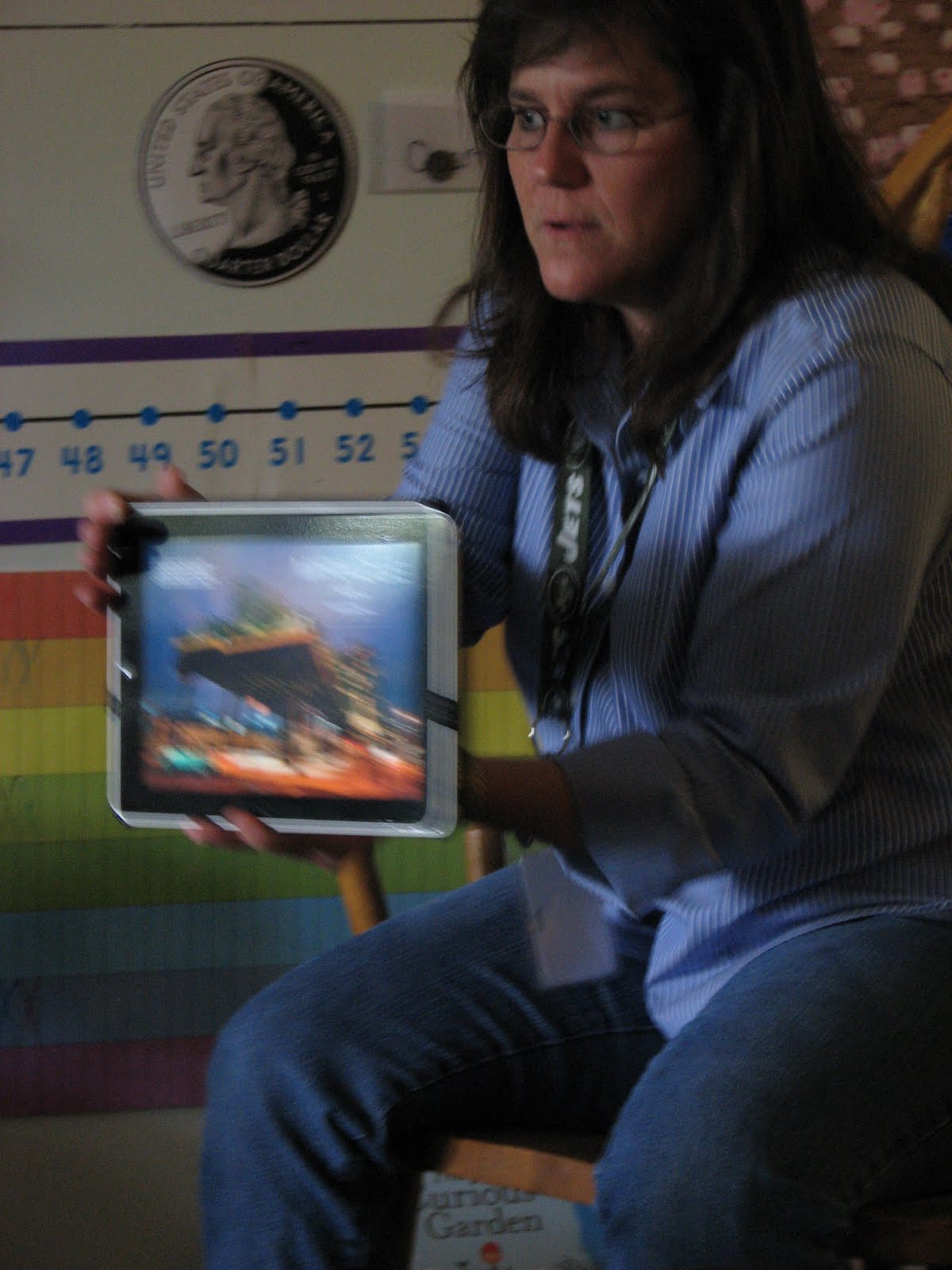
After reading the delightful story and asking questions throughout the text, Tracy showed the children an article that she had read in National Geographic that is based on the real story of an abandoned rail line called the High Line in Manhattan. The city turned this abandoned rail into a walking park with chairs to sit and read, an amphitheatre, and a leisurely strolling path filled with greenery right in the middle of the city. This additional piece gave the children an opportunity to draw conclusions between the two pieces of literature and worked well with the idea that we are working with in writing - that children can use real experiences to base their fictional writing. While we could have pulled one of our laptops to the document camera to share the on-line magazine article, instead Tracy used her personal ipad to quickly pull the story up for the children to see. The site even included a video in elapsed time of someone walking the path! Using the ipad was quick and convenient. We first tried just holding the ipad and showing it like we would a book but quickly realized that the pictures and video showed very well through the document camera! How exciting it would be to have an ipad at our disposal. It was so quick - so convenient! I can see how we would use the Internet so much more often in our lessons and with such great ease! Anyone know where we can find the money for ipads?!


Wednesday, March 9, 2011

Demo-teaching 2011

One of the best things about Chets Creek is that we do lots of demo-teaching which means doing demonstration lessons for our peers and for visitors. Today I had the pleasure of watching a demonstration lesson by co-teachers Carrie McLeod and Laurie Thompson. Our Standard's Coach Suzanne Shall arranged the lesson for both the Reading Council and primary Science Council which means the teachers watching the lesson were the grade level leads for Reading and Writing at each grade level and the grade level Science leads for the primary school, plus, of course, the Standard's Coach and Principal. No pressure! I am sure Carrie and Laurie had a moment of stressful concern, wondering why they ever agreed to do this, but Chets Creek is a forum where risk-taking is admired and celebrated, and it is a safe environment where peers support and help each other... so they took a deep breath... and it was - on with the show!

The point of this lesson was to show both Reading, Writing and Science teachers what echoes across the day can look like. We know that we get a bigger bang for our buck when we are able to integrate the Science content into our reading and writing lessons and when we are able to practice those reading and writing skills in Science.

Readers' Workshop
Mini-lesson: Today's big topic in reading was Reading Like a Writer. Carrie and Laurie, whose rituals and routines are crisp and clean, began with a mini-lesson connecting today's lesson with the bigger topic. Next for the teach, they showed the students a report written by a 2nd grader (completed in 2nd grade but pulled from a 4th grader's cum writing portfolio!) The teachers identified some of the text features in the report, such as the Table of Contents, words highlighted that were found in the Glossary, headings, captions, etc. - all text features that had been covered in earlier lessons. Then the teachers labeled each noticing with a stickie note. For the active involvement they turned to a new page of the report and had the students "turn and talk" about their noticings so that the students could practice the strategy that had just been demonstrated. The teachers pulled the group back together and had them share out their labeled noticings. The link involved giving each group of two or three students a different 2nd grade report to repeat the same - notice and label text features.

Work Session: As the students divided into small groups (effortlessly!) they each received a 2nd grader's report that had been completed in years past (pulled from cum writing portfolios). Each of the small groups worked independently until they were joined by one of the two teachers to discuss their noticings and labeling. All of the observing teachers were either watching one of the presenting teachers meet with a small group or were soon sitting with a small group themselves helping the children through the task, asking them questions about what they were learning and generally thinking about how they could redesign some of their own work after seeing the lesson. The room was full of artifacts to support the learning that is being integrated. For instance, it is obvious how the day is integrated when you look at the essential questions posted each day. You can see some of the earlier mini-lessons as you read some of the charts that are hanging around the room. As students completed their noticings of the 2nd grade reports, they went to their independent reading, half of the students on the floor reading and half reading in their seats. As the students read quietly Laurie pulled a small group together to reinforce the strategies of text features in a non-fiction leveled book that was on this small group's reading level. At the same time, Carrie, pulled a different small group to go over testing strategies of a state assessment-style non-fiction test. I am assuming this group was pulled together after a task analysis of last week's assessment to work with the students that had specific difficulties with specific types of non-fiction questions. The point is that both of these small groups are off the topic that is echoing across the day!

Closing: The presenting teachers chose two groups as they were circulating to present in the closing. Each group had chosen one example to highlight for the larger group - a text feature that they had noticed and labeled with a stickie note.


Writers' Workshop
We had the good fortune to be able to stay for the Writers' mini-lesson so that we could see how these same lessons were being incorporated into the writing part of the day. The Writers' Workshop also included the 4-part mini-lesson.
Mini-lesson: The teachers began with connecting today's lesson with what the students were doing in reading and what they are doing in Science, which is a habitat and life cycles unit. For the teach the teachers are using butterflies as their example of a topic for writing a report. The students have plenty of background knowledge for this example because they are raising butterflies during Science. The teachers have a seed journal where they have been taking notes about caterpillars and butterflies. As the students begin their writing, they will each choose different animals to write a report on its habitat and life cycle. Some of the previous lessons are obvious, both from charts in the room and the teacher's seed journal example. Today's lesson was on how to organize the notes from the seed journal. The teacher thinks aloud her decision to start with a chapter on "Appearance" and then numbers her notes so that the sequence makes sense. For the active involvement she then turns to a new page in the seed journal where she has taken notes and has the children "turn and talk" about how they would organize this page of information. The link gives the children the facts they need to use the information they have just learned as they go into the work session.

At that point, we had to leave. We had been in the classroom for an hour watching this unforgettable lesson. We will debrief this lesson after school tomorrow. It will be interesting to see if my colleagues took away as much as I did. As for me, there will be things I will tweak and change in my classroom tomorrow because I have had this opportunity today!

Tuesday, February 8, 2011

The Test Quest

Today I spent the day with a group of eight first and second grade teachers who were committed to writing first grade assessments that: 1) close the gap between first and second grade, 2) include the appropriate new standards, 3) guide instruction by deepening oral read aloud comprehension with questioning of higher complexity, and 4) are written with our high stakes test in mind. This is not the first time we have undertaken this work. The first time was probably six to eight years ago when we selected weekly reading passages and wrote questions. Then again a couple of years later we gathered sample leveled text and wrote questions to be used with our DRA assessments because our second grade colleagues felt that the oral retelling of the DRA did not reflect the comprehension that was required in weekly written assessment as students entered second grade. Then again two years ago we looked at the last assessments in first grade and the first assessments in second grade to make sure there was a smooth transition. Once again today we tackled the idea of doing an even better job. I imagine that a few more years down the road we will again take a look at assessments! After all, in a few years I expect our state to adopt the Common Core standards and I also expect the pendulum to swing more to the middle as we de-emphasize high stakes testing for a more comprehensive view of assessment. We must always take a look at how we assess our students so that we get the best information possible and in this time of test frenzy, we actually seem to have the opportunity to perfect our understanding of how a multiple choice test might inform our instruction, as limited as that might be.

What is the most amazing about the work that was done today was the depth of knowledge, background work that had been done before the meeting, and the level of collegial conversation. The day was led by first grade lead Maria Mallon, second grade lead Carrie McLeod, and Special Education Teacher Debbie Rossignol under the direction of our Standards Coach Suzanne Shall. The amount of work these ladies had done BEFORE our day together was amazing. It took them half the day to explain all the background work of looking at the first grade standards, identifying the standards that could be on our state assessment, and then taking each standard and looking at the benchmarks, test attributes, context limits, stem/excerpts, distractor attributes and samples of FCAT released items for each standard! Even with all the background organization, it still took my small group of three teachers three hours to complete a single test! However, the conversation and the learning that took place was well worth it and makes us all better teachers in the end! This kind of time and this level of conversation embedded in our day-to-day work is what great professional development is all about! How I wish this was the norm in all our schools!

Wednesday, September 1, 2010

The Assessment Period

This is our second week in school. We are busy assessing our first graders. In my classroom we have just finished giving the DRA2 so that we have a reading level for each child. The children chose books today for their individual reading bins - 6 that are "just right" books, 2 that are challenge bocks and 2 that are "easy cheesy" and will begin Monday taking one of the books home to read each night for homework. Tomorrow we will begin the state's F.A.I.R. testing that is on-line and will also begin some of our "home grown" assessment that includes additional testing in fluency, phonics and vocabulary. We have also completed our "home grown" Math Diagnostic which took several days of Math time. All this assessment will help us work with children exactly where they are so that we don't loose valuable instructional time.

As a school we are doing the same kind of assessment. Our Leadership Team has met each week and today our Curriculum Leadership Council (picture to the left) met for the first time this year, which includes a teacher representing each grade level in each academic discipline. We discussed roles and responsibilities and reviewed data from last year. We discussed the work to be done as we decide on our goals for our School Improvement Plan. It's a year full of hope and excitement. Looks like a good crop this year!

Tuesday, July 27, 2010

Summer Training, 2010

I have to admit that my attitude walking into training this week at 8:00 on my "vacation" was not the best. We were at a high school - really small room with no windows, loud air conditioner and desk chairs that were attached, certainly not made for larger women. I noticed several teachers opted to find another chair and just use the desk top as a desk because they couldn't fit comfortably. Not even water in the room, but... much to my surprise, I was totally engaged with the information in the workshop and I almost forgot all the small inconveniences. The three day training is meant to gather educators from counties in our area and teach how to interpret the F.A.I.R., Florida Assessment for Instruction in Reading, Florida's answer to reading assessment that will inform instruction and take the place of DIBELS.

I felt really good about several things. For one thing the state has changed the "Fab 5" to the "Sensational 6" by adding oral language to phonics, phonemic awareness, fluency, comprehension and vocabulary. At Chets we realized early on that we had to continue with our work in oral language and even pioneered work in kindergarten that we took from Lucy Calkins' work with Elizabeth Sulby, which we call "Star Books. " The program has our youngest learners doing oral retellings as a way to help decide when they are ready for conventional reading. We had felt this was really a missing part in the "Fab 5", so I guess this confirms that initial belief. It certainly is a strong step toward infusing oral language into the day.

I also felt very good that we seem to be ahead of the curve in vocabulary. As the state is just now looking at vocabulary resources, we spent a year with our Books-of-the-month program looking at vocabulary strategies four years ago after our Principal and a group of teachers traveled to a Kylene Beers' summer workshop. We had our faculty reading Beck and McKeown's Bringing Words to Life and even ordered a vocabulary program, Text Talk, based on the their research to use in first grade that same year. That was so successful that we now also have Text Talk in second grade and when we couldn't afford to buy it for Kindergarten, a group of Kindergarten teachers spent a summer writing their own program using that same research which we call "Star Vocabulary". We've had that program in effect for three years and it has made a huge difference. All of that has given our teachers such a strong background in vocabulary. I did especially like one vocabulary activity that I heard today of a Principal or coach choosing words from the Book-of-the-month and doing activities with the words twice a week on the daily internal news program - that's an idea that would be really exciting for the new year!

Another area that I feel good about is the idea of using a Spelling Test to analyze phonics skills. We have been doing this in first grade for quite some time as part of our three times a year assessment and it is also being done now in second grade. Obviously, this is not a new idea, but it's the first time I've seen state training advocating that sort of assessment.

All in all, I have a good feeling. leaving this training. One of the things I really like about the F.A.I.R. is that the state is really trying to link resources to instructional need, which is the same thing we are trying to do with our wikis. My only complaint is that the trainers had to go through over 300 slides (and Melanie, the state has never heard of Presentation Zen! - just old style PowerPoint!) and even with many video clips, there was entirely too much "sit 'n' git." If we want our teachers to use engaging activities with their students then we need to engage them in professional development that models what we want them to do!

Tuesday, May 25, 2010

The scores are in! The scores are in!

As much as I hate the idea that so much depends on a single day of testing, I have to admit that the day the scores begin to come in is an exciting time! As the Principal sprinted into her office today (she rarely sprints!) she called for the Leadership team and a pack of highlighters. We waited impatiently as she powered up her computer to pull up the school scores. At this point we simply get the scores of each third grader from the state. It's up to us to figure out the rough percentages and then to figure out which kids will not count in the school score (because we didn't have them in both attendance periods or because they are active second language learners or Special Education students). We will get a final score from the state much later, but we simply cannot wait! Each of us takes a list and we figure the grade level percentages and then the percentages for each homeroom in both Math and Reading before the Principal calls the grade level together. Of course, during the hour that it takes to figure it all out, the buzz has run through the building that the 3rd grade scores are in! As the grade level gathers, teachers look stressed. Some are anxious and others look like they might get sick. A few are really excited! As soon as the percentages are unveiled with the grade level, you can hear teachers talking among themselves, congratulating themselves on their successes. They are both proud and relieved! Very few disappointing scores come as a surprise. We did notice for this grade level that of the 16 or so students who scored a Level 1 or 2, over half of those students live in the community that we have just decided to target for some intensive academic support!

There's nothing like a young teacher who has 100% of her students score 3 or better or the seasoned inclusion teacher who will spend hours tonight going through the scores of every single student to decided what worked and what didn't and how to tweak instruction for some of her most needy students. Many teachers will look at when the children came to Chets Creek because historically, it's the students that come new to us that are the ones that struggle the most. I'll never believe that the one test should determine passing and failing or should ever be the largest factor in a teacher's pay but there is something very satisfying and validating about seeing in black and white that all of your hard work has made a difference! Wow! What a day!

Sunday, September 13, 2009

Roaring Retellings

One of my favorite "Star Books" is The Three Billy Goats Gruff. This standard-based bulletin board from Mrs. Alvarado's class actually shows the exact text from the book and then the teacher's dictation of three children reading that same section of the book. Using the scale developed by Elizabeth Sulzby and refined by Lucy Calkins, Mrs. Alvarado assesses each passage. The assessment helps her know what the next step is in conferring with each child. In the case where the child's retelling begins to sound so much like the story language in the book that it sounds like the child is reading instead of just retelling the story, the teacher knows that the child is ready for conventional reading.

Thursday, May 28, 2009

That four letter word - FCAT!


The rest of the elementary FCAT scores came in this morning, our high stakes assessment. Writing came in a couple of weeks ago and 3rd grade came last week so 4th and 5th, the last to come, were in today. The 4th and 5th grade teachers anxiously walked straight into the conference room as they arrived this morning. You could see the stress on their faces as they sat down to highlight the students in their classes. They were serious and focused. You heard celebrations - Oh my gosh, Joe got a 4! - Can you believe Sammy got a 3? Woo hoo! Look how many 5's we had! You also heard the sighs and the questions - I knew he wasn't focused when we took the test - What happened to Jerry? Could she have missed a page or bubbled in incorrectly? Just as soon as they completed their highlighting, you could see them turn to their teaching partner and begin to celebrate, question, discuss and reflect.

Although teachers stress, we have been and continue to be a very high performing schools.  We have little dips and we have spikes and peaks but if you look at the trend, we stay in the top 50 schools in Florida an at the top of the pack in our county.  Still teachers worry about every single student.

As I watch this scene every year, I hate the visible pressure that teachers feel... but on the other hand, it is a time of deep reflection. I heard a teacher who had 100% of her children reach 3 or better this year say, "After 24 years of teaching I think I finally found the answer in using small groups to make the difference." For teachers that didn't do as well as they expected, I saw their devastated faces but also heard that many of them came back down to discuss their results with the principal, trying to figure out how to change their results for the next year. Isn't that the promise of assessment? Can we really change student achievement through instruction if we are not brutally honest with where we are and what the problems are? We need to know what works and what doesn't work.

Don't get me wrong. There are so many things I would change about testing - especially the weight that is put on a single test, the fact that the measures are not the same across states, and who can be exempted from taking the test at all - but there is also much about the accountability that helps us improve our practice. And isn't that the point?

Friday, March 6, 2009

Big Chicken: March Book-of-the-Month March 2009

This is a time of the year when we talk about fear and risk and being brave. As teachers and students face our state's high stakes assessment next week, we often do a book-of-the-month that has to do with worrying such as The Worrywarts. This year Principal Susan Phillips introduced Big Chickens authored by Leslie Helakoski and illustrated by one of our favorite artists, Henry Cole. (Henry has been to Chets Creek a couple of times and we are expecting Leslie Helakoski next month!) Beside our Principal loves chickens and it seems that at least once a year, we have a Book-of-the-Month About chickens!

Of course, taking risks and being brave is more than a skill we practice for the high stakes test each year. It is also part of our theme, "Around the World in Technology in 180 Days." This year teachers are taking risks and overcoming any fear they feel about integrating technology into their classrooms. The challenge this month is to use technology as a response to this book of the month and then to post a blog about it! Melanie Holtsman has set up a separate blog for the posts! We have learned about so many different techy tools this year and we are all at different levels of integrating the tools into our classrooms, so this project will provide the ability to differentiate by the breadth of opportunities!

The whole purpose of the books-of-the-month this year is to give us, as teachers, an opportunity to try out technology so that we feel more comfortable with it. It will not become embedded in our daily practice unless we can use it quickly and comfortably. We are, of course, frustrated, as all schools have things that they need that are blocked by our county for our own protection but there is still so much that we can use to make our teaching more visible, more timely, more authentic. How I appreciate the "opportunity" to be pushed to think beyond my comfort zone and to embrace the digital natives that I teach. Stay tuned as this project unfolds in the weeks to come and then is opened up to the world wide web.