Showing posts with label Demo lesson. Show all posts

Monday, January 4, 2016

Making a Difference through Demo Lessons

People often ask me how Chets Creek Elementary became the school that it is.  Why did the teachers open their doors in the beginning and let their colleagues in?  Why did teachers agree to do  demonstration lessons?  Why did teachers come in droves to Book Study groups that were often scheduled off the clock?  What did we do to make the culture what it is?

Creating and sustaining the culture at Chets is not really my story to tell.  The inspiration and design for the culture building piece at Chets goes back to the founding vision and first Principal, Dr. Terri Stahlman and then to our current Principal Susan Phillips who was left with the mission of sustaining the culture.  How to create and sustain a culture in a high performing school is their story to tell.  However, what I can say about teaching in this school for so many years is that professional development has played a significant role in and continues to support the culture.  To me, the biggest pieces of professional development that have served to bind us together across the years are demonstration lessons, book-of-the-month, and book studies.  Through a series of three blogs, I would like to share my view about how each of these has played a part in supporting our learning over time.

Teachers watching a demonstration lesson as it unfolds.
Demonstration Lessons -  It is demonstration lessons that are at the heart of our PD.  These are lessons where one teacher teaches while other teachers watch.  After a demonstration lesson, there is always a debrief where those watching list all the positives that they saw and then also ask questions about things they didn't understand.  Some years we have called those Warm and Cool Comments and in other years, "Glows and Grows." With new groups, the comments are usually superficial, because they don't yet trust each other but in a Chets group they jump right to the heart of the matter and get to the core questions, the new information, and the wonderings for implementation. Regardless of the group, the conversation is always enlightening.  The teacher that presented the lesson usually stays to listen and answer questions and to reflect for the group on how she thinks that lesson went and what she might have done differently.

I am not sure who did the first demonstration lesson at Chets Creek, but it was Dr. Stahlman's vision that if we were going to get good at this work, we would have to learn from each other by opening up our classrooms and watching each other teach.  It was not easy to prepare a lesson and stand before your peers and present it.  I will never forget my own first demo lesson.  It was shortly after coming to Chets.  I was a 20 year veteran of the classroom, but in all those years I had only had a very small handful of people watch me teach and those were usually principals at evaluation time.  I was so nervous that Stacy McCollough, whose students and classroom I was using for the lesson, brought over a trashcan because she thought I might throw up!

I think if you ask any of the teachers that do demo lessons,  they would all agree that they were pretty shaky that first time.  It is risky.  What if you fail and the kids are terrible?  Maybe the others will find out that you aren't as good as they think you are.  I'm sure on some level those thoughts go through everyone's mind, so why do we even agree to do the demo lessons?  We probably could say, "No!"  but most of us don't.  You never want to disappoint the person asking, because they have faith in you, and... you know they will help you, if you need it.   I guess it seems like a compliment to be asked.  Besides Chets Creek is a place where it is safe to grow, learn and make mistakes!  And there is this mantra that if you know something, you have a moral and ethical obligation to share it for the greater good! Maybe that sounds corny, but we became a community of learners early in our history.  Instead of trying to be the best teacher, we became a community that believed our best was only as good as our weakest link and that we could only get better by supporting each other, not competing against each other, so... we have learned to work together.  We demo because we know that those watching understand how we feel, and that they know we are taking a risk and... they know they might be next!
Teachers debriefing a lesson they have just watched.
 Of course, as time went on we learned that having something unexpected happen in a demo lesson was  inevitable.  It was okay and that was most often where we learned the most.  We discovered that teachers don't want to see the "perfect" lesson with the "perfect" kids.  They want to see the lesson that doesn't go so well and the class with the "challenging" child, so they get some ideas on how to handle those things when they happen... and they always do!   In fact, it is those "unplanned" happenings that often exploded with the most honest, pure and deep conversation.

After teaching a lesson teachers
debriefing with an audience of teachers
at the professional development site.

Teachers at our county's PD site watching
 and then debriefing a lesson with the
teachers through videostreaming.
It wasn't long before the "demo lessons" broadened to groups visiting our school.  For about five years we hosted over 400 visitors a year literally from around the world who came to watch lessons!   Then for several years we video streamed 175 live lesson to our county's professional development site. The professional development instructors would let us know what lesson they needed when and we would match their needs with what was being taught at the time.  We tried not to present anything artificial, but instead we strived to present actual lessons as they were being taught.  It took leadership that was willing to say "whatever it takes" and lots of trust and collegiality between the school and professional developers to make those lessons a reality, but that was usually managed!  We would film the lesson live while it was happening at Chets Creek while a classroom of teachers taking a class at our county's professional development site from all over the county watched the lesson and then  the teachers who taught the lesson would debrief through videostreaming. While this might not seem like such an amazing task today, at the time the technology was so new that most of us had never seen anything like it. Talk about risk taking!

Professionals from all over the
world watching a lesson live
at a national convention in Hollywood, CA
from CCE in Jacksonville, FL!
One time we even videostreamed a live kindergarten lesson from Chets Creek across the country to a national conference in Hollywood CA.  You can imagine the headaches trying to do the lesson live with kindergartners with the time change and with the technology challenges of the time!  I don't know whose crazy idea that was, but, like I said, we had become risk takers!  Those years or videostreaming live lessons and doing so many lesson for visitors gave many teachers a chance to get comfortable with the idea of opening up their classrooms.  Most became comfortable with the transparency.

We also began having professional development days once a week so one grade level met each week and those days always began (and still begin) with a demo lesson.  I think if you asked teachers, they would tell you that this is a part of professional development that they look forward to - at least the observing part - and one of the activities where they feel like they have learned the most. It also opens up dialog between teachers.  It is not unusual to watch a demonstration lesson and then go back to the teacher later in the week to ask about a resource or a behavior technique or to ask for help in getting your class from where they are now to where you want them to be after watching the lesson.  We know that watching a lesson live is much more memorable than just telling a teacher about a concept. The advantage of the lesson live in your own school is that the observing teacher has ready access if there are questions about the lesson later on. The resource is right there to go back to any time! And that  leads to collegial friendships and partnerships.  From a leadership standpoint, when you have your finger on what the grade level needs, then it's easy to guide the demonstration lessons to meet the need.  Of course, that takes an experienced instructional leader (principal or coach or Leadership Team).

What demo lesson have done is to breakdown the walls of teachers' classrooms.  For years we taught in little isolated cubicles.  We never watched another teacher teach and we never had feedback on our own teaching except through artificial evaluations.  The practice of demo teaching allows us transparency, the ability to observe and take from the observation ways to move our own teaching to the next level.  It takes a lifetime to learn this work, and one thing I know for sure, it cannot be done alone. Demonstration lessons open the doors, provide the camaraderie for open dialog that continues to be a hallmark of our success.

How do we sustain the culture of collegiality?  By embedding demonstration lessons as a cornerstone of professional development! Learning at its finest!

Sunday, November 23, 2014

Math TDE

I realized today - once again - that I work with some amazing teachers.  My mind is so full, it just might burst!

Today was a first grade Math TDE.  We began with a demo lesson with Cheryl Dillard.  Cheryl is our Math Lead and so understated.  When you ask her about this or that, she just tells you what she's doing, like it's just another simple idea.  Then when you go watch all those "simple" ideas put into action, you are simply blown away.  There is no curriculum for the skills that Cheryl adds to Math every day - no book of Math Journal ideas, but she has the innate ability to look at her students, compare them to the standards and where they need to be, and find the exact activity to move them in that direction.
Cheryl teaching decomposing
Math Journal
I really wish I had videotaped this entire lesson because I find I need a rewind button because I am continually thinking, "How did she do that?"  It's just effortless.  There are so many new ideas that I find I have to prioritize.  I'll implement this one and that one right now and then after a couple of weeks of adding those to the routine, I think I'll add that other one.  By then, of course, Cheryl has moved on to the next.  I sit here just thinking how thankful I am that I have teachers right down the hall in both Reading and Writing and Math that help push my thinking.  We have talked about pushing the children's thinking up a continuum and that's exactly what happens as we begin to debrief this lesson.  It pushes my thinking up the continuum and there is new learning.

Math Coach (She's really the AP-we don't have a Math Coach!) Suzanne Shall was ready to push that continuum too as she reminded us of all the reasons that we are where we are.  She reminded us of the early days when we embraced Stigler and the TMMS study and realized that students from other nations were coming to take some of our highest paying jobs in the US because we didn't have enough students prepared to take them!  We recalled the days when we realized that the Math education in our country was severely lacking and how we slowly and painfully switched our thinking to embrace a more conceptual math.  Because we adopted Math Investigations so early, we now have the opportunity to enjoy the fruits of that labor as we have students in high school, college and in the job force who were part of this new Math wave.

Suzanne had us work problems that our current students will work in second and third grade and it was obvious that we still need to bump up our own thinking.  What Cheryl proved to us is that our children can think at that level and they can do this work.  I remember how dubious I was in those early years that we were expecting too much and how I worried that what we were doing might not be developmentally appropriate, but now I realize that if we allow students to begin to work at that concrete level for as long as they need, that they will have the building blocks to naturally move to representational and abstract thinking.

I am not a Math guru.  I have made it my life's work to teach children to read, but as I have ended up teaching Math these last years, I have found a new challenge and interest.  I can get just as excited when the light comes on as a child embraces and understands a Math concept as I ever did as they unlocked reading.  And I have to say...  I'm really proud of the Math work going on in my classroom...  There's a pretty strong foundation being laid...

As we left our TDE, Suzanne had us do one last exit ticket, that I have reproduced below - always teaching the example of what it is she wants us to do...


First Grade Math TDE  Exit Ticket

1.        Please mark the circle to represent the topic that allowed you the most reflection.


5
Classroom Observation; Debrief  (Dillard)

Shifts in Math:  TIMSS, 3-Prongs of Math, Instructional Implications
1
Instructional Sequence of Math (Concrete-Representational-Abstract) w/Engage NY video Alignment: Standards, Curriculum, Instruction, Assessment- Grade 1 and 2 Lessons
Tweaking Student Sheets; Creating Exit Tickets
6


Analyzing Addition ; Subtraction Student Work- Beginning of Grade 2, Unit 1
1
Second Grade Work Session Video (Justo ; McLeod)

Beyond the Standards- cardinality, equality, and decomposing


2.      What is one thing that you will implement in the next two weeks?

o   Reteaching one on one to clear up misconceptions from previous day during skills block.
o   I will target 3 skills during calendar as well as work on 3 skills during the block. 3 days of journal and 2 days of number bonds.
o   Move students from concrete to representational in small group support.
o   Differentiating student sheets for higher level students.
o   Analyzing student work for their next step.
o   Skills Block- use exit tickets for small group & one-on-one instruction.
o   Run a better skills session.
o   Incorporate instructional concrete instruction
o   I want my skills block to include more of what I saw in Dillard & Mallon’s room. Add the hundreds chart, guess my number, asap!
o   Adding more of what I saw in calendar math this morning into my math centers.
o   Using math games more because they are very beneficial.

3.      What is one long-term implementation goal that you have?
o   Look more closely at the standards to guide my instruction toward second grade.
o   Becoming more comfortable with the addition strategies.
o   Pushing the rigor of the work to allow students to problem solve and explain.
o   Rewrite student sheets with larger numbers & exit tickets before I start a unit.
o   Strategies for next step (2nd grade) push to the next level!
o   Having students always talking about how they reached an answer to a problem, giving them enough time to explain their answers.
o   Have a good flow during the math block by making sure all materials are prepared and ready. Kinds knowing routines.
o   Moving toward written visual representations with my students instead of using manipulatives which will get them ready to show expressions.

Thursday, November 20, 2014

Infomational Writing - the Second Bend

One the great things about life at Chets Creek is that we take professional development very seriously.  We often provide professional development on the clock but there is a non-negotiable expectation - you are expected to be engaged and to participate.  Last week first grade met for a day of professional development while our students were treated to a special all-Resource day.  The students really look forward to their special day, and for us, it means no lesson plans for subs!

The day always starts with a demonstration lesson.  Maria Mallon hosted all 14 of us in her classroom for a Lucy-inspired (Lucy Calkins) lesson.  We are just beginning the second bend of Informational Writing.  Maria is our grade level lead so her job is to stay just a few lessons ahead of the pack so she can prepare us for what is to come.  She and Reading Coach Melanie Holtsman worked together to provide the perfect day.

The thing that always impresses me about Maria is that her classroom is just so joyful.  I can just imagine being a little first grader sitting on the floor at her feet.  I would believe every single thing she said!  She is so genuine and it just pulls you right in. I just feel good in her room. It just makes me smile.  Of course, there is also a lot of learning going on.  Her rituals and routines are such perfection that you feel like you want to rewind and figure out,  "How did she do that?"  The children transition with such ease.  On this day she transitioned with a song for fluency.  The kids went soundlessly to their seats on the floor and she started...  First she told them how incredible they were and how proud she was.  Then she launched into the gist of the lesson - which was about using all the tools in the room - the charts and rubrics and mentor texts and words around the room...  Then it was off to writing.  The children look like busy little bees.  Every single child is engaged in the process of writing and the only sounds you hear are productive conversations between partners. Maria does drive by conferences, walking around purposefully stopping to chat with a few students, asking purposeful questions and just generally supervising the flow of the workshop.  Before you know it, it's time to Close and the children quietly put all their supplies away and in a blink are back on the carpet.  When they are settled Maria reads the informational rubric and challenges the children to work toward the second grade standards.  You can see the excitement in their little bodies as they already begin to rise to the occasion.  I think I want to be a first grader again in Maria's class!

Then it's to the conference room where we debrief the lesson with Melanie, commenting on the things that we really liked in the lesson, asking Maria questions about things we still wonder about.  I think each of us questions how we  would do the same lesson and we make a mental list of things we want to try or change tomorrow.  That's what "starting with a demo" is all about.

Then it's to the work of the day.  As we wait for the Calkins Reading Units to be released this summer, we know we need to ramp up our reading instruction. Melanie digs in and begins to challenge us to push the continuum of thinking in our classrooms.  She frames the work that will be expected in second and third and fourth grade that is changing with the Common Core so that we begin to define a path from where we are to where we need to go.  Melanie doesn't give us the answers.  She doesn't spoon feed us but challenges us to think.  We don't need dummy-proof curriculums. We don't need scripted Core Curriculums but we do need teachers that think.  We need teachers who can look at the data, but so much more than that - teachers who can read the room, who KNOW their students as learners and from that wealth of information can take the standards and define the teaching that needs to be done. That's what will transforms education.

Saturday, February 1, 2014

Kindergarten Math Professional Development


Today we had a day of Kindergarten Professional Development in Math.  Oh my!  What a fantastic day!  Not only did I get to spend the day with a grade level of teachers I adore, but Suzanne Shall, who is our Assistant Principal, slipped on her Math Coaching hat and ran the TDE.  What a treat, in so many ways!

We started with a demo in the famous Mall-ard class!  There was so much to take back into my own class that I don't even know where to start.  Since this is my reflection, I guess I'll give you the high points for me and the things that I will be taking back!

1. The demo started with Math Journals. Unfortunately I didn't get a picture but they use composition books with a cross drawn on each page so that the students have 4 squares on each page.  These quick activities review skills/ standards from previous lessons.  Today's skills were: 1) How many more in a tens frame, 2) using pictures of 10 bundles to count by tens, 3) "counting on" starting with 6 donuts and then 3 are added, and 4) a 4+1 __ and 1-1 __ from our One More, One Fewer Math Investigations Game.  They actually set the timer for 5 minutes and called time.  Students that finish early know to go to the left side of their page and start writing the numbers by 1 as far as they can go.  This routine is so firmly established that it looked like most students finished. The compositions books were put away so seamlessly that I didn't even notice how it was done or where the composition books went!

2.  They transitioned to the carpet with a math song with the words on a chart and a child pointing to each word as the children sang.  They use Math in Motion by Mr. Al and Math in Motion by Jack Hartman and change the song every couple of weeks. This week the skill is counting by 5's.  Now, I know I have had both of those CDs at some point in my career.  They are not new, but I can't find them now, so I ordered them both and they will be here on Tuesday!  Woo hoo!

3. Next was a quick skill review.  Today they used an interactive game.  Only 5-6 minutes but today a quick review of ten frames with students sometimes identifying the number filled and sometimes identifying the empty blocks.  At the debrief later, Cheryl would share some favorite 5-10 minute Math Skills that she uses.

4.  We are in the middle of a geometry unit so today we saw the Math Investigations lesson about filling hexagons with shapes. The lesson started with the essential questions and then began with the comedy team of Mrs. Dillard and Mrs. Mallard pretending to be the students and playing the game together.  I blinked and the students were at their seats, playing while the 14 teacher (!) milled around talking to students as they worked.


Mrs. Dillard closed by going back to the essential questions and having students she had pre-selected come to the front and explain the combinations they had used as she filled in a design.

5.  At the end Mrs. Dillard used an "exit ticket" as an informal assessment.  She had five shapes on a piece of paper in a plastic protector sleeve at each student's desk.  She asked the students 3 questions and each student marked their answer and held it up.  This way she could do a a quick assessment of who got it and who didn't.  Master teacher in action. 
They did all this in a one hour Math Workshop!  The reason they can do so much is because their rituals and routines are so incredibly seamless and their time is tight not a second wasted.  As the children got out materials and put them away it was without directions.  They simply knew what to do.  Amazing!

As always, the teachers went back to the conference room and the debrief was full of praise and insight.  If we had done nothing else today, the entire day was worth seeing colleagues teach!  

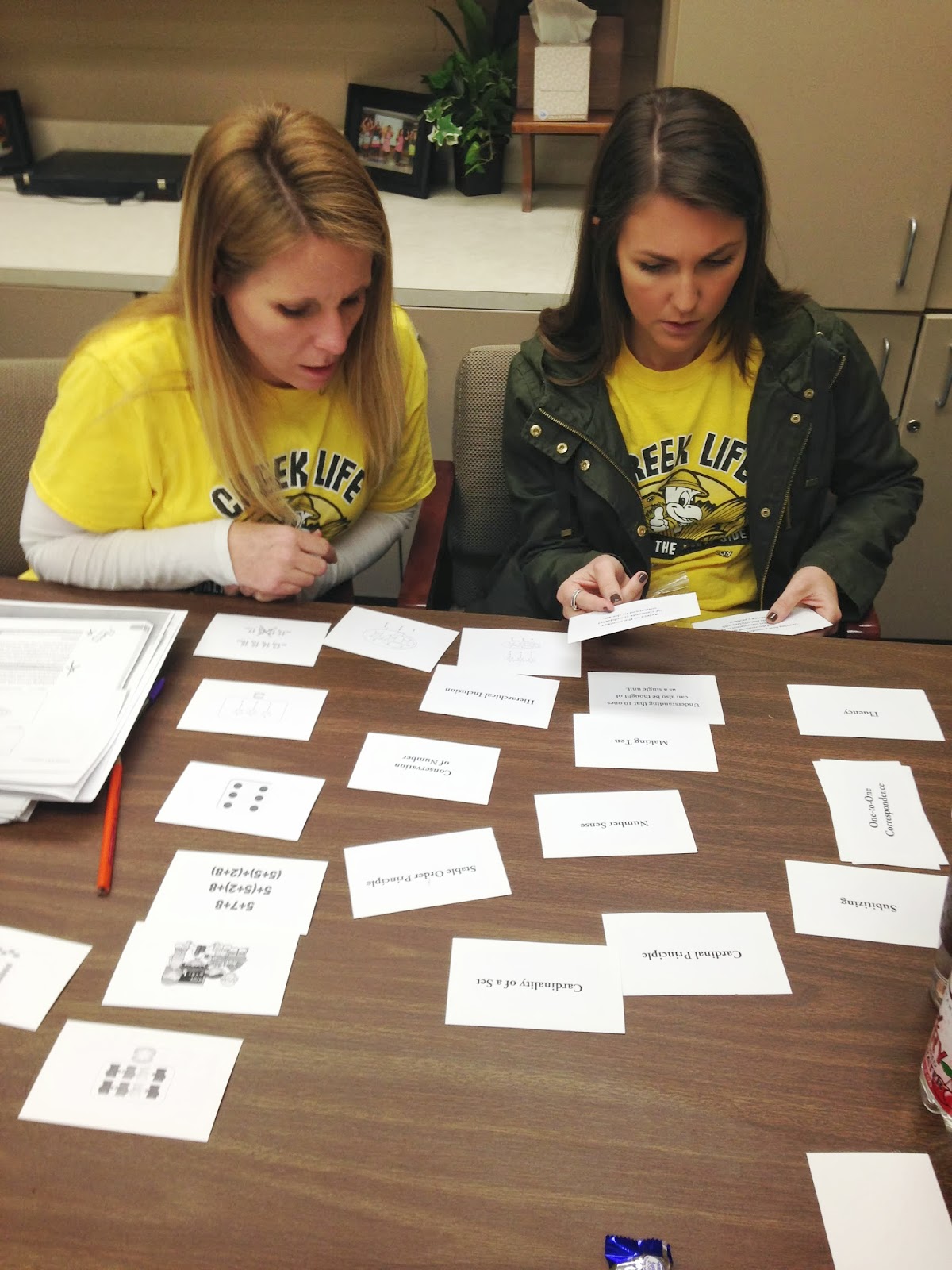
But that was just the beginning of what Suzanne had planned with our Math Lead Cheryl Dillard for us to do.  We had been assigned a chapter to read from  Number Talks: Mental Math Computations by Sherry Parrish.  Instead of debriefing the chapter, we played a word/ definition/ picture game with partners - love when the coach models by using a teaching strategy we could do in the classroom.  Then we watched 5 minute video clips from the chapter with kindergarten teachers and students.  It makes such a difference when you can see a teacher demonstrating the principles.
This chapter is all about using ten frames, rekenreks and  dot cards to teach subitizing and conserving numbers, one-to-one correcsponse, counting by 1's and counting on by using 5's and 10's.  All of this is our foundation in these early grades.  That's not to say that we didn't have trouble wrapping our minds about how we would fit all this in! Suzanne has copied a stack of work we could use in the classroom tomorrow which is the sequence for implementing these strategies as part of a daily skills review.

The rest of the day was about showing us tools that we could use during our Math Workshop and for our small groups.  Our county has bought i-Ready, which is a computer program.  Although we are expected to use it, there has been little professional development on this massive program so we went through some of the reports and how they could be used to inform parents, but also how to use them to inform instruction, such as forming small groups and then monitoring progress.  Unfortunately we are a school, not living in the 21st century with our technology so the barriers to implementing this program with kindergartners often seem insurmountable but as is our way, we shared the barriers and our frustrations and then quickly went to sharing solutions and ways that teachers were making it work.  Our technology is so less than ideal, but our children will live in an age where technology is part of their life, so we have to embrace what we have!   We looked at the Toolbox Lessons (Access code: NASM-X9SA) for i-Ready and some of the cpalms lessons that might supplement our lessons and our own professional development.  Although some of the lessons were taped right here at Chets Creek, we were especially interested in the videos, Is it still a triangle? and Compare Hexagons for this geometry unit.

The thing about Suzanne is that she walks in the shoes of a teacher.  She has a family.  She knows how tight our time is and how much is being added to our plate every day without anything coming off, so, instead of just giving us a list of resources that we could look at "when we have time" (as if that ever happens!), she made sure that she had carved out time in our day so  that we could look at some of the sights right then and there and see what we could find on our own. That way she assures that we will know how to return to the sights and actually use them later!
Suzanne always ends with time for partners to discuss what they learned and what they want to do with what they have learned and then has them share with the group the first thing that they saw that they want to implement.  You have to have time to synthesize and reflect and then develop a plan.  Each of us left with a plan.
 
I don't mind telling you that my head is swimming, but what a great day of learning.  Maybe other schools do this on a regular basis like we do at Chets Creek, but that was never true in the eight schools I taught at before coming to Chets.  Recently I inquired from someone in the county about wanting professional development in a reading technique that I knew was being offered in our county, but not at my school.  The person suggested that if I wanted the training, I should transfer to that school!  They so don't get it. Chets Creek is about being a learner and collaborative teaching. It's the leadership, the collegiality, the passion, the synergy that makes it work - that makes it different here. That's why I stay here.  Did I say that I love my job?

Wednesday, January 15, 2014

Working on the Work


Today was one of my favorite days.  It was a WOW day (a Working On the Work day), now referred to as PLC (Professional Learning Community)Days by the county.  Our children spend the day with our Resource teachers and we spend the day studying together.  We started off our WOW with a demo lesson by our Literacy lead, Maria Mallon.  All 14 of us loaded into Maria's room to watch her masterfully teach one of the new lessons from Lucy Calkins' new Units of Study for Teaching Writing.  We opened with narrative writing after the holiday and Maria demonstrated the 5th lesson, the last lesson in the first bend of the narrative genre.  I love watching a colleague work!  Maria masterfully taught the children how to use their pencil for reading and for writing.  She taught them to use the eraser end for "rereading your work and the point for writing new words" as the children co-wrote the beginning, middle and end of a story together about our trip to watch the Polar Express at the church next door.  Besides using a magic pencil  I also loved how she demonstrated using "writing in the air" as an active involvement.  Maria gave each student his or her own writing pencil and then had them use it to "pretend" write or "write in the air" a she wrote on the paper on the board.   Both of those tips - using a magic pencil and writing in the air - are things that we can teach in our classroom tomorrow.

Melanie Holtsman, our Literacy Coach, is the producer of our literacy professional development and she and Maria designed this learning opportunity together.  Melanie studied at Teachers' College last summer so she has been able to artfully incorporate pieces of that "Lucy" training into our professional development this year.  She shares some of her learning from the summer and from a recent day with Lucy with us, and the greater community at our school PD blog, Live from the Creek.  Check it out.  It's almost like being at Teachers' College!

Melanie always tries to have us experience something as a learner so that we feel comfortable incorporating it into our lessons.  Today she had us "write a story in the air" -  tell a true story from our childhood to a partner - thinking about the beginning, middle and end..  She suggested this as  way to have our students get ready to write.  In other words, instead of simply telling our students to "turn and talk" about what they are going to write, to actually have them tell their partner the story with a beginning, middle, and end to jumpstart their story writing.  Can't you just see how that would work?

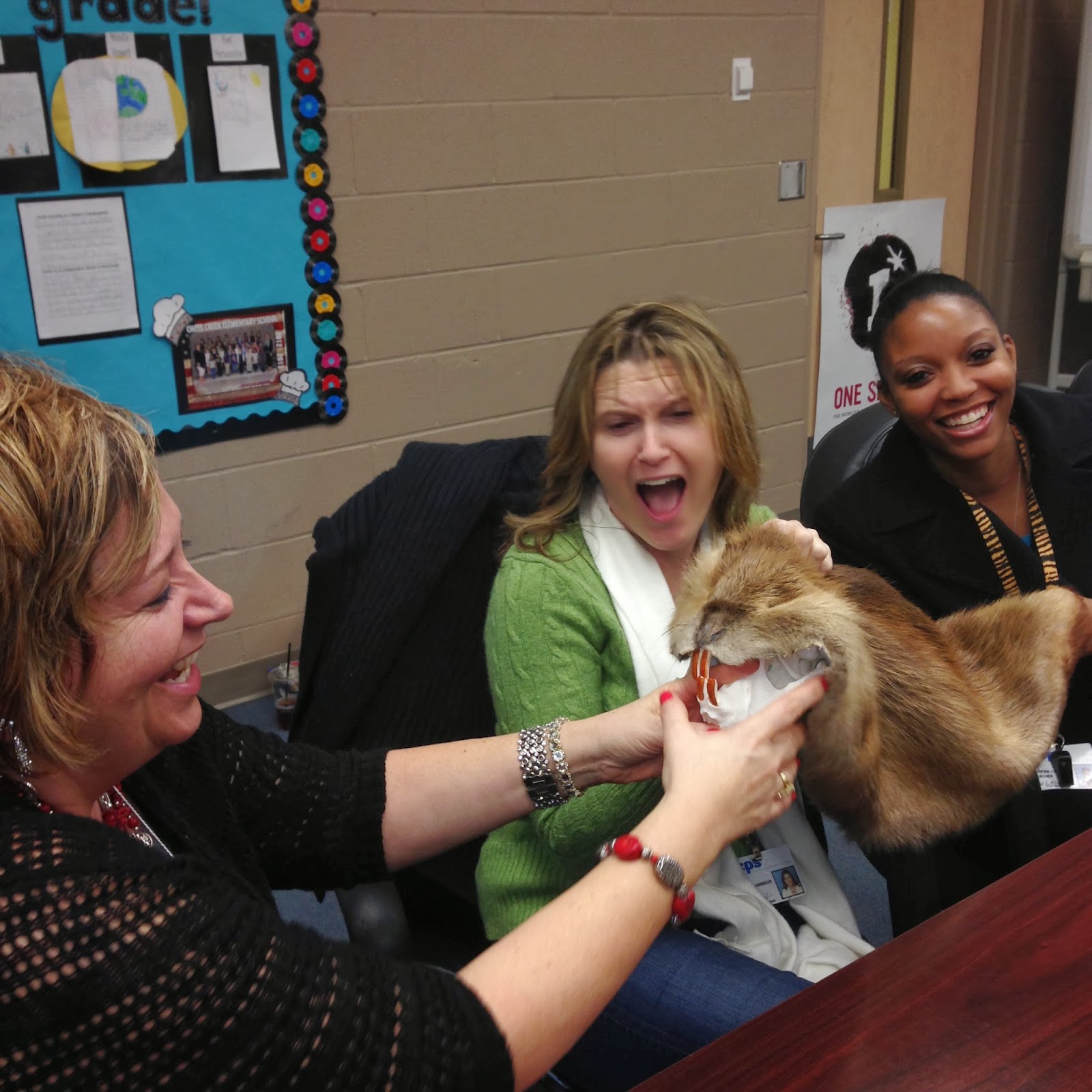
After lunch together - we always order in to save time! - our Science lead Tracy Ruark took over for the last hour.  Tracy shared the content of boxes that were loaned to Chets by the Safari Club for us to use in Science.  We looked at pelts and skulls and I even learned about "scat" - felt like I'd visited Duck Dynasty!  The boxes also included books and lesson plans.  I know how much fun the teachers had with these items, so I can just imagine how the children will engage with them!  We ended by talking about Tracy's latest Science lab with Sound.

I LOVE the teachers I work with.  They are engaged.  They are never at a loss for questions and share an endless supply of creative ideas.  There is no questions that I will be a better teacher tomorrow because I shared time with them today!

Sunday, October 13, 2013

Close Reading Conversation continues...

Last week we had the county's Director of K-2 Reading come and do a demonstration lesson for our kindergarten teachers.  We don't usually get to watch lessons from outside of our school, so this was a treat.  Besides, how many Directors of Reading do you know that would come into a kinder class and demo a lesson?

This week our reading coach, Melanie Holtsman, took the big leap and taught a different type close reading lesson in the same kindergarten class.  Melanie was not a kindergarten teacher but she is a risk taker and willing to put herself out there for the greater good.  As you can see from her video, she is a natural and the age of the students really doesn't matter.  She's simply a master teacher. She crafted her lesson around her learning from the Summer Institute at Teachers' College so she used the idea of visual text - in other words, looking at pictures!  Now doesn't that make sense?  What I notice when I watch the video is this new verbiage she uses,  like, "I seem to think... "  "I'm starting to think..." "My thinking is growing and changing..."  She also asks for evidence, evidence, evidence. That's what I see as different so that she moves the students into deeper thinking about the pictures - uh, excuse me - visual text!

Make sure to go to Melanie's blog and let her know what you think about the lesson.  Before the lesson, Melanie told me she'd probably pass out, but looks like she managed pretty well!  Thank you Melanie!

Wednesday, October 2, 2013

Close Reading in Kindergarten

Today we were treated to a demonstration lesson by Duval County's K-2 Reading Director, Katie Moeller.  How fortunate we are to have a Director of Reading that is willing to come into a classroom and actually demonstrate with children (and kindergartners at that!) as she teaches teachers.  Today's essential question was around a subject that our kindergarten teachers have been working with since the beginning of school, "What does close reading look like in kindergarten?" 

Today's lesson came from an exemplar K-2 lesson from the website Achieve the Core around a poem, "The Wind" by James Reeves.  The poem was written out for the kindergartners without the title (which gives away the main idea of the poem).  This "unit" of lessons would be presented over many days as the students look at small portions of the text each day.  However, today we were shown several different ways to use the text and then left with a lesson plan full of additional ideas. 

There were so many examples of just good teaching such as calling on students randomly, using "turn and talk" with a partner, asking for text evidence, using thumbs up for a quick assessment, teaching vocabulary, etc., not to mention the depth of the questioning that moves us toward the Core. 

Chets Creek kinder teachers have committed to teaching this lesson and some of its extensions so that they can come together again and discuss successes and challenges.  This is the idea of lesson study.  What a great way to spend a morning - learning with some of my favorite colleagues!

Tuesday, January 31, 2012

Gizmos

As budgets have been slashed, we have had to get really creative about professional development.  Today we had a consultant come in and do a demonstration lesson for every grade level!  We had a rotating schedule using a few subs and lots of in-house coverage so that every teacher that teaches Math or Science could attend their grade level demo.  Each grade level gave the consultant a topic that they were studying and she came into a real class and used Gizmos to teach the concept to the children while taking time in between to answer questions.  We have been talking about Gizmos for some time but, honestly, until I actually saw it in action, I really couldn't envision all that it could do.  It's really a way to set up experiments on the computer.  For our kindergartners who have been studying the effects of gravity, she set up an experiment at the Leaning Tower of Pizza.  Of course, Angel identified the Tower and let us all know that it is "a landmark in Europe!"  The children suggested different scenarios involving a ping pong ball, basketball, backpack, etc. dropping two items at a time and predicting which they thought would hit the ground first and then making a hypothesis and testing it out on the next scenario.  The students were so engaged!

Of course, like so many things, the Gizmos are designed for our 3-5th graders and not for Kindergartners.  Of course, the instructor showed how they can be adapted and used but it would still take lots of time to search the bank and figure out how to modify the different scenarios for such students.  However, this is a post about being creative in designing professional development and this set up provided such a "real" experience with our own children.  Doesn't get any better than that!

Wednesday, February 16, 2011

Changing Our Practice

I've never claimed to be a Math expert! In fact, I haven't had the opportunity to really teach Math for many years, concentrating instead on reading, so it was with anticipation and a little anxiety that I embraced the opportunity to teach first grade Math this year.

Our school teaches math conceptually so there has certainly been lots to learn. While Math always came easy to me as a student that doesn't always make for the best teacher. Because it came easily, I always got the right answer but couldn't always explain how I got the answer! It's a lot like reading comprehension. You understand an inference but it's difficult to explain how and why you understood it! That is a real handicap when you are trying to explain strategies to young Mathematicians! Most recently Tracy and I have been teaching a unit on Measurement. While we have done most of the lessons as they are outlined in the book, Tracy just didn't feel like the majority of our students were grasping the more difficult concepts - especially as we moved into word problems. We had discussed our approaches with our office mate Suzanne Shall who is our Standards Coach, so finally Tracy just asked her if she would teach a simple lesson that we could incorporate into our on-going review that is the Skills-based part of our Math instruction. This short part that we call EDC (Every Day Counts) is a 10-15 minute introduction to our hour long Math Workshop.

What a great opportunity to watch a Master at work. I learned so many simple things! First of all, Suzanne used the white boards! Now why hadn't we ever thought of using the white boards for this introductory work? We use them all the time in Skills Block, but for some reason, we'd never thought to use them in Math! Using the white boards made a difference because we could gather the students close and easily look to see if they were getting the skill, instead of having them working at their tables. There, it was harder to see at a glance if the majority of students were getting a skill! Besides, we don't need to kill trees EVERY day!

Suzanne also approached the Math word problem much like we are approaching retelling in Readers' and Writers Workshops'. She started with, "And who are the main characters in this problem?" Main characters? While I have had students close their eyes and visualize the action in a Math story problem, I had never thought to have them understand and underline main characters and use those labels/names as they show their work. Duh!

Another simple technique that had never occurred to me was to use color. I am teaching retelling right now in reading and writing so I write the beginning of the story in one color, the middle in another color and the ending in still another color to show the different parts of a retelling. It's not like I didn't know that using different colors helps students see differences, but I had never applied that knowledge to Math! As Suzanne showed the hops of one animal on a number line she used one color, a different color to show the hops of the second animal, and then a third color to show the difference. Such a simple technique that helped students visualize the differences.

I especially liked when Suzanne said, "Now this is a little trick that mathematician use..." I could have been sitting in Lucy Calkins' summer institute listening to her say, "Now readers this is a trick that really good readers use..." It's like they are letting you in on some really top secret strategy now that you are in the club of the "really smart"! The students just automatically lean in to hear that little inside secret and you have them hooked.

It's not that I didn't learn some Math concepts along the way (such as when I was comparing hops that I needed to start my number line at 0!) or that the level of questioning that Suzanne used included so many beginnings with "why?" but there were just so many little things that just jumped out at me. That is why I feel so fortunate to be in a school that encourages teachers to demonstrate lessons for each other. I couldn't help but think if we had a demo ready - just one for every unit - how helpful it would be to teachers at all levels of their development.
Thanks Suzanne for making me think and for changing my teaching practice. Next time you're listening in from the office, make sure to notice how I am incorporating all your little hints and tricks!

Wednesday, February 3, 2010

Vertical PD: Co-teaching

Today was another in our series of vertical professional development days - vertical because the content cuts across grade levels. This day was billed as a day to see co-teaching at its best, including watching co-teachers deliver a mini-lesson, watching them each take a small group during the work session while monitoring the students that were working independently, and then finally watching two teachers conduct a closing meeting.


First we watched Christy Constande and Vicky Cole in their inclusion 3rd grade classroom. They presented a very deep and difficult lesson on the "seen" and "unseen" or rather how to make inferences. This is such a difficult concept. Christy and Vicky used the text, Book Fair Day, to demonstrate the megnacognition of the skill and then had the children practice with a different piece of the same book as their active involvement before they had the children practice independently at their seats with "just right" books in their book bags. In the work session Christy then took a small group that she knew would be challenged with the skill to offer guided practice with the picture book, When the Relative Came. At the same time Vicky took a small strategy group that she selected based on their data. After the children worked for about 40 minutes the teachers came back together and had two children demonstrate their thinking.

Eighteen teachers attended this professional development day. Well actually, 30 teachers signed up with an interest in the topic, but we were only able to accommodate the first 18. The others will be signed up for a second day on this same topic. The 18 came together to view and debrief the lessons and also to share lunch together.

Next it was off to see Melissa Ross and Ashley Russell's second grade Math Workshop. Once again the two teachers delivered a masterful lesson together that included both a Calendar Math and Math Investigations lesson. Their opening included modeling a problem with both teachers participating equally. During the work session of the Workshop the students worked with partners. As the students settled down to work with their partner, Ashley took a group that she knew would struggle with the hands on activity while Melissa took a challenge group. All of the students completed the first problem in their small group, with a partner, or on their own and then the second problem was differentiated - a more difficult problem for the challenge group. After the teachers got their groups started, they left the group to continue working alone as they each did "drive by" conferences with other partners that might be struggling. As they worked with their small groups and with partners, the teachers looked for and chose specific children to explain their thinking in the closing meeting to help all of the children understand several different strategies for completing the first problem.
I'm not a Math teacher, but anyone would understand how exceptional this lesson was!  What an outstanding day!

Tuesday, January 12, 2010

Learning From Each Other

Last week 15 of our teachers attended our Vertical Day of Professional Development around the topic of Skills Block. We watched Maria Mallon and Cheryl Dillard's Kindergarten lesson, Randi Timmons' 2nd Grade Skills Block and Jenny Nash's 4th Graders. Each of the 15 teachers watched the demonstration lessons from the lens of their own grade and classroom.

One of the many skills that we watched was Randi Timmons' second graders practice their spelling words by doing jumping jacks for each letter as they said each letter aloud. You can actually watch Randi's entire 2nd grade lesson. One of the teachers watching the lesson last week was kindergarten teacher, Haley Alvarado. As Haley watched the activity, she was drawn to the idea of pairing physical activity with memory. While her kindergartners don't have spelling words each week, she has been working on their memory of some of the high-frequency words that appear often in early text. She liked the physical activity but knew that her kindergatners couldn't really do jumping jacks without falling all over themselves! So... she thought about a skill her youngsters do need which is to recognize that the letters of the alphabet come in three different sizes - tall letters that touch the top line, medium letters that only touch the middle line, and letters with tails. She decided to pair the memory of the high frequency words with physical activity that would also help the children pay attention to the height of the letters. Watch the lesson.

The exciting part is that one teacher was able to demonstrate an activity and another teacher was able to take the idea of the activity and then redesign it to fit her own needs. Isn't that what we do as teachers in the best of situations? We take an activity that has componets of best practice and remake the activity to fit the needs of our students. That is one of the most exciting things about these days of professional development when teachers have an opportunity to peek into classes at different levels and think about how they can take the ideas and adapt them to their own students. Now how great is that?!

Thursday, January 7, 2010

Vertical PD - Skills Block

Today we provided vertical demonstration lessons for those teachers that were interested. Before the holidays, teachers were invited to sign up for a day of professional development if they were interested in looking at the Skills Block in several different grade levels. About fifteen teachers took advantage of the opportunity. We gathered together to first watch Maria Mallon and Cheryl Dillard's Kindergarten Skills Block.  Watch it here.Then it was off to Randi Timmons' Second Grade class
and finally we spent time with Jenny Nash's Fourth Graders.
Each Skills Block included grade appropriate activities for phonemic awareness, phonics, fluency, vocabulary, capitalization and punctuation, syntax, and spelling. Each demo lesson was debriefed with facilitator and Standards Coach Suzanne Shall, listing "warm" comments - things we noticed and really liked and "cool" comments - questions we still had. Some of the conversation time was spent looking at the standards for each grade level and how the time changes for skills throughout the grades. While Kindergarten and First Grade have about 30 minutes daily to work in Skills Block in their two and a half hour Literacy Block, second through fifth grade are lucky to carve out ten minutes daily for a Skills Block and find that they must instead embed many of the skills in their Readers' and Writers' mini-lessons.

What the lessons had in common were that they were fast-paced, engaging, and fun. They were totally devoid of typical pencil and paper busy work. Instead the activities included songs and poems, games, and interactive activities. Each class had impeccable rituals and routines that made the transitions, the use of individual white boards, bags of words, or group work fast and easy - without the loss of instructional time. These are master teachers who provided so many ideas for those of us that watched. What an incredible gift!

Friday, November 6, 2009

Vertical Professional Development

One of our challenges in professional development at the Creek has always been to move our seasoned teachers forward while at the same time offer foundational work to our newcomers. Accomplishing this type of differentiation at an individual school with limited professional development time has been challenging and sometimes frustrating. We don't want our seasoned teachers to start on lesson one at the beginning of every year, repeating the same content year after year, but at the same time we don't want to leave our beginning teachers behind. We have also always wanted teachers to take more personal responsibility for their own professional development. We want the time that they spend learning to be be useful and applicable. I am sure you have been to hundreds of training sessions that were "required" where you left and felt like you had wasted your time. We have been committed to trying hard NOT to have teachers say that, but how do you meet the many and complex needs of such a large faculty?

This year we decided to try something new and different. We are offering whole days of instruction around a single topic. The topic is chosen based on what teachers identified as their number one need earlier in the year. The day is open to anyone that feels like s/he wants to learn more about that particular subject. The day includes the topic with information from K-5 so that teachers leave with both deep and wide knowledge of the subject. There is some reading/ research about the topic, multiple demos and debriefs with an emphasis on vertical conversation.

Our first day this year was a Science day. Our first Reading/Writing day was on the topic of "Shared Reading." The group included about 10 teachers representing most of the grade levels who had chosen this topic as one they wanted to further investigate. Susanne Shall, our Instructional Coach facilitated the training. She gave each teacher a reflection sheet (on the right) to take notes during each of the live demos. The sections on the reflection sheet included What Shared Reading is... What Shared Reading is not... Artifacts, Resources, Implementation ideas for my classroom.

Kindergarten, of course, was the natural starting place, and Maria Mallon and Cheryl Dillard did not disappoint. They began by reading a new "sounds chart" together - one that they will do every day for quite a while. Next they demonstrated how they use the sound chart to practice new skills and to review previously taught skills in their Morning Message. This too was another example of how they use shared reading. Then they let us peek into a rereading of a favorite Joy Cowley big book. They have been doing an author emphasis of the many delightful Joy Cowley big books since school started. This was their third day of working with this book, and to reread it for the demo, each of the teachers and two of the students took parts while most of the reading was done chorally by the entire class. After this shared reading, the children were asked to match some of the phrases in the book with sentence strip phrases. Finally as yet another example of shared reading, the teachers brought out a chart with the words to a new color word song for the students to practice singing together. All of these examples were part of their Skills Block. When you leave Maria and Cheryl, the one thing that you absolutely know for sure with so much learning going on, is that they are having fun and so are their students!
Then it was off to first grade with Carrie McLeod. The interesting thing about Carrie's presentation was that the children used a familiar text that was enlarged on the document camera so that all of the children could see the words. While this is a common way for intermediate teachers to find an enlarged text to use for shared reading, it was an a-ha for me. I have become so accustomed to pulling out laminated charts from previous years and using my set of big books, that I had forgotten how easy it is to take any text and enlarge it on the document camera. Duh? I am kicking myself for not thinking of this strategy to use with the many rebus nursery rhymes that are on the web while we were doing nursery rhymes. It is this sort of professional development that can introduce you to new strategies, remind you of some that you have used in the past or help you find new and easy applications of strategies that you already know. We debriefed both lessons, finding the things that were alike in the lessons and the things that were different. All of the teachers who taught the lessons joined us for the debrief.  Watch the lesson.

The Principal provided lunch for this group (isn't that a treat?!!) so we could work through our lunch time, getting to know each other better, trading ideas and gaining new respect for those that teach other grades. We jigsawed a text on shared reading to get the researched best practices and then it was off to fourth grade.

Jenny Nash is one of those teachers that is just a natural so it is always a pleasure to watch her teach... anything! She began by having the children read a poem by a familiar author, Roald Dahl. It was a funny poem with a part for the teacher and a part for the class. It required the children to really understand the poem to use their voices correctly. Jenny often uses poetry in her intermediate classroom because it is shorter than a story, picture book or chapter and poems often have interesting punctuation and phrasing, perfect for oral reading. Jenny then took two familiar texts to enlarge by flashing them on the document camera, one that had punctuation clues to help the reader know how to read it and another with and and or without punctuation that still required the reader to understand the passage to read it correctly. Watch the lesson. These were both great examples of how to use shared reading in the Readers' Workshop to enhance comprehension at a more advanced level.

One of the great things about a day like this is that it is relaxing and yet you feel like you've really learned something when you leave. You feel like you really understand the concept presented and the activities and conversation help you to figure out how to incorporate the topic into your everyday teaching. What a delightful way to ENJOY professional development! Can't wait until the next day.