Showing posts with label Science. Show all posts

Saturday, May 23, 2015

Health Workers Fair

One of the Science standards for first grade is for students to recognize health care workers. To meet that goal first grade teachers organized a Health Workers Fair. 

We  welcomed doctors of one of our students.  The mom is a general practitioner and the dad is a specialist with the liver.  They brought lots of models of the organs and equipment that doctors use to show the children.  As the children left their informative session they gave each of the students a syringe (without a needle, of course!), a mask and a pair of gloves.  Looks like we will have lots of doctors in our midst - they liked pretending to give shots the best!


Next we were visited by former Jacksonville Jaguar player David Garrard. He played quarterback for twelve years in the National Football League.  He and his wife explained the important part that diet and fitness play in keeping us healthy.  They talked about a healthy diet and showed the children some games and exercises that they might enjoy this summer.


Next the children loved seeing Dr. Zenk, known to them as the "Garden Lady."  Dr. Zenk is responsible for the Chets Creek garden that is enjoyed by every student in the school. I think the students were a little surprised to find our that Dr. Zenk's real job is as a general practitioner.  Not only did she remind the students about a healthy diet, but she showed some of the tools that the students might see in the doctor's office.
Finally students heard from Dr. Roberts, a trauma surgeon, and a Life Flight nurse who stressed always wearing a seat belt and wearing a helmet when they ride a bike or skateboard, so they never have to see them!  What a remarkable way to meet our Science standards!

Thursday, March 5, 2015

Working on the work


One of the best things about teaching at Chets Creek is the WOW days.  WOW stands for Working on the Work and four times a year, each grade level gets to spend an entire day just working together.  We don't do lesson plans because our amazing Resource Team takes the children for the entire day.  I'm not sure it's the Resource Team's favorite day - to have first graders for an entire day - but the kids really look forward to it and come back at the end of the day, raving about the experience.

As is the tradition, each day starts off with a demo teach.  A teacher volunteers to have all of her grade level watch her teach and then debrief the lesson.  The idea is to show something that colleagues can go right back the next day and teach in their own classrooms.  This week, my co-teacher, Tracy Ruark, who is the Science Lead for our grade level, got the call.  Science is not graded at first grade and in reality, there is no real accountability, except that you are suppose to teach it!  At our school, however, there is a real emphasis on Science at every grade level.  Tracy is part of a Science Council that meets regularly to look at Science horizontally.  They meet together to find additional Resources and labs, to read and study, and to work together to make Science through-the-grades more aligned.  So today, we got to see a lab and lesson in the larger unit of "The Earth's Surface."  Tracy is such a natural when it comes to Science,  Unlike so many of her primary colleagues, she has a love for Science and has background knowledge that enhances every discussion.  I feel so fortunate to teach with someone with such a gift.

Below are some of the pictures I snapped as our first grade colleagues talked with the students as they made aquifers with their partners during the lab portion of the lesson.  The students came back and discussed the results of the lab and then recorded in their Science notebooks.


After the lesson first grade teachers met together and debriefed the lesson.  Tracy made sure that each teacher had the background information and the supplies (bought out of her own pocket) to repeat the experience in their own classes.

After lunch we were treated to a debrief from our first grade Reading and Writing lead, Maria Mallon who had just returned from a Lucy Calkins' Workshop.  Our Principal funded teachers at every grade level to attend the one day seminar in Orlando, so that those teachers could come back and teach us the newest information hot off the press!  I guess we are just educational nerds, because we hung on her every word.  Besides just telling us, Maria had taken pages of meticulous notes and obviously had come home and enhanced her notes so that they would be understandable to each of us.  I know it wasn't like being right there, but it was the next best thing!

The day ended with Math lead Cheryl Dillard presenting a rekenreck training that had been designed by our own Assistant Principal Suzanne Shall and tweaked by Cheryl to meet our needs.  Although we have this Math tool in our classrooms, we don't use it as much as we should.  I, for one, shook off the dust, and had it out today using it while I was teaching a new Math game that we worked on yesterday at our WOW, "Close to 20."  Cheryl presented several Resources and new games that match exactly where our students are and what they need.  I couldn't wait to try them out today.  Cheryl made that especially easy because she had been to Office Max and had copies of the charts in larger sizes that we would need and had bought the wooden dice for us to make to play the game.  Therefore, I came in early to laminate my poster and the game was up and running this afternoon.

That's what I LOVE about this day.  It's a time to laugh and enjoy collegial conversation.  It's a time to ask questions.  But most of all, it's a time to learn. So much went into making our WOW day successful: Tracy being willing to find a new lab that met our standards on her own time and to buy supplies that would be needed for the entire grade level; our Principal funding Maria to spend a day with Lucy Calkins and then Maria coming home and spending countless hours on preparing notes that she could present to us;  Our Assistant Principal preparing a rekenrek training for principals in another state and teaching it to Cheryl so she could present the highlights to us and then Cheryl taking the best of Suzanne's work to craft it to meet our first grade needs and then going out and finding all the resources that we would need to come right back to our classes and be able to teach it the next day.  I know I have said it before, but I work with some incredible teachers!! 

Saturday, August 30, 2014

What is a Scientist?

Today we had our first 1st grade Science lesson.  It was all about Scientists.  Mrs. Raurk started by reading a simple book about Scientists and then moved quickly into making a chart of what Scientists have,  what they can do, and what tools they use.

The children were so influenced by the experiences they had with Science as kindergartners.  They remembered putting on goggles and lab coats and working with thermometers and hand lenses and balance scales.  They remembered gardening.  They remembered that they were just like Scientists when they wrote in their Science journals.
As the children cut and colored their own little Scientists they talked about all the things that they had done as Scientists and about Scientists they saw on television, in books and in videos.  What a fun way to begin a year of Science investigations.

Wednesday, January 15, 2014

Working on the Work


Today was one of my favorite days.  It was a WOW day (a Working On the Work day), now referred to as PLC (Professional Learning Community)Days by the county.  Our children spend the day with our Resource teachers and we spend the day studying together.  We started off our WOW with a demo lesson by our Literacy lead, Maria Mallon.  All 14 of us loaded into Maria's room to watch her masterfully teach one of the new lessons from Lucy Calkins' new Units of Study for Teaching Writing.  We opened with narrative writing after the holiday and Maria demonstrated the 5th lesson, the last lesson in the first bend of the narrative genre.  I love watching a colleague work!  Maria masterfully taught the children how to use their pencil for reading and for writing.  She taught them to use the eraser end for "rereading your work and the point for writing new words" as the children co-wrote the beginning, middle and end of a story together about our trip to watch the Polar Express at the church next door.  Besides using a magic pencil  I also loved how she demonstrated using "writing in the air" as an active involvement.  Maria gave each student his or her own writing pencil and then had them use it to "pretend" write or "write in the air" a she wrote on the paper on the board.   Both of those tips - using a magic pencil and writing in the air - are things that we can teach in our classroom tomorrow.

Melanie Holtsman, our Literacy Coach, is the producer of our literacy professional development and she and Maria designed this learning opportunity together.  Melanie studied at Teachers' College last summer so she has been able to artfully incorporate pieces of that "Lucy" training into our professional development this year.  She shares some of her learning from the summer and from a recent day with Lucy with us, and the greater community at our school PD blog, Live from the Creek.  Check it out.  It's almost like being at Teachers' College!

Melanie always tries to have us experience something as a learner so that we feel comfortable incorporating it into our lessons.  Today she had us "write a story in the air" -  tell a true story from our childhood to a partner - thinking about the beginning, middle and end..  She suggested this as  way to have our students get ready to write.  In other words, instead of simply telling our students to "turn and talk" about what they are going to write, to actually have them tell their partner the story with a beginning, middle, and end to jumpstart their story writing.  Can't you just see how that would work?
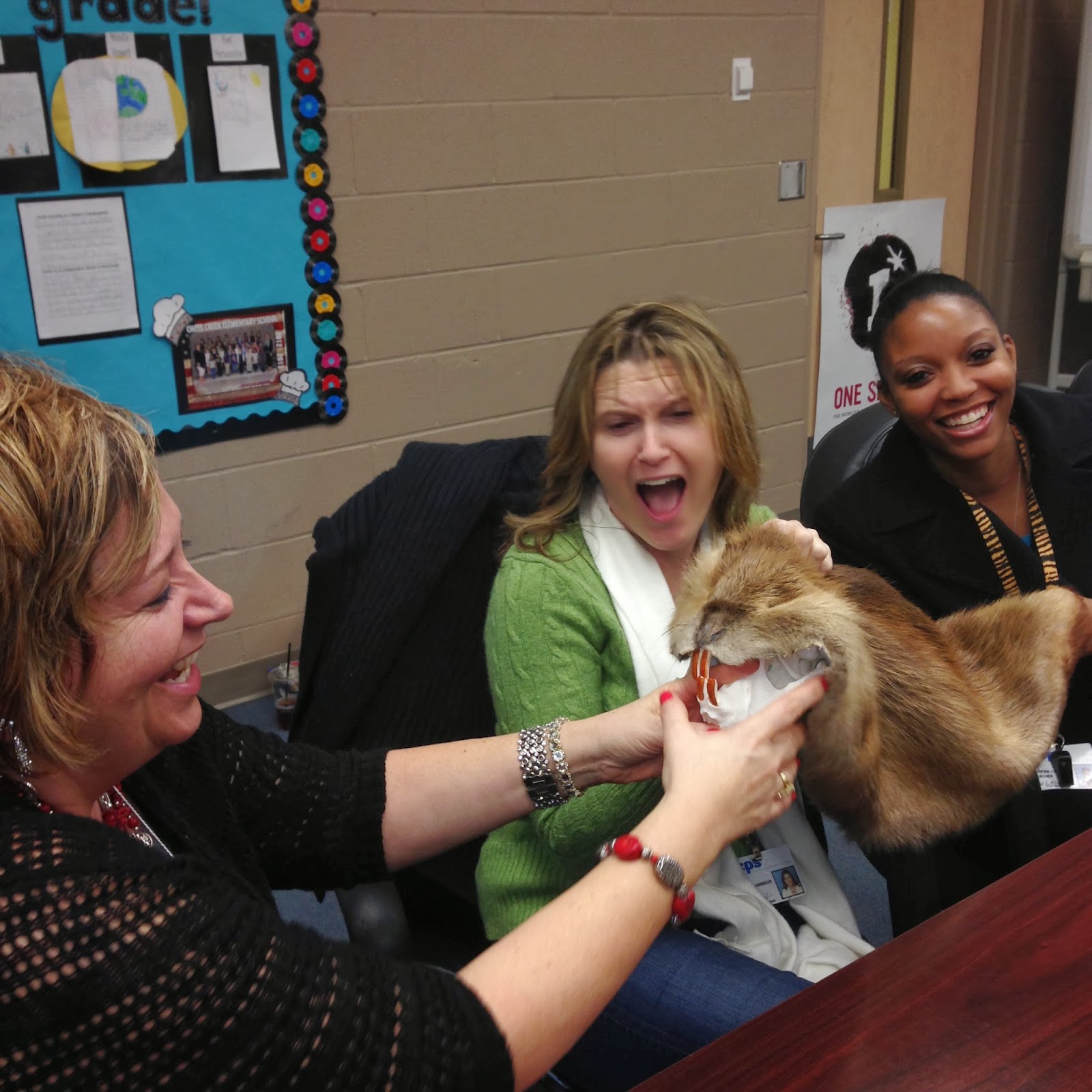
After lunch together - we always order in to save time! - our Science lead Tracy Ruark took over for the last hour.  Tracy shared the content of boxes that were loaned to Chets by the Safari Club for us to use in Science.  We looked at pelts and skulls and I even learned about "scat" - felt like I'd visited Duck Dynasty!  The boxes also included books and lesson plans.  I know how much fun the teachers had with these items, so I can just imagine how the children will engage with them!  We ended by talking about Tracy's latest Science lab with Sound.

I LOVE the teachers I work with.  They are engaged.  They are never at a loss for questions and share an endless supply of creative ideas.  There is no questions that I will be a better teacher tomorrow because I shared time with them today!

Thursday, September 26, 2013

Scientific Writing in K

Over the past week our class has been investigating the tools scientists use. We have discussed how and why scientists use goggles to protect their eyes, balance scales to compare weight, hand lenses to magnify objects, as well as various other tools.

Yesterday the students were each given a thermometer and were asked to observe it by using their five senses.  We then investigated the effects of hot and cold (using a cup of ice and the sun) on thermometers and how to read the thermometer. Today we had a group discussion on how we can use thermometers. We talked about how our moms and dads place a thermometer in our mouths when we are sick. We talked about how outdoor thermometers can help us figure out how to dress in the morning for school. We also talked about how mom and dad sometimes poke a thermometer in the turkey at Thanksgiving to tell if the meat is fully cooked so we don't get sick. At the end of our discussion the children were tasked with answering the essential question, How can we use a thermometer? in their Science Notebooks. At this early stage of kindergarten the children are writing in pictures but they are starting to show beginning stages of labeling words. The student pictures below show amazing detail of how well they grasped the concept of how thermometers can be used, as well as, the general understanding of how hot and cold as they refer to temperature.


This student shows Farenhiet and Celcius and includes the numbers associated with thermometer. He decided to show how we use a thermometer when we are sick so the smiley face and sad face represent if you are feeling well or feeling sick. His second page shows that the thermometer gets hot when someone is feeling ill and he shows this in the color red indicating hot. Above he is feeling better and no longer needs a thermometer. An amazing understanding of how thermometers work!


This student chose to represent her understanding of thermometers by drawing a picture of herself sick in bed but she also has begun to label her pictures as well. Here she spells thermometer "simo" and bed "bad". She also chooses the color red to represent hot for the rise in temperature when you are not feeling well. If you look closely you can see the thermometer sticking out of her mouth. So cute!


Finally, our last student decided to use the outside weather to show her understanding of how we utilize thermometers. On the left hand side of her drawing she shows that is it night time with stars in the sky and the little girl in the picture in her words "was not dressed appropriately and so she is cold". The thermometer numbers are in blue indicating cold and the little girl has a sad face. She also labels "DOK" for cold.  On the right hand side of the page it is day time with the sun shining with the little girl still wearing her pretty little dress. This time, however, she is much happier as the thermometer shows red around it labeled as "toH" showing hot. The middle of the thermometer shows red more than half way up indicating its hot outside. The little girl is smiling and happy. These students have a clear understanding of how and why we use thermometers. What an amazing job!


Saturday, June 1, 2013

The Sun and Our Skin

Our last Science lab had to do with what the sun does to our skin.  Each child was given ten white beads to string on a pipe cleaner and turn into a bracelet.   
The students were told that the sun's UV rays would penetrate the beads.  Depending on how much of the sun's rays were absorbed, the beads would turn colors - the more rays, the darker the color.  The children were so amazed as the beads turned bright colors in the bright Florida sun.
Next we put some beads in clear bags and covered the outside of each bag with a different SPF sunscreen - from a 4 to a 60

The students made predictions and discovered that the sunscreen did block the sun's rays.  The higher the sunscreen the lighter the beads.  Next we went inside and wrote about our experience in our Science journals.  Children took the beads home to explain to their parents what they had learned.

Thursday, April 11, 2013

Erosion

Teaching our children about forces that can change the Earth's surface today. After watching a PowerPoint of before and after land forms, Mrs. Ruark unveiled the lab. They discussed the rocks, sand, clay and humus that they saw on the slanted board.  Then children were off to their journals to draw the "before" landscape,  Finally they predicted what they thought would happen if we added air and/or water.


The students then gathered so they could watch and participate in each step of the lab.  Just sitting the students so everyone can easily see is a management technique!


We started with a little air through a straw.  The children noticed that the sand moved around just a little as the child blew a little stream of air.
Next the wind picked up a little and the students noticed that much of the sand moved, but the rocks, clay and grass stayed put.
A spray bottle provided the light rain.  The children noticed that the water made the dirt a little darker so that it looked a little like mud but didn't really move the soil around.


Then finally it was a flash flood!

And the children watched as the water moved much of the sand, clay and even rocks.  They also decided that the grass stayed put because  the roots helped to keep the humus in place.

After an excited discussion, the children went back to their journals to write the conclusion to the experiment, observing the air and water can move soil.

Tuesday, April 9, 2013

Soil experiment

Several times a week we have Science.  Every couple of weeks the children participate in a lab/ experiment and it is their favorite part of Science.  We started today's lab with a PowerPoint showing different types of soil in our area.  Mrs. Ruark showed the children where she had been to collect rocks, clay, sand and humus.

Next the children helped her add each of the types of soil to make a soil milkshake. 

Add a little water and then... shake, shake shake it up!
The children then went to their Science Journals to predict what they think will happen to the soil if we leave it to set overnight. 


How do you think the soil will settle?


Saturday, February 2, 2013

Down 'n' Dirty

New bulletin boards went up today.  We decided to display our combination of Science and Writing.  In Science we have been doing a unit on "What Plants Need to Survive."  As part of our on-going gardening project we are planting potatoes.  I posted earlier about how we planted the potato eyes and then came in and wrote instructions for other classes. 

For our bulletin board border we had our children first draw themselves planting the potatoes on an index card and then had them draw what they thought the potatoes would look like when they were ready to harvest.  The picture to the left is one of my favorites!  I guess we forgot to discuss that the potatoes actually grow as part of the roots under the ground!  The children are going to be quite surprised that they don't see the potatoes growing as leaves and flowers!  Can't wait til harvest time!

We decided to use our potato planting papers for our bulletin board.  It was especially difficult to choose just four pieces of work, because there were so many that we really adored.  Below is Hailey's instructions with her thoughtful and heartfelt opening and closing!  Following that is the teacher commentary.


Hailey’s Commentary


Opening

You have to adore Hailey’s introduction - an original.

Steps

She has several steps in her process and uses the transition words
first, next and finally.

Closing

Hailey ties her closing into her introduction by suggesting that
some of the potatoes might go to Second Harvest.  She goes on
to explain that Second Harvest is a truck that brings food to people
who are hungry.  Love how she’s thinking!

Drawings

Hailey’s pictures reinforce each step of her procedure

.

Capitals

After an editing conference, Hailey added capitals at the beginning
of each sentence.

Punctuation

She also added some of the missing punctuation.

Sight words

Hailey spells most sight words correctly without consulting her word wall.

Potato Planting

Thanks to a wonderful volunteer, Dr. Brenda Zenk, our school garden was prepared for potato planting.  We went to the garden today and gave each pair of children a potato prepared for planting (you can see an example on the left).  Potatoes had been cut to have 2-3 eyes in each piece.  Trenches were dug about twelve inches deep with our class name attached to the row.  In pairs, the children dug a hole with a trowel approximately 8 inches deep and dropped their potato "seed."  The potatoes were planted about 12 inches apart. Then each pair covered the potato piece with about 2 inches of soil and 2 inches of leaves.  The leaves provide nutrients and, like mulch, keep the potatoes from freezing.  It will take about three months for the potatoes to mature so we should be harvesting in April.  Mashed potatoes? Potato chips? French fires?  Can't wait!

When we returned to the room, we reviewed the steps to planting and talked about writing the instructions for other classes that might enjoy planting their own potatoes.  Below is Avery's example of the instructions:
 
Hmmmm... Maybe this is our next bulletin board!

Monday, January 7, 2013

The Crickets are Here!

As so often happens, one of the suggestions in our Science manual is to set up a habitat for crickets to engage and introduce the students to a new unit, Needs of Living Things, but, of course, the supplies that we need are not available. I wonder how many teachers just read the suggestions and move on when they realize that they don't have what they need and sometimes don't even know where to get what they need? Not so in our class! Being a total Science nerd, my co-teacher decided to go to the pet store and buy what we need. She invested about $10 in a terrarium container and live crickets, and we were ready. With the children's help, they added soil, sticks, a water saturated cotton ball and some fruit (apples) and vegetables (lettuce). They identified the crickets need for shelter, water, food and space. The children were all ears as Tracy explained that we couldn't put too many crickets in the environment or they would eat each other, because they wouldn't have enough space! Then came the moment of truth. Tracy dumped the first crickets into the container easily but then one little hyper cricket jumped into the container and jumped right back out onto the carpet! That started the commotion as Tracy tried to catch the cricket and the children either began to scream and head for a safe spot (such as on top of a table!) or ran to help her catch the cricket. As Tracy turned to chase the runaway cricket, she put the box down... and I watched as 5 more crickets escaped from the box! Quickly the classroom was in a total uproar as crickets jumped all over the room to the sound of shrieking children and me laughing!  I just wish I had had a video!

Today as we were writing a class "How to" paper, the children suggested that we write about how to create a cricket environment! What a great idea! And if we had any doubt that our little cricket habitat had thoroughly engaged our children, we were assured as they excitedly added every detail of yesterday's event! They just can't keep their eyes off their new "class pets!"

Monday, October 15, 2012

A Little Gardening


It was out to the garden today to plant radishes. I feel so fortunate to have this opportunity with our students. Each row is marked off  for interested first grade classes and the seeds are supplied. This is a massive effort for a school with over 1200 students! 

After our visit to the the garden the children came back to the room and wrote about their garden predictions.


Thank you Dr. Zenk and the entire Science Council for making this opportunity available!