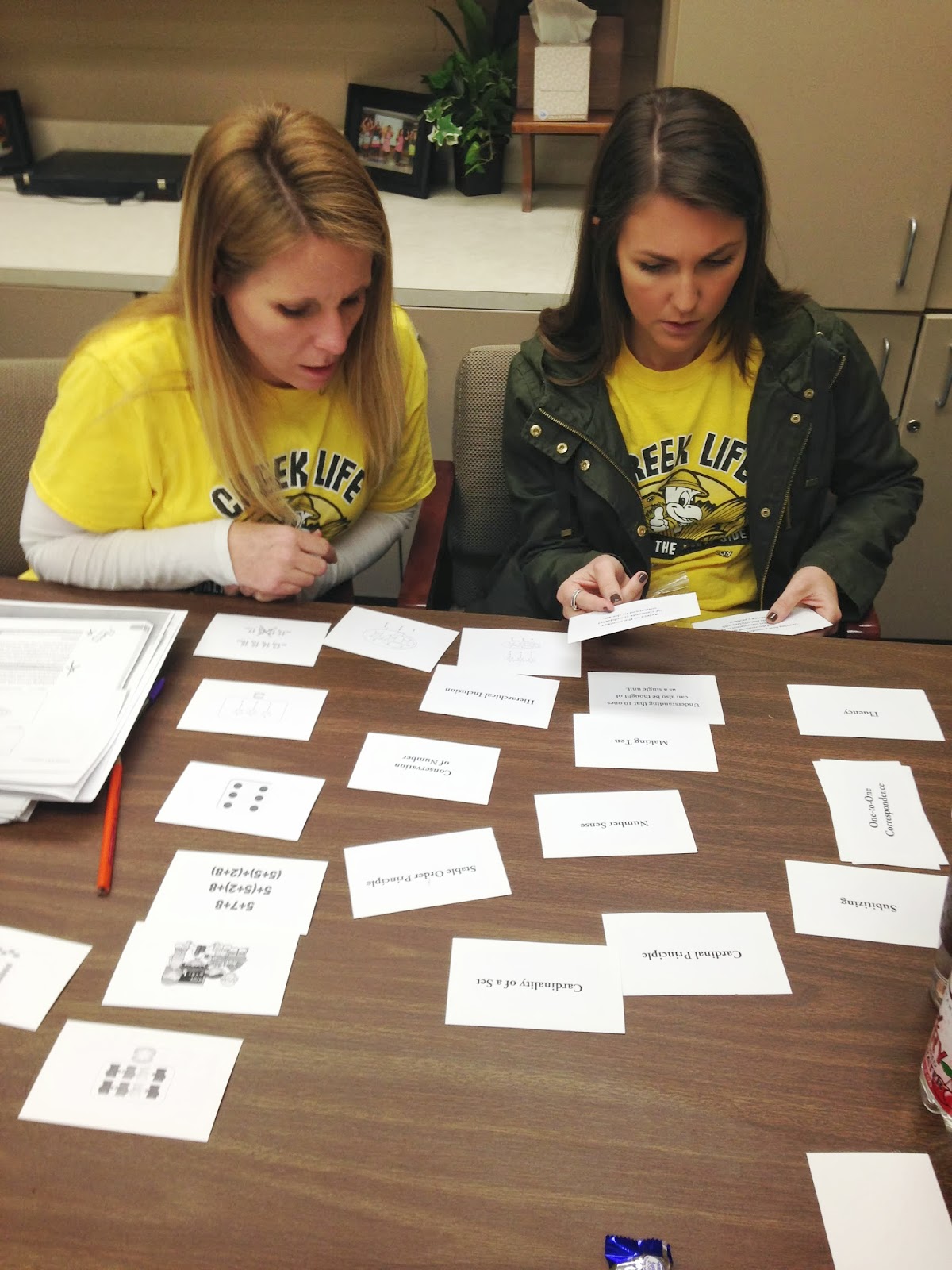
A year ago before leaving for summer break, I received a new Math book, Number Talks, from our Assistant Principal, Suzanne Shall. She said she knew I would like it and even spent some time to show me the part I should read over the summer. I did. I am not a Math person but this book was pretty easy to read... although I did glaze over some of it, I think, because I just didn't have enough background knowledge to anchor some of the ideas. Very few K-1 teachers choose early childhood because they want to be Math teachers. Most of us dream of teaching children to read and we just teach the basic math fundamentals. But today the expectation for Math is different.
Our first grade Math lead, Cheryl Dillard, taught several teacher meetings over the year from the book and I would reread the chapters again, each time internalizing more of the information and trying pieces in my classroom. I knew it was making a difference because I could hear the difference in the conversation and vocabulary that the children were having. But I knew that what I really needed was a Math book study where I could read each of the chapters again, ask questions, and have discussion and instruction to help me implement the strategies into my practice. I really needed to understand the big picture and then to put the pieces inside that master plan. I asked for the book study early in the year for K-1 teachers that were interested, but the books are expensive, and at our school, the perk of doing a voluntary book study on your own time is that the Principal tries to find the money to buy each participant the book. I don't know about where you teach, but where I teach, money is really, really tight and she simply couldn't find the money to buy the books, even though we all agreed that this was instruction that was really needed in our primary school.
I knew time was running out and I knew I still needed the professional development (it's really all about me!) so I asked if teachers would buy their own book, could we do the book study? But... the Principal was really adamant that teachers should not have to buy the materials to teach if they were willing to give their own time to do extra professional development. Finally, with only six weeks left in the school year, the Principal somehow found the money and eight teachers came together for a book study, taught by our Assistant Principal (we do not have a Math Coach). Is this ideal timing? Heck, NO! But we had no trouble getting these teachers to commit, meaning that they would be meeting all the way until the last week of school. No teacher REALLY wants to be reading, thinking and meeting the last week of school and no Assistant Principal (who is also the testing coordinator) really has the time to plan professional development to inspire a group of K-1 teachers. It's just too much with everything else going on as the school year closes. BUT... meet we did and the time was engaging and filled with electricity and excitement. We were able to think about what we HAD done this year and how we would do it differently next year with all that we were learning. We had a chance to discuss how it all fit so perfectly into the county's new adoption of EngageNY. For me, it put the pieces together. I will never teach Math the same way and probably for the first time in my career, I know exactly what I should be doing with my youngest students that are struggling. I actually have techniques and strategies that will make a difference.
We are sending the best prepared first grade Math students that we have ever sent to second grade, but I can't wait to see where we are able to take next year's group. I just can't thank Susan Phillips (she swore she had to sell one of her kidneys to pay for the books!) and Suzanne Shall enough for making this professional development a reality. I can only imagine how many children will benefit...
Showing posts with label Math. Show all posts
Thursday, May 28, 2015
Thursday, March 5, 2015
Working on the work
One of the best things about teaching at Chets Creek is the WOW days. WOW stands for Working on the Work and four times a year, each grade level gets to spend an entire day just working together. We don't do lesson plans because our amazing Resource Team takes the children for the entire day. I'm not sure it's the Resource Team's favorite day - to have first graders for an entire day - but the kids really look forward to it and come back at the end of the day, raving about the experience.
As is the tradition, each day starts off with a demo teach. A teacher volunteers to have all of her grade level watch her teach and then debrief the lesson. The idea is to show something that colleagues can go right back the next day and teach in their own classrooms. This week, my co-teacher, Tracy Ruark, who is the Science Lead for our grade level, got the call. Science is not graded at first grade and in reality, there is no real accountability, except that you are suppose to teach it! At our school, however, there is a real emphasis on Science at every grade level. Tracy is part of a Science Council that meets regularly to look at Science horizontally. They meet together to find additional Resources and labs, to read and study, and to work together to make Science through-the-grades more aligned. So today, we got to see a lab and lesson in the larger unit of "The Earth's Surface." Tracy is such a natural when it comes to Science, Unlike so many of her primary colleagues, she has a love for Science and has background knowledge that enhances every discussion. I feel so fortunate to teach with someone with such a gift.
Below are some of the pictures I snapped as our first grade colleagues talked with the students as they made aquifers with their partners during the lab portion of the lesson. The students came back and discussed the results of the lab and then recorded in their Science notebooks.
After the lesson first grade teachers met together and debriefed the lesson. Tracy made sure that each teacher had the background information and the supplies (bought out of her own pocket) to repeat the experience in their own classes.
The day ended with Math lead Cheryl Dillard presenting a rekenreck training that had been designed by our own Assistant Principal Suzanne Shall and tweaked by Cheryl to meet our needs. Although we have this Math tool in our classrooms, we don't use it as much as we should. I, for one, shook off the dust, and had it out today using it while I was teaching a new Math game that we worked on yesterday at our WOW, "Close to 20." Cheryl presented several Resources and new games that match exactly where our students are and what they need. I couldn't wait to try them out today. Cheryl made that especially easy because she had been to Office Max and had copies of the charts in larger sizes that we would need and had bought the wooden dice for us to make to play the game. Therefore, I came in early to laminate my poster and the game was up and running this afternoon.
That's what I LOVE about this day. It's a time to laugh and enjoy collegial conversation. It's a time to ask questions. But most of all, it's a time to learn. So much went into making our WOW day successful: Tracy being willing to find a new lab that met our standards on her own time and to buy supplies that would be needed for the entire grade level; our Principal funding Maria to spend a day with Lucy Calkins and then Maria coming home and spending countless hours on preparing notes that she could present to us; Our Assistant Principal preparing a rekenrek training for principals in another state and teaching it to Cheryl so she could present the highlights to us and then Cheryl taking the best of Suzanne's work to craft it to meet our first grade needs and then going out and finding all the resources that we would need to come right back to our classes and be able to teach it the next day. I know I have said it before, but I work with some incredible teachers!!
Sunday, November 23, 2014
Math TDE
I realized today - once again - that I work with some amazing teachers. My mind is so full, it just might burst!
Today was a first grade Math TDE. We began with a demo lesson with Cheryl Dillard. Cheryl is our Math Lead and so understated. When you ask her about this or that, she just tells you what she's doing, like it's just another simple idea. Then when you go watch all those "simple" ideas put into action, you are simply blown away. There is no curriculum for the skills that Cheryl adds to Math every day - no book of Math Journal ideas, but she has the innate ability to look at her students, compare them to the standards and where they need to be, and find the exact activity to move them in that direction.
I really wish I had videotaped this entire lesson because I find I need a rewind button because I am continually thinking, "How did she do that?" It's just effortless. There are so many new ideas that I find I have to prioritize. I'll implement this one and that one right now and then after a couple of weeks of adding those to the routine, I think I'll add that other one. By then, of course, Cheryl has moved on to the next. I sit here just thinking how thankful I am that I have teachers right down the hall in both Reading and Writing and Math that help push my thinking. We have talked about pushing the children's thinking up a continuum and that's exactly what happens as we begin to debrief this lesson. It pushes my thinking up the continuum and there is new learning.
Math Coach (She's really the AP-we don't have a Math Coach!) Suzanne Shall was ready to push that continuum too as she reminded us of all the reasons that we are where we are. She reminded us of the early days when we embraced Stigler and the TMMS study and realized that students from other nations were coming to take some of our highest paying jobs in the US because we didn't have enough students prepared to take them! We recalled the days when we realized that the Math education in our country was severely lacking and how we slowly and painfully switched our thinking to embrace a more conceptual math. Because we adopted Math Investigations so early, we now have the opportunity to enjoy the fruits of that labor as we have students in high school, college and in the job force who were part of this new Math wave.
Suzanne had us work problems that our current students will work in second and third grade and it was obvious that we still need to bump up our own thinking. What Cheryl proved to us is that our children can think at that level and they can do this work. I remember how dubious I was in those early years that we were expecting too much and how I worried that what we were doing might not be developmentally appropriate, but now I realize that if we allow students to begin to work at that concrete level for as long as they need, that they will have the building blocks to naturally move to representational and abstract thinking.
I am not a Math guru. I have made it my life's work to teach children to read, but as I have ended up teaching Math these last years, I have found a new challenge and interest. I can get just as excited when the light comes on as a child embraces and understands a Math concept as I ever did as they unlocked reading. And I have to say... I'm really proud of the Math work going on in my classroom... There's a pretty strong foundation being laid...
As we left our TDE, Suzanne had us do one last exit ticket, that I have reproduced below - always teaching the example of what it is she wants us to do...
Today was a first grade Math TDE. We began with a demo lesson with Cheryl Dillard. Cheryl is our Math Lead and so understated. When you ask her about this or that, she just tells you what she's doing, like it's just another simple idea. Then when you go watch all those "simple" ideas put into action, you are simply blown away. There is no curriculum for the skills that Cheryl adds to Math every day - no book of Math Journal ideas, but she has the innate ability to look at her students, compare them to the standards and where they need to be, and find the exact activity to move them in that direction.
| Cheryl teaching decomposing |
| Math Journal |
Math Coach (She's really the AP-we don't have a Math Coach!) Suzanne Shall was ready to push that continuum too as she reminded us of all the reasons that we are where we are. She reminded us of the early days when we embraced Stigler and the TMMS study and realized that students from other nations were coming to take some of our highest paying jobs in the US because we didn't have enough students prepared to take them! We recalled the days when we realized that the Math education in our country was severely lacking and how we slowly and painfully switched our thinking to embrace a more conceptual math. Because we adopted Math Investigations so early, we now have the opportunity to enjoy the fruits of that labor as we have students in high school, college and in the job force who were part of this new Math wave.
Suzanne had us work problems that our current students will work in second and third grade and it was obvious that we still need to bump up our own thinking. What Cheryl proved to us is that our children can think at that level and they can do this work. I remember how dubious I was in those early years that we were expecting too much and how I worried that what we were doing might not be developmentally appropriate, but now I realize that if we allow students to begin to work at that concrete level for as long as they need, that they will have the building blocks to naturally move to representational and abstract thinking.
I am not a Math guru. I have made it my life's work to teach children to read, but as I have ended up teaching Math these last years, I have found a new challenge and interest. I can get just as excited when the light comes on as a child embraces and understands a Math concept as I ever did as they unlocked reading. And I have to say... I'm really proud of the Math work going on in my classroom... There's a pretty strong foundation being laid...
As we left our TDE, Suzanne had us do one last exit ticket, that I have reproduced below - always teaching the example of what it is she wants us to do...
First Grade Math TDE Exit Ticket
1.
Please
mark the circle to represent the topic that allowed you the
most reflection.
5
|
Classroom Observation; Debrief (Dillard)
|
Shifts
in Math: TIMSS, 3-Prongs of Math,
Instructional Implications
|
|
1
|
Instructional
Sequence of Math (Concrete-Representational-Abstract)
w/Engage
NY video Alignment: Standards, Curriculum, Instruction, Assessment- Grade 1 and 2 Lessons
Tweaking Student Sheets; Creating Exit Tickets |
6
|
Analyzing Addition ; Subtraction Student Work- Beginning of Grade 2, Unit 1 |
1
| Second Grade Work Session Video (Justo ; McLeod) |
| Beyond the Standards- cardinality, equality, and decomposing | |
2.
What is one thing
that you will implement in the next two weeks?
o
Reteaching
one on one to clear up misconceptions from previous day during skills block.
o
I
will target 3 skills during calendar as well as work on 3 skills during the
block. 3 days of journal and 2 days of number bonds.
o
Move
students from concrete to representational in small group support.
o
Differentiating
student sheets for higher level students.
o
Analyzing
student work for their next step.
o
Skills
Block- use exit tickets for small group & one-on-one instruction.
o
Run
a better skills session.
o
Incorporate
instructional concrete instruction
o
I
want my skills block to include more of what I saw in Dillard & Mallon’s
room. Add the hundreds chart, guess my number, asap!
o
Adding
more of what I saw in calendar math this morning into my math centers.
o
Using
math games more because they are very beneficial.
3.
What is one
long-term implementation goal that you have?
o
Look
more closely at the standards to guide my instruction toward second grade.
o
Becoming
more comfortable with the addition strategies.
o
Pushing
the rigor of the work to allow students to problem solve and explain.
o
Rewrite
student sheets with larger numbers & exit tickets before I start a unit.
o
Strategies
for next step (2nd grade) push to the next level!
o
Having
students always talking about how they reached an answer to a problem, giving
them enough time to explain their answers.
o
Have
a good flow during the math block by making sure all materials are prepared and
ready. Kinds knowing routines.
o
Moving
toward written visual representations with my students instead of using
manipulatives which will get them ready to show expressions.
Labels:
Demo lesson,
First Grade,
Math,
Professional development
Monday, November 17, 2014
Off the Clock
When I walked out of school today, it was already dark. That's not so unusual, but what is it that keeps teachers at school so late? Today I was working with a Math Coach ( actually she's the AP- we don't have a Math Coach - but she knows more than any Math Coach I've ever worked with!) and two other teachers, writing new Math Unit Assessments. With new standards and new state assessments, and a new Math computer program, come the need for new aligned assessments. No one is doing this work for us. So, if we want our first graders to get the foundation they need to be ready for the rigor of more complex math, it has to start with us. We can't wait a few years, until children have failed, to start asking why are they failing. We need to scaffold instruction now so that never happens. This is not work that can wait.
I am so fortunate to be in a school where there is a cohort of teachers who don't mind doing this work... and it is "work." There is nothing easy about it. It takes time and lots of that time is off the clock. But the benefit... the benefit is why we are hashing out what the big ideas are in the next math unit and what the question stems should look like if they are to be aligned with the new FSA specs, and the new Math computer program language (i-Ready). We are all learning from each other. It makes us think about different ways to reach children and different strategies for teaching. And... the bottom line is... I will do a better job of teaching because I have spent this time working through this unit.
Now if someone was just interested in paying me for all this extra time...
I am so fortunate to be in a school where there is a cohort of teachers who don't mind doing this work... and it is "work." There is nothing easy about it. It takes time and lots of that time is off the clock. But the benefit... the benefit is why we are hashing out what the big ideas are in the next math unit and what the question stems should look like if they are to be aligned with the new FSA specs, and the new Math computer program language (i-Ready). We are all learning from each other. It makes us think about different ways to reach children and different strategies for teaching. And... the bottom line is... I will do a better job of teaching because I have spent this time working through this unit.
Now if someone was just interested in paying me for all this extra time...
Saturday, October 25, 2014
Texting in the Classroom
I have written often about how pitiful the technology resources are at my school - not that administrators don't work to stretch every single resource and get as much usage as they can. The county simply doesn't supply the needed resources. We're on a list somewhere to be updated at some time, but in the meantime... So often I have a lesson planned and can't get on Youtube or the Internet is down or whatever - seems like there are always more problems than solutions. Our Media Specialist, who works tirelessly to keep everything going and helping us find solutions, is amazing, but the resources simply aren't there. I do have four land computers that are old, but they work as student stations and a laptop for my desk. I am thankful for those. However, I do not have wireless, so even though I have my own ipad, I can't get wireless and I'm really not allowed to use it anyway - rules about not using your own stuff, because... there's a long list (most of it probably justifiable).
Anyway, we have been struggling with ways to take anecdotal notes in Writing, Reading and Math and even Behavior with two teachers and a Special Education teacher all servicing the same students. We've used lots of systems over the years - notebook (it's too inconvenient to keep one notebook for several teachers), sticky notes (they fall off over time and they still go into one notebook so you can't see the last note that was written), individual notebooks for each student at their desks (they get so ratty by the end of the year and there's really not enough room at their tables), stickers (they aren't big enough for everything I want to write), and on and on and on. Nothing has really been very efficient... until... we found an app!
Although we can't get a signal on our iphones in much of our building, we are able to get a signal in our classroom because our room is on an outside wall, so one piece of technology that I can use is my iphone (although technically, I am not suppose to use personal devices). For two years we have been using an app called Confer (we have had some recent syncing problems, but it was flawless for the first year, and I'm sure it will be again). It was developed by a Nationally Board Certified Teacher - imagine that?! A teacher with a solution! This app allows each of us to take notes during the day and then to sync at the end of the day and get each other's notes. So, if I'm working with a child tomorrow, I will know that my co-teacher worked on conventions today during a writing conference or that the ESE teacher worked through a total melt down with a child yesterday in her room so I need to reinforce a specific behavior today. We have very little time in our packed schedule to actually talk to each other about all the little conversations we have with children or all our noticings or wondering about specific children but this is a way we can keep in touch and keep a record of the progress students are making.
I never really thought to explain to the kids what I was doing while I was taking notes, so today one of the children asked me who I texted all day on my phone! I wonder how many adults or other teachers have wondered through my class and asked the same question?! I quickly pulled up my notes on this particular child so he could see what I was doing, but for anyone that has peeked into the classroom and seen us "texting," we really are taking notes!
Stop by. I'd love to share what we are doing! LOL!
Anyway, we have been struggling with ways to take anecdotal notes in Writing, Reading and Math and even Behavior with two teachers and a Special Education teacher all servicing the same students. We've used lots of systems over the years - notebook (it's too inconvenient to keep one notebook for several teachers), sticky notes (they fall off over time and they still go into one notebook so you can't see the last note that was written), individual notebooks for each student at their desks (they get so ratty by the end of the year and there's really not enough room at their tables), stickers (they aren't big enough for everything I want to write), and on and on and on. Nothing has really been very efficient... until... we found an app!
Although we can't get a signal on our iphones in much of our building, we are able to get a signal in our classroom because our room is on an outside wall, so one piece of technology that I can use is my iphone (although technically, I am not suppose to use personal devices). For two years we have been using an app called Confer (we have had some recent syncing problems, but it was flawless for the first year, and I'm sure it will be again). It was developed by a Nationally Board Certified Teacher - imagine that?! A teacher with a solution! This app allows each of us to take notes during the day and then to sync at the end of the day and get each other's notes. So, if I'm working with a child tomorrow, I will know that my co-teacher worked on conventions today during a writing conference or that the ESE teacher worked through a total melt down with a child yesterday in her room so I need to reinforce a specific behavior today. We have very little time in our packed schedule to actually talk to each other about all the little conversations we have with children or all our noticings or wondering about specific children but this is a way we can keep in touch and keep a record of the progress students are making.
I never really thought to explain to the kids what I was doing while I was taking notes, so today one of the children asked me who I texted all day on my phone! I wonder how many adults or other teachers have wondered through my class and asked the same question?! I quickly pulled up my notes on this particular child so he could see what I was doing, but for anyone that has peeked into the classroom and seen us "texting," we really are taking notes!
Stop by. I'd love to share what we are doing! LOL!
Labels:
Accountability,
Anecdotal notes,
First Grade,
Math,
Reading,
technology,
Writing
Tuesday, October 21, 2014
Is anybody in charge out there?
Sometimes it is hard for me to understand what the decision makers are thinking when decisions are made. One recent decision really has me scratching my head.
Our county has put a lot of eggs in one basket. The basket is a computer program called iReady. Not only is it being used for progress monitoring in Reading and Math but also will be used this year to monitor many teachers' progress with their students. That score along with a teacher's evaluation and professional development plan will be used to decide if a teacher is "highly effective" and theoretically will eventually be linked to teacher pay, so... this computer program becomes pretty important. I don't really think the program was ever designed to be used in this way, but that's probably a different blog!
As I have been working on rewriting assessments with some of my first grade peers, we have been trying to align test questions with what we anticipate will be on the state's FSA (state's high stake assessment), our curriculum, and this iReady computer program - all things with accountability attached. It is impossible to see an alignment.
Recently the county gave us iReady "cut" scores to make decisions. If a child received below a certain cut score they were to be administered a DAR, an instrument that breaks down reading skills in simpler parts. This assessment allows a teacher to pinpoint exactly what the problem might be so that interventions might be targeted - a sound goal - but the cut score is too high (although nobody is asking teachers!) In my class 22 of 35 students, 63%, were identified as needing this extra assessment which also assumes extra intervention is needed. Fourteen of those 22 are reading at the level expected for this time of year according to the DRA (a long used and reliable measure of reading levels) and 19 are making "Satisfactory" in Reading this nine weeks on their report cards (6 have S+ and 3 have E's!) This is common across our grade level. According to this cut score, I would have well over half of the students in my class in need of extra intervention, Tier 2. Really?
Is it really necessary for me to spend about three weeks of reading instructional time to give these students a test that will tell me nothing? Is it necessary for me to spend time each week giving these students Tier 2 intervention when they don't need it, so that I don't have enough time to provide the intensive intervention where it is really needed? Maybe the decision makers will figure out the problem... eventually... after all the instructional time has been wasted? I can only scratch my head and ask, "What are they thinking?"
Our county has put a lot of eggs in one basket. The basket is a computer program called iReady. Not only is it being used for progress monitoring in Reading and Math but also will be used this year to monitor many teachers' progress with their students. That score along with a teacher's evaluation and professional development plan will be used to decide if a teacher is "highly effective" and theoretically will eventually be linked to teacher pay, so... this computer program becomes pretty important. I don't really think the program was ever designed to be used in this way, but that's probably a different blog!
As I have been working on rewriting assessments with some of my first grade peers, we have been trying to align test questions with what we anticipate will be on the state's FSA (state's high stake assessment), our curriculum, and this iReady computer program - all things with accountability attached. It is impossible to see an alignment.
Recently the county gave us iReady "cut" scores to make decisions. If a child received below a certain cut score they were to be administered a DAR, an instrument that breaks down reading skills in simpler parts. This assessment allows a teacher to pinpoint exactly what the problem might be so that interventions might be targeted - a sound goal - but the cut score is too high (although nobody is asking teachers!) In my class 22 of 35 students, 63%, were identified as needing this extra assessment which also assumes extra intervention is needed. Fourteen of those 22 are reading at the level expected for this time of year according to the DRA (a long used and reliable measure of reading levels) and 19 are making "Satisfactory" in Reading this nine weeks on their report cards (6 have S+ and 3 have E's!) This is common across our grade level. According to this cut score, I would have well over half of the students in my class in need of extra intervention, Tier 2. Really?
Is it really necessary for me to spend about three weeks of reading instructional time to give these students a test that will tell me nothing? Is it necessary for me to spend time each week giving these students Tier 2 intervention when they don't need it, so that I don't have enough time to provide the intensive intervention where it is really needed? Maybe the decision makers will figure out the problem... eventually... after all the instructional time has been wasted? I can only scratch my head and ask, "What are they thinking?"
Saturday, February 1, 2014
Kindergarten Math Professional Development
Today we had a day of Kindergarten Professional Development in Math. Oh my! What a fantastic day! Not only did I get to spend the day with a grade level of teachers I adore, but Suzanne Shall, who is our Assistant Principal, slipped on her Math Coaching hat and ran the TDE. What a treat, in so many ways!
We started with a demo in the famous Mall-ard class! There was so much to take back into my own class that I don't even know where to start. Since this is my reflection, I guess I'll give you the high points for me and the things that I will be taking back!
1. The demo started with Math Journals. Unfortunately I didn't get a picture but they use composition books with a cross drawn on each page so that the students have 4 squares on each page. These quick activities review skills/ standards from previous lessons. Today's skills were: 1) How many more in a tens frame, 2) using pictures of 10 bundles to count by tens, 3) "counting on" starting with 6 donuts and then 3 are added, and 4) a 4+1 __ and 1-1 __ from our One More, One Fewer Math Investigations Game. They actually set the timer for 5 minutes and called time. Students that finish early know to go to the left side of their page and start writing the numbers by 1 as far as they can go. This routine is so firmly established that it looked like most students finished. The compositions books were put away so seamlessly that I didn't even notice how it was done or where the composition books went!
3. Next was a quick skill review. Today they used an interactive game. Only 5-6 minutes but today a quick review of ten frames with students sometimes identifying the number filled and sometimes identifying the empty blocks. At the debrief later, Cheryl would share some favorite 5-10 minute Math Skills that she uses.
4. We are in the middle of a geometry unit so today we saw the Math Investigations lesson about filling hexagons with shapes. The lesson started with the essential questions and then began with the comedy team of Mrs. Dillard and Mrs. Mallard pretending to be the students and playing the game together. I blinked and the students were at their seats, playing while the 14 teacher (!) milled around talking to students as they worked.
Mrs. Dillard closed by going back to the essential questions and having students she had pre-selected come to the front and explain the combinations they had used as she filled in a design.
5. At the end Mrs. Dillard used an "exit ticket" as an informal assessment. She had five shapes on a piece of paper in a plastic protector sleeve at each student's desk. She asked the students 3 questions and each student marked their answer and held it up. This way she could do a a quick assessment of who got it and who didn't. Master teacher in action.
They did all this in a one hour Math Workshop! The reason they can do so much is because their rituals and routines are so incredibly seamless and their time is tight not a second wasted. As the children got out materials and put them away it was without directions. They simply knew what to do. Amazing!
As always, the teachers went back to the conference room and the debrief was full of praise and insight. If we had done nothing else today, the entire day was worth seeing colleagues teach!
But that was just the beginning of what Suzanne had planned with our Math Lead Cheryl Dillard for us to do. We had been assigned a chapter to read from Number Talks: Mental Math Computations by Sherry Parrish. Instead of debriefing the chapter, we played a word/ definition/ picture game with partners - love when the coach models by using a teaching strategy we could do in the classroom. Then we watched 5 minute video clips from the chapter with kindergarten teachers and students. It makes such a difference when you can see a teacher demonstrating the principles.
This chapter is all about using ten frames, rekenreks and dot cards to teach subitizing and conserving numbers, one-to-one correcsponse, counting by 1's and counting on by using 5's and 10's. All of this is our foundation in these early grades. That's not to say that we didn't have trouble wrapping our minds about how we would fit all this in! Suzanne has copied a stack of work we could use in the classroom tomorrow which is the sequence for implementing these strategies as part of a daily skills review.
The rest of the day was about showing us tools that we could use during our Math Workshop and for our small groups. Our county has bought i-Ready, which is a computer program. Although we are expected to use it, there has been little professional development on this massive program so we went through some of the reports and how they could be used to inform parents, but also how to use them to inform instruction, such as forming small groups and then monitoring progress. Unfortunately we are a school, not living in the 21st century with our technology so the barriers to implementing this program with kindergartners often seem insurmountable but as is our way, we shared the barriers and our frustrations and then quickly went to sharing solutions and ways that teachers were making it work. Our technology is so less than ideal, but our children will live in an age where technology is part of their life, so we have to embrace what we have! We looked at the Toolbox Lessons (Access code: NASM-X9SA) for i-Ready and some of the cpalms lessons that might supplement our lessons and our own professional development. Although some of the lessons were taped right here at Chets Creek, we were especially interested in the videos, Is it still a triangle? and Compare Hexagons for this geometry unit.
Suzanne always ends with time for partners to discuss what they learned and what they want to do with what they have learned and then has them share with the group the first thing that they saw that they want to implement. You have to have time to synthesize and reflect and then develop a plan. Each of us left with a plan.
I don't mind telling you that my head is swimming, but what a great day of learning. Maybe other schools do this on a regular basis like we do at Chets Creek, but that was never true in the eight schools I taught at before coming to Chets. Recently I inquired from someone in the county about wanting professional development in a reading technique that I knew was being offered in our county, but not at my school. The person suggested that if I wanted the training, I should transfer to that school! They so don't get it. Chets Creek is about being a learner and collaborative teaching. It's the leadership, the collegiality, the passion, the synergy that makes it work - that makes it different here. That's why I stay here. Did I say that I love my job?
Monday, January 27, 2014
Kinder Math Standard-based Bulletin Board

This is the standard.
K.CC.B.4 – Count to tell the number of objects
4. Understand the
relationship between numbers and quantities; connect counting to cardinality.
b. Understand that the last number name said
tells the number of objects counted. The number of objects is the same regardless
of their arrangements or the order in which they are counted.
This was the task.
Six
Tiles in All asks students to use six one inch tiles
to make different arrangements. Each arrangement
has to follow a special rule – each tile has to touch another tile in some
way. The teacher showed several
arrangements and also had the students identify non-examples. Then several students demonstrated their idea
of how the six tiles could be arranged. The
students were then challenged to find different arrangements of their own six
tiles and to choose one way to record and then share with the class, using
paper tiles and one inch grid paper.
On the following day these same paper tile
arrangements were used as quick images.
Children were encouraged to explain how they remembered the image to
reproduce it.
This task begins to meet the standard by having the
students practice different arrangements of a single number, 6. To meet this element of the standard the
students needs to demonstrate their understanding of this same concept
with other numbers. They would also need to count the items in each arrangement,
understanding that the last number said is the number of objects.
This is the background information.
Six tiles are used for this investigation because six
is the number that most kindergartners can count with accuracy. Because it takes two hands to represent six,
students naturally work with two numbers to make combinations of six. In addition, six is one of the largest
amounts that can be mentally visualized and manipulated and instantly recalled. This is also a number kinders are intimately
familiar with because most of them will turn six during the year!
This investigation gets to Piaget’s work with
conservation which is a foundational skill in number sense. Conservation of number is the understanding
that the quantity of a given number of objects remains the same regardless of
how it is spatially arranged. Six is
six is six. The child that sees six tiles horizontally as six but then has to recount
those same tiles when they take another arrangement would be unable to conserve
numbers. But a child that identifies the
horizontal as six, and then the same six tiles rearranged to make a rectangle
as six, would be able to conserve numbers.
The child that has conservation does not need to recount the same tiles
as they take different shapes because he knows that the number stays the same.
This investigation also gets at subitizing which is
the ability to immediately recognize an arrangement as a single unit. The ability to see the particular
arrangements of indentions on a die and know it is 5 without counting would be
an example of subitizing. This
investigation, like dot cards, ten-frames and rekenreks, provide students with
the opportunity to practice subitizing.
Quick images help a child practice subitizing and visualizing what the number
looks like with different patterns of that same number.
Eren was especially proud of his arrangement which he
said looked like a chess board. He liked
that the “ends” were touching and that it was a design that no one at his table
had imagined.
Nia thought it looked like a zigzag and Alex
recognized the checked pattern when he said it looked like a checker
board. Tommy said it looked like racing
and when Sawyer said he couldn’t see racing, Tommy explained that it looked
like the racing start line, the checkered flag!
Love the fact that these very young children are beginning to challenge
each other in their number talks!
Saturday, November 16, 2013
Technology at its Finest!
The county has purchased a computer support program for Math, called I-Ready. Hooray! So we have been charged with getting all of our little ones on the computer and through the pre-test. Sounds simple, right? Not! First the children, some who have never used a mouse before, are expected to log on to the county's system. The county doesn't make that easy for a 5-year old. Their username is a l-o-n-g sequence of numbers and letters. Then their password is another l-o-n-g sequence of letters and numbers including both upper and lowercase letters. Now it may be simple for you and me to follow a sequence of numbers and letters on a card, but for a 5-year-old that is virtually impossible! They can't tell the l's from the 1's (did you get that? the lowercase letter l and the number 1!) They can't tell if it's the number 0 or the letter O, not to mention not knowing how to use the shift key to make uppercase letters. To say it's a nightmare is an understatement. There is a county policy barring teachers from using their own information to log all the kids in, so how in the world can this mandate be accomplished?The good news is that once a child learns that long sequence of letters and numbers, it stays the same for the rest of their school career - thank goodness! Having taught Kindergarten and first grade all these many years, I know it takes until about the middle of first grade, going to the lab often, before most children can actually log in independently. Seems like the county could come up with a little simpler system for their youngest learners, doesn't it?
But Chets Creek is built for solving problems! To solve our problem with the pre-test, we invited our fifth grade partners to join us in the computer lab. We also invited the Technologist/Media Specialist to join us. Good thing! We needed every single computer for our 35 students and our Technologist had made sure all were working. However, several of the headphones were down and had to be replaced on the spot. Had she not been with us (and she had to rearrange classes to make it happen!) those children would have lost that time and not completed the pre-test. When we first went in, the entire system was down and had she not been there to call the county and get a fix, we would have wasted an hour of our time and our fifth grade class. That is our more normal, frustrating experience! But today, all was right with the world, and after some initial frustration and lack of patience, all the fifth graders were able to log their kinder on and the kinders were able to work through the problems.
I am anxious to begin using this new resource in our classroom. I am trying to figure out a way to not have to log each student on, which would have me jumping up and down 35 times during each day to log in for a child. Any suggestions? If I don't log them in myself, they will spend their entire time logging in (and maybe never hit the magic combination) and will get no time working on Math! Also, we only have 3 computers and will find it challenging to get every kid on every day, but nonetheless, being an optimist, can't wait!
Thursday, May 23, 2013
Summer Activities to help get ready for Second Grade
I work with amazing colleagues and one of those is Carrie McLeod, a second grade teacher. She put together this incredible list of Internet games and worksheets for children to use over the summer to warm up to second grade! Enjoy!
Monday, February 4, 2013
Happy 100!
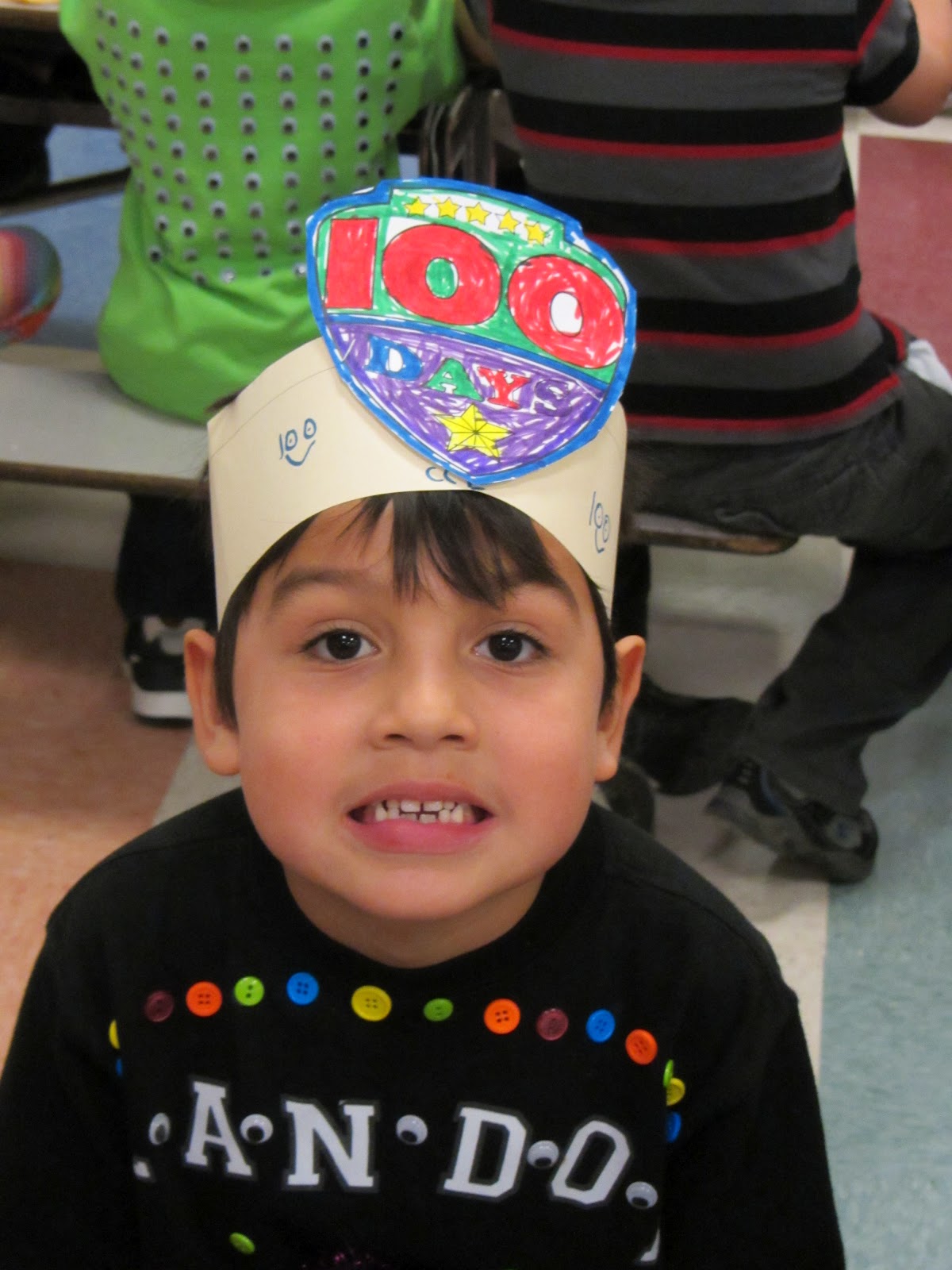
I'm not sure we did anything different than any other class celebrating the 100th day of school today, but we sure had lots of fun! We started with the children explaining their 100 collections that they brought from home. My favorites were shark's teeth and Q-tips! One student just poured Cheerios into a Ziploc. When we asked if he was sure he had 100 Cheerios, he admitted to not counting so we made him count them during snack! No free rides. My favorite collections were the ones brought in by Mrs. Mallon and Mrs, Dillard's class in water bottles! Love this idea!Then we made the cutest hats ever. Not only were they fun but the children had to put 10 dots on each of 10 strips of paper and then write from 1-100. We used extra bulletin board border so the prep was really fast. The 10 snack is always a hit! The kids get so excited about counting 10 pieces of 10 different snack foods and didn't realize that they are actually working on counting skills!
The 100 Fruit necklace is another favorite. The youngsters are encouraged to string 10 of one color before switching colors so they can practice counting to 10 and seeing that 100 is really just ten tens.
We hid 100 Hersey Kisses and then challenged the children to find them and put them on the 100s chart. We did such a good job of hiding the kisses that we still haven't found five of them! Is it possible that one of the kids ate the missing 5?
I know it seems like everything this year was has been food but we also played the 100 Dice Game and rolled dice, coloring in the sum of each throw to see how many roles it would take to reach 100.
Such a fun day!
Friday, October 26, 2012
Fall Celebration Ideas
We start our fall celebration each year with a Literacy Parade. Some children use their Halloween costumes and just find a book to match and others actually design a costume around a favorite book. As they arrive so full of excitement, we ooooh and ahhhh over the selections before we parade around the downstairs.
We spend the rest of the day celebrating with fun activities that have a wee bit of academics.
We love "cooking" this year with our "Recipe for Success" theme so our first activity was making a ghost cookie. The idea actually came from one of our mothers, that has her own cookie blog, that sent the teachers a few ghost cookies as a treat. We simplified the cookie and the children loved this easy ghost - a Nutter Butter cookie covered with white icing and then two small chocolate chips for eyes and a larger one for the mouth.
When we did our Math Diagnostic earlier this year, we noticed that the students were really struggling with interpreting graphs so we took this opportunity to add some work with graphs. We looked for individually wrapped themed candies. This year we found colored skulls and bones. After each child graphed his candies and colored in his graph, we showcased different graphs, asking questions such as. How many more green bones than black skulls? Which candies have equal amounts. Make an equation using the red bones and green skulls. Love that Math practice!
Also from our Math work, we put 10 candy corns and 10 candy pumpkins in a Ziploc for each child and then asked the children to make combinations of ten. This is a play on our Math Investigations "peas and carrots" activity. The children used these fun manipulatives to make the combinations and then shared their work in a typical math closing activity.
It seems like one of the things that often gets cut in our curriculum is art. So... today we did our own version of pumpkin making. Each pumpkin had its own personality!
After lunch we cut the traditional jack-o-lantern. I am always amazed at the number of children who say they have never cut a jack-o-lantern. Every single child had a chance to stick a hand inside the pumpkin and pull out some "gunk". Then we reviewed geometric shapes as we made a group decision on the shapes of the eyes, nose and mouth. We lit the jack-o-lantern with a flashlight to shine tonight as the children came back to trick-or-treat during our annual school wide Fall Festival. We saved the seeds to count and cook another day.
This year we also cut the top off one of the smaller pumpkins, cleaned it out, and replanted a few of the seeds inside the pumpkin. The idea is to let the seeds sprout in the window and then replant the pumpkin (shell, soil and sprout) in a larger pot before the shell rots! Will let you know how it goes.
Labels:
Art,
First Grade,
Holidays,
Math,
Reading,
Science/Gardening,
theme
Friday, August 31, 2012
Partners
Today we selected partners. This is pretty important because partners are long-term partners. Except for the case of total discontent, these partners will remain the same until the mid-term.
These partners will work together during each day's partner reading so we have like partners together. After the mini-lesson students have 15 minutes of quiet independent reading when students are reading books from their own book buddy. These books have been carefully selected - mostly books at their independent level to practice, with a couple at their instructional level to challenge. During that time they are putting sticky notes in their books of places that they want to share with their partners - funny parts, interesting parts, tricky parts... When the timer goes off, the students know that they have an assigned place at a table or on the floor to meet with their partner. There they sit side by side - knee-to-knee and shoulder-to-shoulder and share what they have been reading. They might also read together. They have learned how to decide who goes first (rock, paper, scissors is a favorite and so is the mature, "Why don't you go first today?") and how to put the book in between. It is important that we choose partners that are compatible but also who are close to the same reading level.
These partners are also Math partners - same partners, same place to sit. This is the person that they will play most of the Math games with, so it is important to make sure we match children, not only who read at a similar level but who also have Math skills at a similar level. No easy task!
This is also the partner that they will sit beside any time we are doing whole group work on the carpet. The children sit in four rows, crisscross. When the teacher says, "turn and talk," this is the person that they will face and share with.
Having the same partner for everything cuts down on any confusion and loss of instructional time. It makes for smooth transitions.
At the mid-term we will interview each student and see how s/he thinks the partnership is working out. Some students will want a change and some will beg to stay together. Working with another person and negotiating games and activities is just another life lesson in the daily work of a child.
These partners will work together during each day's partner reading so we have like partners together. After the mini-lesson students have 15 minutes of quiet independent reading when students are reading books from their own book buddy. These books have been carefully selected - mostly books at their independent level to practice, with a couple at their instructional level to challenge. During that time they are putting sticky notes in their books of places that they want to share with their partners - funny parts, interesting parts, tricky parts... When the timer goes off, the students know that they have an assigned place at a table or on the floor to meet with their partner. There they sit side by side - knee-to-knee and shoulder-to-shoulder and share what they have been reading. They might also read together. They have learned how to decide who goes first (rock, paper, scissors is a favorite and so is the mature, "Why don't you go first today?") and how to put the book in between. It is important that we choose partners that are compatible but also who are close to the same reading level.
These partners are also Math partners - same partners, same place to sit. This is the person that they will play most of the Math games with, so it is important to make sure we match children, not only who read at a similar level but who also have Math skills at a similar level. No easy task!
This is also the partner that they will sit beside any time we are doing whole group work on the carpet. The children sit in four rows, crisscross. When the teacher says, "turn and talk," this is the person that they will face and share with.
Having the same partner for everything cuts down on any confusion and loss of instructional time. It makes for smooth transitions.
At the mid-term we will interview each student and see how s/he thinks the partnership is working out. Some students will want a change and some will beg to stay together. Working with another person and negotiating games and activities is just another life lesson in the daily work of a child.
Labels:
Math,
Partners,
Readers' Workshop,
Writers' Workshop
Saturday, February 25, 2012
"Out takes"
So we are picking work for the bulletin board. The children were given shapes and asked to use the shape in their picture. This child chose a dog and drew the dog at a dog park. Although this picture clearly met the standard, after very careful inspection, and a few laughs, we decided NOT to use it on the bulletin board. Can you see why? (1. poop! 2. the wrod "bench") LOL!
Sunday, February 5, 2012
100th Day of School
Teachers at Chets Creek take the 100th Day of school seriously from dressing up like they are 100 years old to making their own "100 of something" shirts and costumes!
Most of the kindergarten classes strung a hundred of something. To make sure the activity was related to the Math work they are doing, the youngsters used a ten frame - making ten frames of 10. Some classes included their 5th Grade partners. I'm not sure who enjoyed the counting more - the kindergartners or the 5th graders!
Most of the kinder classes made some kind of 100 hat. Some of the classes counted 100 stars or stickers for their hats and others counted by 10's. Some simply celebrated that it was the 100th Day!
Every class also did some type of counting activity for snack. The kids counted 10 of 10 different snacks, e.g., raisins, gummies, popcorn, chocolate pieces, pretzels, cereal pieces, marshmallows, cheese crackers, etc.
Of course, each class also did a little of their own thing. Timmons-Ruark made a list of "100 Reasons Why We Love Maria" because it was Maria's last day before moving. Mallon-Dillard had the children come in with 100 balloons on the ceiling and had 100 cupcakes to form the numeral 100. Many of the classes searched for 100 numbered Hershey Kisses and put them on a 100 number chart. Some classes wrote a list of 100 words around the room. The Kindergartners ended the day with a presentation by Zero the Hero who read a book and had the children do exercises such as 100 jumping beans, 100 jumping jacks, etc. All in all it was a 100 Perfect Day!
Each child was also invited to come with a hat, tie or shirt with "100 of something". The creativity was amazing!
Most of the kindergarten classes strung a hundred of something. To make sure the activity was related to the Math work they are doing, the youngsters used a ten frame - making ten frames of 10. Some classes included their 5th Grade partners. I'm not sure who enjoyed the counting more - the kindergartners or the 5th graders!
Most of the kinder classes made some kind of 100 hat. Some of the classes counted 100 stars or stickers for their hats and others counted by 10's. Some simply celebrated that it was the 100th Day!
Of course, each class also did a little of their own thing. Timmons-Ruark made a list of "100 Reasons Why We Love Maria" because it was Maria's last day before moving. Mallon-Dillard had the children come in with 100 balloons on the ceiling and had 100 cupcakes to form the numeral 100. Many of the classes searched for 100 numbered Hershey Kisses and put them on a 100 number chart. Some classes wrote a list of 100 words around the room. The Kindergartners ended the day with a presentation by Zero the Hero who read a book and had the children do exercises such as 100 jumping beans, 100 jumping jacks, etc. All in all it was a 100 Perfect Day!
Subscribe to:
Posts (Atom)