Showing posts with label Narrative Writing. Show all posts

Thursday, May 21, 2015

Narrative Post-Prompt

With soft music playing in the background, our students took 45 minutes today to complete their last prompt piece of the year, this time a small moment narrative. Most of these students we have had for two years. Some came in drawing detailed pictures with the ability to orally tell us about the pictures. At most, they could write a few words, like love, mom, dad and their name. A few came only able to scribble.

Lucky for us (and for them!), Lucy Calkins and Teacher's College, introduced their new writing units as we began kindergarten with this group. We eagerly embraced the new units the day they were in our building. We are so fortunate to have a Reading Coach, Melanie Holtsman, in our building that has been steeped in Lucy's work for years and is an often participant in the summer professional development offered by Teachers College, so we had help along the way as we implemented. We had discussions and saw demo lessons.  This is not the adopted writing curriculum for our county, so we are so fortunate to have a Principal with vision that can see the value and find the money to offer this curriculum to our students.  We were able to teach three of the units before kindergarten came to a close last year and then have been actively engaged with the four first grade units all of this year.

We can see the difference it is making in our youngest writers and today the students will produce this final on-demand piece. As I walked around, I could see that students were going back, rereading and editing.  They had their personal word wall outs to check words, and you could see them stretching words that were unfamiliar.  They were going back to check punctuation, and you could see them erasing and adding capitals. But even more than the conventions, I could see that they were adding dialogue (part of the second grade standard for narrative).  They were adding details to their drawings, speech bubbles and labels.  The best thing is that almost without exception, they worked solidly, without a sound, totally engaged for the entire 45 minutes!  Writing stamina is simply a way of life! As we took the booklets up, I wanted to stop right there and read every one!  We can't wait to see what they have written!

Tuesday, October 14, 2014

Follow the Bend in the Road

As we decided on our first standards-based bulletin board for the year, our Reading Coach, Melanie Holtsman, challenged us to take the lessons that we were teaching in Lucy Calkins' New Units of Study and to demonstrate the students' work as a result of some of the lessons.  It was an idea we had never presented before on a bulletin board so, of course, the challenge was interesting.  I'm always up for a challenge! Normally we like to take a finished genre of writing and show all the ways that a student has used what they have learned but on this board Melanie wanted us to look at student work after each lesson. We decided to accept the challenge with our bulletin board tied to our Wizard of Oz theme, Follow the Bend in the Road.

This was the "task" and standard.

Task
This year First Grade has embraced the new Writing Units of Study written by the Reading and Writing Project at Teachers College under the direction of Lucy Calkins.  We are teaching this “Small Moments” Narrative unit for the first time.

As we opened our first days of Writing Workshop we reminded students of all that they loved about writing in Kindergarten and we welcomed them into a new year’s writing as authors.  We talked about their writing “muscles” and all the books that they were going to write!  We established the rituals and routines of the Workshop.
The lessons displayed on this bulletin board only address the first “bend” in the narrative unit.  The “bend” is like the first set of mini-lessons that go together.  The students stopped at this bend and celebrated their writing, before beginning the next leg of the journey.


Standards
LAFS.1.W.1.3
Write narratives in which they recount two or more appropriately sequenced events, include some details regarding what happened, use temporal words to signal event order, and provide some sense of closure. 


We looked at four different lessons.  This is a sample of an Introduction, the student work and the commentary from one of those lessons.


Translation: One time I went to my cousin's. It was my first time catching a lizard's tail. It was moving. My mom was there. I put it in the grass and my sister was there.  I went (back) in the afternoon. Then her lizard got stuck in the bush. Then I held the lizard's tail. Then I went to go wash my hands.


Wednesday, September 10, 2014

The First Bend

Today we came to the first "bend" in our narrative writing unit. We have been using the new units of Study from Teachers' College.  After a few weeks of writing small moment stories, the children used a red pen to edit one of their finished pieces. And then, like a museum, the students put out their work and invited their friends to stop by and read their completed story.

After looking at each other's work, the students compared their own baseline pieces to their finished piece and discovered that they has really grown as writers. A few years ago I would never have imagined that first graders could do this type of peer review or self-assessment but today, they did! Thank you, Lucy!

Wednesday, January 15, 2014

Working on the Work


Today was one of my favorite days.  It was a WOW day (a Working On the Work day), now referred to as PLC (Professional Learning Community)Days by the county.  Our children spend the day with our Resource teachers and we spend the day studying together.  We started off our WOW with a demo lesson by our Literacy lead, Maria Mallon.  All 14 of us loaded into Maria's room to watch her masterfully teach one of the new lessons from Lucy Calkins' new Units of Study for Teaching Writing.  We opened with narrative writing after the holiday and Maria demonstrated the 5th lesson, the last lesson in the first bend of the narrative genre.  I love watching a colleague work!  Maria masterfully taught the children how to use their pencil for reading and for writing.  She taught them to use the eraser end for "rereading your work and the point for writing new words" as the children co-wrote the beginning, middle and end of a story together about our trip to watch the Polar Express at the church next door.  Besides using a magic pencil  I also loved how she demonstrated using "writing in the air" as an active involvement.  Maria gave each student his or her own writing pencil and then had them use it to "pretend" write or "write in the air" a she wrote on the paper on the board.   Both of those tips - using a magic pencil and writing in the air - are things that we can teach in our classroom tomorrow.

Melanie Holtsman, our Literacy Coach, is the producer of our literacy professional development and she and Maria designed this learning opportunity together.  Melanie studied at Teachers' College last summer so she has been able to artfully incorporate pieces of that "Lucy" training into our professional development this year.  She shares some of her learning from the summer and from a recent day with Lucy with us, and the greater community at our school PD blog, Live from the Creek.  Check it out.  It's almost like being at Teachers' College!

Melanie always tries to have us experience something as a learner so that we feel comfortable incorporating it into our lessons.  Today she had us "write a story in the air" -  tell a true story from our childhood to a partner - thinking about the beginning, middle and end..  She suggested this as  way to have our students get ready to write.  In other words, instead of simply telling our students to "turn and talk" about what they are going to write, to actually have them tell their partner the story with a beginning, middle, and end to jumpstart their story writing.  Can't you just see how that would work?

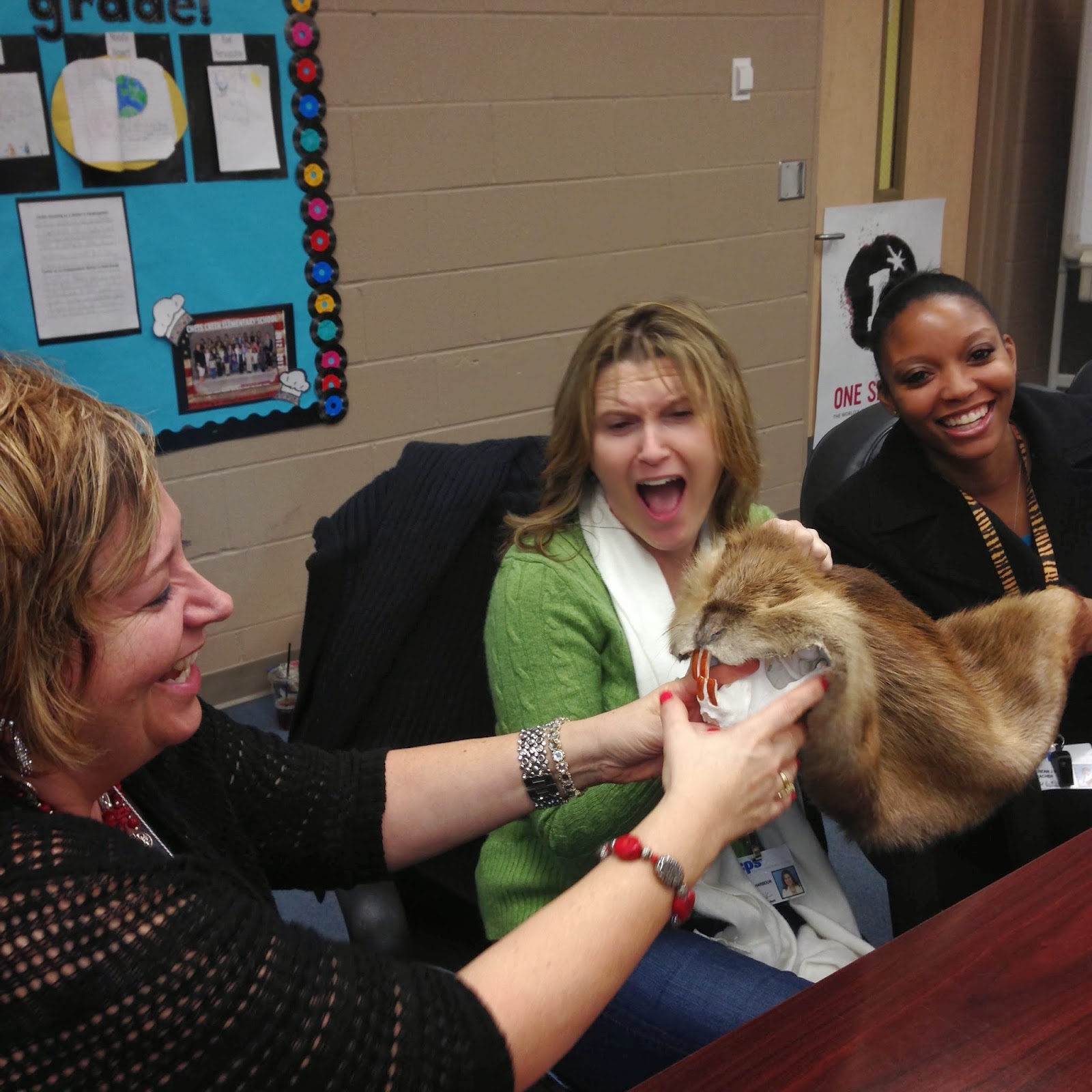
After lunch together - we always order in to save time! - our Science lead Tracy Ruark took over for the last hour.  Tracy shared the content of boxes that were loaned to Chets by the Safari Club for us to use in Science.  We looked at pelts and skulls and I even learned about "scat" - felt like I'd visited Duck Dynasty!  The boxes also included books and lesson plans.  I know how much fun the teachers had with these items, so I can just imagine how the children will engage with them!  We ended by talking about Tracy's latest Science lab with Sound.

I LOVE the teachers I work with.  They are engaged.  They are never at a loss for questions and share an endless supply of creative ideas.  There is no questions that I will be a better teacher tomorrow because I shared time with them today!

Monday, September 24, 2012

Bulletin Board - Sweet - Bulletin Board

We started the school year with a unit on pattern books.  We chose this first unit to get our young first graders back into the habit of writing every day.  We find that our children can write easily and fluently when they are thinking of patterns. It is also the type of books that children typically are reading when they come into first grade.  Below are some of the artifacts and translations for the books above that we featured on our standard-based bulletin board.

About Pattern Books
For the past four weeks our students have been reading and writing pattern books.  Pattern book is not a genre or literary term but a way to talk about the books that our youngest authors write.  A pattern book has a predictable structure with repetitive language.  Understanding pattern books helps a reader predict text.

This unit was four weeks long. The expectation is that all students complete at least one simple pattern book.  Many children finished several pattern books with different patterns and many details. The children have been exposed to many different patterns.  They have also recognized patterns in their own reading and have placed the pattern books they find while reading in the teacher’s chair so that they can be read to the class.  However, they found many more pattern books than we could ever read!

The conventions we expect this time of year (spacing between words, starting with a capital letter, ending with punctuation, sounding out words to write the letters, using the word wall) are practiced daily in the homework and during daily Skills Block.  When children write their stories in Writers’ Workshop they are practicing and applying the skills that they have learned earlier in the day.

The pattern books on the board and hanging under each child’s name represent some of the many patterns that the children have tried using.  They have used their mentor authors from the pattern books they have read to create many interesting pattern books in many different genres.  Enjoy and delight in these adorable examples of the books our children have written!


At Chets Creek

It is Math Workshop at Chets Creek, at Chets Creek.
It is Science time at Chets Creek, at Chets Creek.
It is lunch time at Chets Creek, at Chets Creek.
It is Physical Education at Chets Creek, at Chets Creek.
It is Skills Block at Chets Creek, at Chets Creek.
It is Readers’ at Chets Creek, at Chets Creek.
It is Writers’  at Chets Creek, at Chets Creek.
                                                 It is recess.  Yay recess!
Commentary

Orientation and Context
This student establishes her topic with a cover page and a title, At Chets Creek, which is also her repeating line.

Organization
She uses the pattern phrase, It is ___ at Chets, Creek, at Chets Creek.  The idea for the repeating line comes from a favorite class mentor text, Down on the Farm.  She stays on topic throughout her book.

Closure
This student changes up the pattern with a delightful little twist at the end,  It is recess. Yay recess!

Strategies
Wonderful illustrations provide detail to the text.  She even labels many of the items in her pictures.

On the back cover of her book, this student gives the reader a vocabulary lesson, modeled after the vocabulary activities we do in class.  Hi. I am H... and I am going to teach you the word Physical Education.  That word is for PE.  You exercise.  What does the word mean?

Conventions
 This student's work is easy to read.  She uses spaces between words and spells sight words correctly.  She spells unknown words phonetically, such as fichuckulijuckashin for Physical Education!  After an editing conference she changed the beginning letter of each page to a capital and added periods at the end of each sentence.

Habits
This student is such a delight to have in a Writers’ Workshop.  She is eager to try new patterns each day and loves writing.  She loves to read her work to an adult and would love to have a conference every single day!  She easily revises and edits her work when given suggestions.
I Said
I said, “Let’s go to Disney World.” Mom said, “Okay.”
I said, “Let’s go to Adventure Landing.” Mom said, “Okay.”
I said, “Let’s go to school.” Mom said, “Okay.”
I said, “Can I go to the store?” Mom said, “Okay.”
I said, “Let’s go to the manatees.” Mom said, “Okay.”
I said, “Let’s go to beach.” Mom said, “Okay.”
I said, “Let’s go to the aquarium.” Mom said, “Okay.”
I said, “Can I go play on your computer?” Mom said, “No!”
                      Commentary

Orientation and Context
This student orients the reader with a cover page and a title for her pattern book, I Said.

Organization
She uses the back and forth pattern of I said… and then Mom said… She stays with her pattern throughout her book.

Closure
There is a delightful little twist at the end of the book.  Instead of always saying, “Okay” to whatever the author asks, on the last page, Mom says,  “No!”

Strategies
This student is quite the artist.  Her detailed illustrations are a wonderful compliment to her text.
After a conference she easily added “talking marks” (quotation marks) for the words that were actually said by the author and Mom.

Conventions
This student’s work is easy for an adult to read.  She spells all of the sight words that have been introduced correctly. One of her next lessons will be to spell the word said correctly before she develops a pattern of spelling it incorrectly.  She segments words that are unknown to her and spells them phonetically such as ckunpoodoer for computer.  She adds periods appropriately and is ready to work on question marks.

Habits
Although this student is new to the Writers’ Workshop, she has eagerly taken in the lessons and used them in her writing.  She is quiet and rarely asks for a conference but readily uses suggestions when they are offered by an adult.
Vacations!
On Monday, I went to the circus because funny things happen.
On Tuesday, I went to the zoo because there are lots of animals.
On Wednesday, I went to the beach because I can swim forward in
       the water.
And on Thursday, I just stayed home and took a rest because I felt
       very tired.
On Friday, I went to the farm because I wanted to see all the farm
       animals.
On Saturday, I went to Epcot and bought a book named, “Duffy, the
       Disney Bear.” It was lovely.
On Sunday, I went to the Magic Kingdom and in the night I watched
       a show at the castle.
I like vacations because they are fun!
                               Commentary

Orientation and Context

This student introduces Vacations! as the title of her pattern book.

Organization

We have read many “days of the week” pattern books including the very familiar The Very Hungry Caterpillar by Eric Carle and Cookie’s Week.  This student adapted this sequential pattern, On Monday… On Tuesday… for her pattern book about vacations.

Closure

After a conference she decided on a closing sentence that changed the pattern that was a simple summary sentence.

Strategies

Details after each place add dimension to this student's text.  Her illustrations support the text and her labels and commentary in the pictures help orient the reader to what is happening and where each page takes place.

Conventions

This student's work is easy for anyone to read.  She has beautiful penmanship.  She is an excellent speller whether it is a sight word or an unknown word.  She spells words well above her grade level.  She uses punctuation and capitals correctly.

Habits
 This student is a joy to have as a writer in class.  She loves to try every new pattern that is introduced and then loves to read her book to an adult or share with the students at Closing.  She is always totally engaged in the writing process and thinks seriously about her work.  We often use her work to illustrate new patterns because she is such a fluent writer.
 
All About Ninjago
This is Sensei Wu.  He is the Leader.  Good.
            This is Zane.  He can hold his breath long.  Good.
This is Cole.  He is a dancer.  Good.
This is Kai.  He is a blacksmith.  He owns a star that is called Four
             Weapons.  Good.
Watch out for the Fangpyre.  They can turn you into snakes. BAD!
Watch out for Venomari.  They spray venom. BAD!
This is Pythor.  He sprays the person’s bones.  BAD!
This is Lord Garmadon.  He has four arms.  BAD!
This is Jay.  He has a girlfriend.  Her name is Nya. Good.
Watch out for Hypnobride.  They hypnotize. BAD!
This is Green Ninja.  He has all four powers.  Good.
We won!  I am bitter at the snakes.  Good.
                                      Ninjago!
                                                   About this Book
                        This book is about ninjas that beat snakes.
                                        Can you read these words?
                                                he                    this
                                                Jay                  Kai
                                                Cole                Zane
                                                Dancer           leader
All About the Author This book was made in Florida, September 10th through 11th, 2012.  This author’s hobbies were Ninjas and Star Wars and Harry Potter Epic.  Cool Book!

Commentary

Orientation and Context
This student orients the reader with his cover title, All About Ninjago.  He even added that his writing was non-fiction on the cover, but after a conference, decided that the book was really fiction!  Thank goodness!
Organization
This student uses a pattern that was first introduced by Luke, his classmate, who first wrote about Ninjago and started a movement of Ninjago pattern books in our class.  He stays with his This is… He is…. Good or Bad pattern throughout most of the book.
Closure
He chooses to end his pattern book with a single word, Ninjago!
Strategies
This student peppers each page with art work that is labeled, illustrating his points about each character.
At the end of the book, he includes a summary of the book, like the ones you see on the back of published books giving the reader a short synopsis.  Then he includes a feature that he has seen in many of his own leveled books, Can you read these words? with a list of some of the words in his text.  Finally on the back, he includes his About the Author  page.


Conventions
To an adult not familiar with the Masters of Spinjitzu, this student’s work is challenging to read but he has no trouble at all, reading his own work.  In fact, his eyes sparkle as he reads.  He begins to talk fast, because he is so excited about this piece.  He is an excellent speller and spells all taught sight words with no trouble.  The unfamiliar spellings of words and the characters are spelled phonetically.  After a conference, he was able to start each page with a capital and add a capital after each period.  He also added periods which are not yet habitual for him. He incorporates the vocabulary word bitter into his work!
Habits
This student is a joyful and fluent writer.  He loves writing and even asks to work on his writing during times when he could choose other free time activities.  He easily finds topics to write about and, like this pattern book, works seriously for several days to bring a project to completion.

Wednesday, January 25, 2012

Miss Nelson is Missing!

Mrs. Ruark and Mrs. Timmons have done an outstanding job with this month's kindergarten bulletin board.  They used the book Miss Nelson is Missing to introduce this narrative unit.  The story is about a teacher who decides to teach her disruptive children a lesson by pretending that she is a mean substitute named, Mrs. Viola Swamp.  She comes dressed as the mean sub and gives the children work until they are thrilled to see their real teacher again.  After reading and discussing the book, the teachers invited the children to use the characters in the book and write their own story.  They encouraged the children to write their fictional narrative using themselves and real people that they know mixed in with the fictional characters.  This bulletin board shows three different levels of kindergarten writing. 

The teachers began by having the children help them write an alternate story.  They discussed variations and decided as a class how the story would go. Then they modeled each step over several days.  That story is shown on top of the bulletin board.

The first piece of student writing was done in a guided writing group with the teacher and a small group of students.  The teacher and student went page by page, first talking about what the group thought should go on each page and then each student writing his own sentence.  The teacher supported each child by helping him stretch words so he could write his own individual thoughts.  This group had difficulty veering away from the original story and basically did a retelling of the original story.
The Kids Are Crazy

by Mikaela
There is paper on the floor.  There was a knock at the door. It was Viola Swamp. 
She said, “Do your homework!”  They did their work.  The kids did not like Viola Swamp.  She gave lots of homework.  Mrs. Nelson came back.  The kids were happy.

Each child did a picture of Miss Nelson and Viola Swamp which the teachers used as a border on the board.

The second student piece on the board, which was done independently, is a short story using the writer's teachers along with Mrs.Viola Swamp as the main characters. The teacher supported the student by having her first envision what she wanted to write on each page and then rehearsing it orally.  As the student told the teacher what she wanted to write, the teacher drew a line for each word to help the student remember the sequence.
by Jaylene
             Paper all around.
            The children are being bad.                  
            The children made a mess in the classroom.
             They are coloring on the carpet.  Miss Viola Swamp came in the door.
             There will be homework today.  When school is over we see Mrs. Timmons
              and Mrs. Ruark at the beach.  Mrs. Raurk and Mrs. Timmons are back!


The final piece of student work is amazing.  The fluency of the piece for such a young writer is striking and shows natural talent beyond that taught in the classroom.  This kindergartner is able to write the story totally independently and to control for much of the spelling. She wrote a delightful, imaginative story over a series of days.


by Morgan
Crayons are all over the place.  The bookshelf is tipped over and all of the kids clips are on red!  Mrs. Timmons and Mrs. Ruark decide that something must be done.  The very next day Mrs. Timmons and Mrs. Ruark were missing and the children said, “All right now, let’s really act up!”  They started to throw all the clips in the trashcan.  They started to color all over the white board and the worst thing that you could ever imagine, they were flipping the tables over and they made a piñata.  Then they hung it up somewhere in the classroom.  Then they turned off all of the lights in the classroom.  Then they found a bat in the classroom.  Then they swung the bat to see if they could make the piñata break and they also had a blindfold.  Then one of the boys in the classroom (his name was Ryan) swung the bat and he broke it.  Then lots and lots and lots of candy came out of it.  Then all of the children gobbled the sweets up and they said that it was so so yummy.  Then all of a sudden Miss Viola Swamp ran in the classroom door and screamed, “Stop playing around.  I have lots of homework for you today!”  and the children started to listen to Miss Viola Swamp.  After that Miss Viola Swamp started treating the children sweeter.  Then Miss Viola Swamp read them a story.  It was called Miss Nelson is Missing.  Finally Miss Viola Swamp left, but the children were not very excited because they wanted her to stay, but the children also missed Mrs. Timmons and Mrs. Ruark.  Finally Mrs. Timmons and Mrs. Ruark CAME BACK!  And the children did a silent celebration.


Each piece of work on the board includes a chart that shows a teaching rubric and then discusses the child's work as compared to the standards.  Morgan's commentary is included below.
Elements
Orientation and Context
·         Demonstrates an emerging grasp of context
Morgan brings the reader into the narrative and engages by opening with a description of what is going on in the classroom.  From that initial grounding she begins to describe events.
Plot Development and Organization
·         Creates a “story” or recount made up of several incidents or actions, some of which may be loosely linked
·        Controls for chronological order
Morgan’s story is an interesting sequence of events including the teachers leaving, several incidences involving the children’s misadventures and Miss Swamp entering the picture.  Then she includes several more events with Miss Swamp before she closes.  The story has a natural, easy sequence that is in chronological order.
Closure
·         Provides a sense of closure
After establishing the problem in her story  (the children misbehaving while the teachers are missing), Morgan brings the teachers back as her closing.  She even adds, “And they did a silent celebration.”

Strategies

Details
·         Uses detail to describe incidents and people

Morgan’s uses details throughout her story.  She begins with details describing the opening scene, “Crayons are all over the place.  The bookshelf is tipped over and all of the kids’ clips are on red!” 
Dialogue
·         May attempt dialogue
Morgan uses dialogue naturally when she says, “…and the children said, ‘All right now, let’s really act up!’” and also when she wrote “Miss Viola Swamp ran in the classroom door and screamed, ‘Stop playing around.  I have lots of homework for you today!’” 
Other
·         May use simple transition words
·         May use drawings to expand or illustrate the text

The transition word then pops up often in Morgan’s writing.  She also uses after that and finally. 

She does not depend on her drawings for meaning as she spends all of her time in the Writers' Workshop on her writing.  Morgan also uses capitals to provide emphasis when she writes CAME BACK, a fairly sophisticated strategy for a kindergartner!