Sunday, January 30, 2011

Teaching 2030: Cyberspace

I have to admit to being so envious of our new hires who seem confident, connected and excited about change! They have grown up in a connected world. I am from a different generation. I still remember when my family bought their first color television set (with 3 stations!) I started teaching before computers were even a thought on the educational horizon. All of the connectedness that this new generation takes for granted, I struggled to understand but it will be up to those of us that did not grow up with these technological advancements to lead the charge so that education will remain relevant to our students! Anyone who is even remotely connected has to realize the dramatic changes that are going to take place in the next twenty years! I watched my four year old granddaughter play a game in the car yesterday on her father's iphone and thought how different her world is from the one I grew up in. In order to engage this generation coming to us, schools have got to change.
The TeacherSolutions 2030 Team paints an exciting picture of how we will all be connected in twenty years and how our classrooms will expand to daily worldwide participation. However, the path from here to there is laden with pot holes! Kenneth Bernstein offers this insight: "I admit that I do not use technology as well as I should, even though I spent 20+ years as a certified data processor in the private sector before I became a high school teacher. I would love to use it more, but the school system approach to technology is archaic. The computers are so loaded down with levels of security and pieces of irrelevant software that the first time a student signs on to a particular computer it takes at least 10 minutes before s/he can do anything constructive." I have certainly moaned and groaned often and loudly - and gotten nowhere - about this same problem in my own classroom. I am not suggesting that technologists throw caution to the wind, but I do think they should be investing in many small pockets of teachers who are willing to do the extra work to see where the technology leads us. There certainly are the beginnings of a few schools with grants around the country that are experimenting with the possibilities. It is even harder to be patient when you hear of what can be done and what is being done. I can't stand that my own students do not have those same opportunities! We are praying for visionaries who can integrate education and technology and who are risk-takers. I believe that teachers can and should be trusted and when they are not trustworthy, then they should be quickly ushered out of the profession! I have no tolerance for teachers who do not use the public trust to do all that they can do to make a positive difference.
I will continue to complain - not something I really enjoy - or maybe it sounds better to say I will continue to advocate for change (it still sounds like complaining!) I will try to take every opportunity to use what technology is offered to me. I am lucky to be in a school that has an instructional technologist and a media specialist who are tireless in their efforts to continue to bring us cutting edge information, who meet us where we are and fit the teaching into every little corner of time. Even with all that said, the frustrations are sometimes overwhelming. I have to admit, however, that reading that the group of teachers on the TeacherSolution 2030 Team believe that in 20 years much of our technology woes will be resolved does put a smile on my face. Oh, that it becomes reality... quickly!

Saturday, January 29, 2011

Teaching 2030: Hybrid Jobs

I have just finished reading Teaching 2030 which is written by Barnett Berry and twelve outstanding teachers in the field. I have the utmost respect for this group of educators. I have had the opportunity to work with them virtually for several years as part of the TLN Network. Their expertise in understanding the landscape and their creativity in envisioning the future is unparalleled in anything I have read to date. This book explains "what we must do for our students and our public schools now and in the future" with an eye on what teaching will look like in 2030. I will most certainly not be teaching in the year 2030, but this is the first book in a long time that gives me hope amidst the rainstorm of sanctions and expectations that are flooding a teacher's landscape these days. Sometimes I wonder when in the world "they" actually expect me to teach! I would like to comment on several of the ideas from the book. This post will addresses hybrid jobs.

The Teacher Solutions 2030 Team writes eloquently about hybrid jobs for teachers - jobs that combine teaching with other types of leadership. I had one of those jobs for 10 years. I spent half my day as a Special Education teacher and the other half as a Literacy Coach for Kindergarten and First Grade teachers in the same school. I was able to coach from within the classroom which, I think, gave me a perspective that most teachers nor coaches have. I was able to try out the things that I was asking my teacher colleagues to do which made the coaching so much more authentic. I was not the only person at my school in this type position. We had other literacy teachers doing what I was doing and also Math teachers who taught half day and coached the other half. We have a Special Education teacher right now who teaches small groups but also handles most of the discipline at our school and has established a tutoring center in one of our neighborhoods. She's partnered with a local church to provide food, clothes, medical attention and all sorts of resources. She is working with our county technology department to establish a middle and high school course recovery/ tutoring center to help with the drop out rate in that neighborhood. I could go one and on. This is NOT a county initiative but the grassroots effort of a leadership team in a single school led by a principal who is willing to take a risk. As a result teachers have been willing to give 110% - over and above - to make the impossible happen. We have over 20 NBCT among our ranks with leadership ability oozing from their pores!

Unfortunately, while the vision and energy are at the school, the money for such innovation is drying up. This year there simply was no money nor the ability to creatively use money to provide for half time teaching positions, except for the last one I mentioned. I think we were so ahead of our time, but to continue to stay in that arena is a constant fight. We are fortunate that we are an "A" school in our state and have been meeting AYP or we would not continue to have the small amount of autonomy that we are able to maintain. You would think that we have proven that we can handle our children and that the ropes that continue to hold us down would loosen, but that does not seem to be the case.

What I love about this book is that it presents a hopeful vision for teachers who will not have to leave the classroom to lead. It gives teachers, like me, who love being with children but who want to do so much more, a chance for a future that can combine all of the things that we love. These authors that it will not be the carrot and stick merit pay of our present that will motivate us but it will be the working conditions of a principal who cultivates teacher leadership, the time and tools to learn from each other and the opportunities to take risks that will lure us. Whether these conditions are in our best or our neediest schools will not matter because we will go because we want to make a difference. To realization of that dream is our promise for the future.

Wednesday, January 26, 2011

Observations!

So I had this idea that since we had to do Science for our observation this year, that we should show the principal a complete 5-e cycle. Okay, so it wasn't my original idea! A group of teachers in another grade level did it last year, but I thought it was such an interesting idea that I really wanted to find a way to get involved in something that comprehensive. So, we put an e-mail out and asked if anyone wanted to join us in this venture. Luckily three other classrooms did! So, beginning in December, the seven teachers involved starting meeting to discuss what we wanted to show, who would do what, who would write what up, etc. - no simple task with so many teachers involved. Surprisingly, things have been very collaborative!

This week the lessons were finally taught and observed. I don't think principals REALLY understand how much planning teachers put into their observations. When teachers only have one 45 minute period to showcase a year's worth of work, they can get pretty stressed out in wanting to provide a really reflective lesson that shows what they do every day but also the best of what they do. In a school like ours, where so many teachers are so exemplary, it's easy for teachers to find the entire process daunting and discouraging. However, our group really rose to the challenge and really helped each other think through the lessons and how they would flow. Doing things this way meant that we would really have to teach each other's lessons. When we found glitches along the way, we were able to discuss how to improve the lesson before the next person taught it - almost like a lesson study but in the pressure cooker!

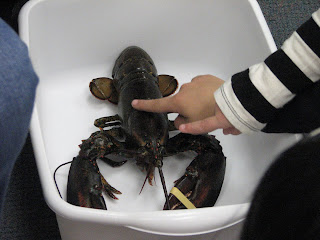
Investigating a live lobster
Investigating a live hermit crab
Our group is working on the essential question, What do animals need to survive? The first teacher did an engage and explore with pets - the animals children are the most familiar, to help the children figure out that pets need water, air, shelter, food and space to survive. The second teacher adapted a game as an explore and explain that was actually designed for older children about deer and their resources, to show that if deer didn't have what they needed they wouldn't survive. Today we (the three of us that teach together) finished a two-day explore-explain on what ocean animals need to survive. Because 75% of the Earth is covered in water and because our children live on the shoreline we wanted them to explore the survival needs of sea life. While we could have only used videos to demonstrate the lesson, we decided to bring in live animals. So, the children were totally engaged with a live lobster, a sea star and hermit crab! Besides the live specimens we also used video and books and had the children synthesize what each sea creature needed by making posters. The final explain came as the children added the new animals to a sort on the SmartBoard. The final lesson in this series will be an extend as children take what they have learned about pets, wild animal and sea creature needs and apply it to birds. The final class will be building bird houses using the information that they know about what animals need to survive. This tinkering project (a principal challenge) will wrap up our four classroom observations. The evaluation will follow as the final set in the 5-e process.
Add caption
I have to say it might have been easier to do our observations alone, just worrying about what was happening in our single classroom (after all, there are three teachers in our classroom, all teaching at the same time!) but working with a larger group helped us clarify the lesson and goals. The discussion brought up things that we might not have considered on our own. It takes longer to meet with a group of people and hash things out, but the results are almost always better. In this case, I am very proud of the lessons that we have created and the learning that took place. The fact that it was also our observation was just icing on the cake!

Tuesday, January 25, 2011

Computer Math

While I don't think that computer programs - no matter how sophisticated - will ever take the place of a good teacher, I do believe that are some computer programs that can reinforce what we are doing in the classroom can make a difference with some students. I have seven computers in my classroom and most days at least five of the computers work! Some are really slow but some were new this year and work at a medium speed. Of course in order to login on a computer a kindergarten student has to remember or copy a ridiculous string of unrelated numbers and letters as their username and password. It's hard, especially for kinders and first graders, to recognize numbers from letters. Is it the number 1 or a a lowercase letter l? Is it a number 0 or an uppercase letter O? You do have to spend some time teaching the children when to use a shift key because some of the letters are uppercase and some are lowercase. If the child can login without your help (and that's a really big IF), it takes about 10 minutes! What usually happens is that they spend 10 minutes trying to get in and then get frustrated and come get you for help anyway! The good thing is that once a child learns his login, he uses the same login for his entire school experience. Right now, however, the login system only makes sense to someone that's not in the classroom using it!

With that said, our county has invested quite a bit of money on site licenses for a few sophisticated, comprehensive computer programs. We've had the programs all year and while we've had some overview of the programs, we've had very little time to actually enroll our students in the programs and figure out how to use them. What we have needed is time! Today - finally - we used one of our Early Release days to sign up for one of the programs. I was thrilled to have the time to enroll all of my students in a math program that I think can support both my three at-risk math students and also my four students who mastered the Math Diagnostic at the mid-term. It will give me a type of differentiation that I don't presently have. The computer program can be used during class, although that time is so precious, but it can also be used at home, during Extended Day, before and after school. I can't wait to get started. I just assign all my students to first grade and the program actually gets to know the student and continues to move the students up and down in the different Math strands as the student responds. I can then print out a progress report each week to see how the students are doing. The program seems especially easy to use and does count as a RtI researched intervention!

Tomorrow I have a half day to do the same thing with Destination Success, a program that I am hoping will do the same thing for Reading that Number World is doing for Math. Will let you know how it goes!

Update: While these programs were implemented, real success was never realized mostly because of a lack of time and a lack of professional development.

Monday, January 24, 2011

Queen Cara

I had the absolute honor of being invited to join a former student at our professional development center this morning to speak about the amazing story of how she became the Homecoming Queen at Fletcher High School this year. I wrote about Cara last fall after she was crowned. This morning I joined Cara and her mother to speak to teachers. Both Melanie and I had the same message, just packaged in different ways. The message to teachers was simple - Keep an open mind. Don't pigeon hole kids because of some label they might carry or because of the color of their skin or their socioeconomic class or what someone else may tell you about them. Believe in the possibilities!
Melanie knew that Cara would be born with Downs Syndrome while she was carrying her. As soon as she found out she tried to read everything that she could. She quickly put down the reading material because it was just so depressing. She decided that she would simply try to give Cara every opportunity she could to become the person that she was meant to be.

I was not invited to be with Cara and her mom this morning because I was THE teacher that made a difference in Cara's life. I simply represented a long line of teachers who had touched Cara's life - some with a caring, positive influence, and I'm sure some with a challenging influence! I remember my time with Cara as having many bumps in the road! But what Cara had on her side was a family that believed in her. Melanie surely is the hero in this story because her ability to advocate for Cara in the most persevering and yet realist way, opened doors at every turn. Melanie said her hope for Cara when she entered high school was simply for her to have a single friend that she could sit with at lunch! Imagine her surprise and delight as Cara was named Homecoming Queen. There wasn't a dry eye in the stadium that night.

Cara is going on to UNF next year in a special program. She is happy. Her face shines and she is a testament to what can be done when people just believe. Melanie told me that God has been whispering in her ear that He is not finished with Cara yet, so this may just be the first chapter in the amazing journey ahead. What I have come to realize is that Cara did not change because she was in my class. The truth is that I am the one that was changed forever because her life touched my mine! I am proud and honored to have been one of Cara's teachers and I can't wait to see what the rest of her life has to hold!

Sunday, January 23, 2011

Solar System Reports

Lest you think our Sleepover is a bunch of fluff and has no academic backbone, you should know that the event ties into our Science unit on Sun, Stars and the Solar System. But it also is the content for our writing unit on Informational Nonfiction Report Writing. Below is Emma's report on the solar system with each planet as its own chapter.
Our Solar System
Mercury
People and animals can not live on Mercury. Mercury is a planet. Mercury is the first planet by the Sun.

Venus
Venus is the 7th planet. Venus is almost the same size as Earth. It has many volcanoes.
Earth
People can live on Earth. Earth is the third planet. Earth has air and water. Earth has one moon.
Mars
Mars has lots of dust. Mars also has caves, rocks, and volcanoes. Mars does not have rings. Mars is the 4th planet.
Jupiter
Jupiter is the 5th planet from the sun. It also has 47 moons. Jupiter is the biggest planet. It is covered with orange clouds.
Saturn
People cannot live on Saturn because it is cold. Saturn has 60 moons. Saturn's surface is not solid.
Neptune
Neptune does not have a solid surface. Neptune is the 8th planet from the sun. You cannot see Neptune without a telescope
Uranus
Uranus is blue. People could not walk on Uranus. It also is the 7th planet from the sun.
Pluto
Pluto is a dwarf planet. Pluto is cold because it is far from the sun. Pluto has 3 moons or more. Pluto is the ninth planet.

Thursday, January 20, 2011

To Infinity and Beyond!

A pajama parade with flashlights, glow bracelets and space pillows in tow 

A galactic breakfast
Dance, teachers, dance!
Today was our big first grade Sleepover! The children began their galactic adventure by parading through the hallways in their pajamas holding their space pillows, flashlights and glow bracelets. They ended to a flurry of flashbulbs as they greeted their parents in the Dining Room for breakfast and a dance fest led by the Principal and the first grade teachers. The rest of the day was filled with fantastic centers.

Teamwork was the theme of our first center as children played spacey games that required them to work together and then identify the skills they used for success.


The students painted frames with the art teachers to go with their astronaut photographs. They ended their time with a space-themed read aloud!


The PE teacher set up a game of asteroids as the children divided into teams and tried to throw the asteroids into a basket - a great way to get out some of their energy!


Songs and dances around the campfire were the theme with our time spent with our music teachers.

The students crawled into a handmade planetarium made from black garbage bags that was one of the coolest activities of the day. There they laid on their backs and went on a simulated ride through space!


The day ended with the Constellation Ball! Laser stars sparkled on the ceiling as the students laid on their backs with their pillows and flashed their flashlights all over the room. Far out! The Media Team then provided dancing and singing 'til you drop!

The students finally landed in the classroom for a final read aloud before they adjourned from their own home base! Tomorrow's a planning day which is a good thing because the teachers will need the rest! May the force be with us all!