Thursday, September 6, 2012

It's a new Science year!

Our county has a new curriculum in Science.  While we still haven't had our first day of professional development to overview the materials (and with the lack of planning time, I wonder when that time might finally come!) I am fortunate to teach with our grade level's Science lead, so... even though the grade level hasn't had the training, our Science lead has. Now, to be fair, the standards have not changed - only the curriculum. 

There has been a push in Science for several years - since the state began to test Science in fifth grade.  It is obvious that our children can't learn all the Science that they need to know in 5th grade unless some of the foundation is built in K-4th.   However, we know that most primary teachers do not consider themselves Science experts.  Most would consider themselves reading experts and maybe a few, Math experts, but very few have an extensive Science background.  They took the standard Science Methods course that was required, but unless they just have a natural interest in some area of Science, their knowledge is generally rather shallow.  Once again I am lucky to teach with a second career teacher who has an extensive Science background.  I realize everyday how much more she knows than I do when she expands on the Science "word of the day" that is introduced every day on our school-wide television "wake up" program.  Off the top of her head she can  expand on the word  and its use in a Scientific context.  Often I learn as much as the children.

Today we had our first investigation around a Five Senses unit.  Items were put in a sock and then the sock was knotted so that the students had to feel the object, describe it and then try to identify it.  This is the kind of activity that our children love.  The new curriculum comes with workbooks which I normally am not a fan, but in this case where the investigations are new to teachers, the workbooks form a support of how to work through the investigation.  I would think that after using the workbooks this year, that we will be able to transfer to Science journals next year.

This Science curriculum also comes with readers that are at, above and below the expected first grade reading levels.  I'm not sure exactly how they are meant to to used but the idea of having the readers opens lots of possibilities!  This is really going to be a great year in Science!

Wednesday, September 5, 2012

We Begin Skills Centers, 2012

Once a week on Wednesdays, the children participate in Skill Centers.  We take the phonics skills we are working on and each of our six tables gets a basket of interactive activities.  The six centers for the next six weeks include writing cvc words from pictures on white boards (this student also likes to draw the picture, which is not required!),

short vowel slides,
writing "real" words given short vowels in a cvc pattern (this is an FCRR activity) - which vowel a-e-i-o-u- make the word g_t ?
matching pictures to initial blends and digraphs, a Concentration game using the first nine weeks sight words and writing initial blends for picture words.  Each week the students work with one of the activities for about 20 minutes.  The next Wednesday they get to work with a different activity until they have worked with all six. This is really a fun time for the students!  And it gives teachers a chance to work with individual students in areas where they might struggle.  Not bad!

Tuesday, September 4, 2012

The Highs and Lows of Technology

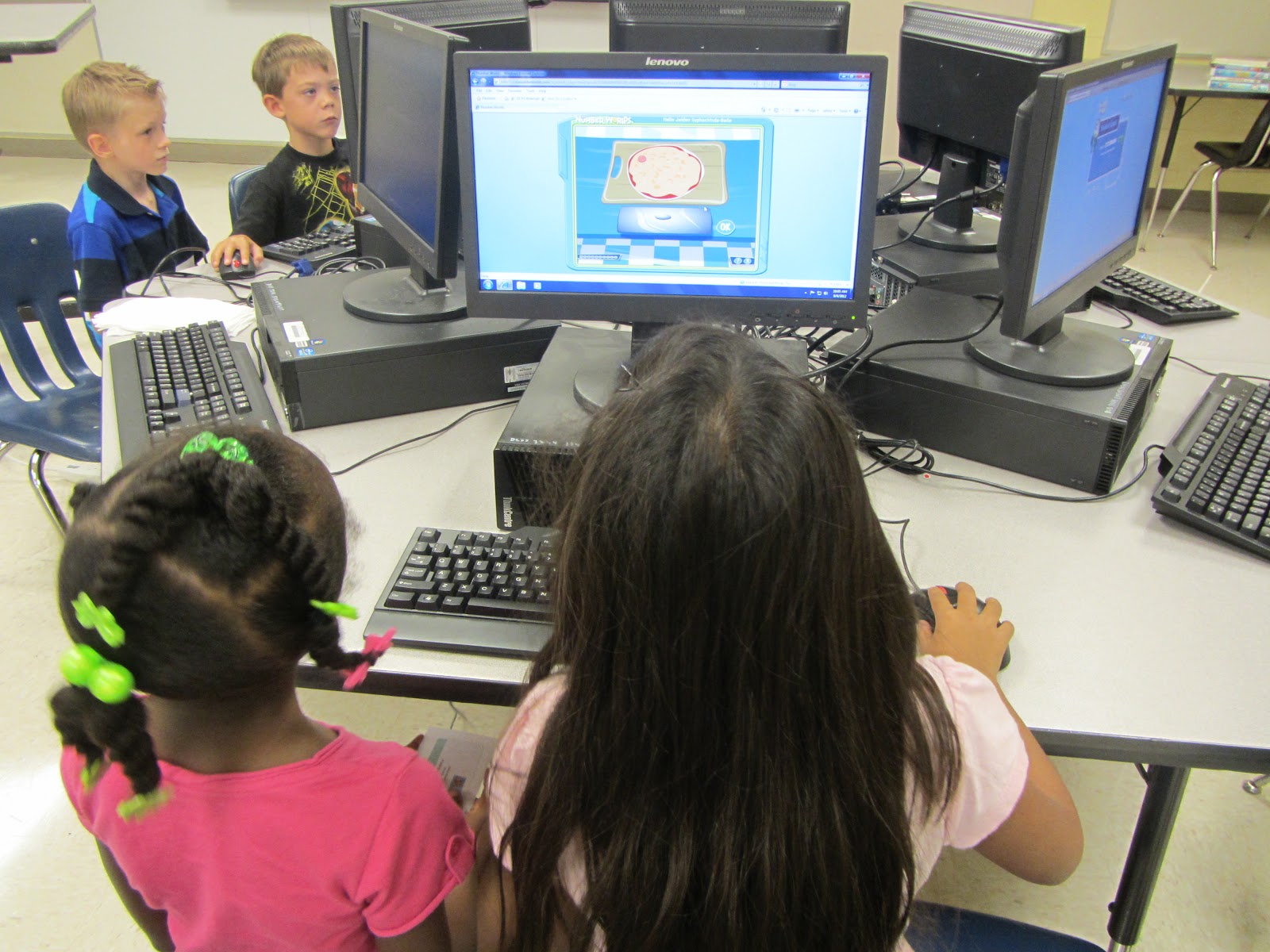
We took our first graders to the computer lab today for the first time this year.  We took them a couple of times last year but just teaching kindergartners to sign in is close to impossible.  In our county students use a 9-10 number/letter username and a 9-10 number/letter password.  Just getting youngsters to follow the sequence of the letters - and did I mention that some are uppercase and some lowercase so you have teach them to use the shift key - is a tedious task.  Now granted, once they learn the username and password at least they keep the same one for the duration of their time in Duval County.

In Kindergarten it is hardly worth the time it takes to get kids signed in, but by the time students reach first grade, there are several programs that the county has paid big money for that really can supplement the curriculum.  So... off we go to the computer lab to practice turning on the computer and signing in...

We have to sign up for the lab, but the calendar was blank today and probably will be until the lab is filled for mandatory testing.  Regardless, when we troop up the stairs  - a first for most of our students - we find another small group in the room - not using the computers, just using the room.  As sweetly as I can muster, I say that we came because we didn't see anyone on the calendar.  We even checked with the front office to be sure.  She, just as sweetly, says the room should have been signed out to her every day from 9-10 to work with her small group.  My line of first graders out the door are getting antsy as she kindly agrees to find another place to work.  Good thing too because I have promised these pint-sized learners an exciting hour!

We never really have enough computers  in the lab for every child to have their own, especially when our numbers are so swollen at the beginning of the year.  You can see the disappointment as children are asked to share... And, as always a few of the computers don't work.  While I'm sure this happens everywhere, younger students really have not developed much patience and tolerance for broken machines and again, even  a few more have to double up. 

As I am leaning over computers to help students realize that the 1 they typed is actually a lowercase l and the o is really the number zero 0 and not the letter O, the sweat rolls down my back.  It's bloody hot in this lab, but I guess no one has used the Lab this year to report that the air is not working properly.  Why is it that I seem to be the only one sweating as the children are totally engrossed with the task at hand!  Of course, there are several trying to sign in once, throwing their hands up in utter exasperation and complaining that their computer is broken.  I want to yell - IT'S USER ERROR! - but instead I smile and go the next student that has a hand raised.

Finally - and I do mean F-I-N-A-L-L-Y - we get to the site - SRA Number Worlds - and are faced with another username and password - a different one, of course. We have been working for an hour now when a few students finally reach the game stage.  Of course, now we realize that most of the computers don't have headphones.  The noise level begins to rise so... we congratulate the children for getting the computers turned on and teach them how to sign off!  Are we really going to call this Math today?

It was an exhausting lesson, but most of the children leave with smiles.  The first students sign in on our four computers when we get back to the room and we're off and running.  We've assigned a few computer "experts" to help friends get signed on so we are not disturbed every time a child wants to use the computers throughout the day. So... with all the barriers and all the bumps along the way, why do we make the effort?  Because this generation of children will be digital natives and will grow up in a world that we can't even imagine, and also because... it's part of our first grade standards!

Sunday, September 2, 2012

Reviewing Student Work

I brought my writing folders home over the long Labor Day weekend -  all 35 folders! - so I could analyze student writing and get a good idea of how much of the teaching I have been doing is getting through.  I also want to try to learn each author as a writer.  As I go through each folder I have been writing and printing notes on labels to post in our Writer's Notebook under each child's name.  This is an example of one child's note:


Name      9/1/12       Pattern Books 
+good spacing with sight words spelled correctly and phonetic spelling of unknown words
+good fluency
+has started "Have you seen my mom?..." pattern book

-work on finishing pattern and creating a "changed up" ending
-add question mark to "Have you seen my mom?" and capital after the question mark

These notes are a little more thoughtful and longer than I am usually able to write after a conference because we always have a number of children waiting for a conference and the time seems so short... so my jots during the Writers' Workshop are quicker and more to the point.  I do like the + (plus) to indicate noticings and things they already do well and the - (minus) to indicate next things to work on.  Because we have more than one teacher using our Writers' Notebook, we generally write our notes on sticky notes during the Workshop and add them at the end of the day under each child's name.  When you have more than one teacher involved, it is extremely important to make sure you know what the other teacher(s) may have talked to the student about the last time they had a conference so it's important to review the notes before each conference.  The Writer's Notebook becomes our way of detailing the progress of each learner.

I learned so much about these writers... As I was reading the pattern books I came across one student's pattern book that broke my heart.


Translation:
My Dad does not have a job.
My mom does not have a job.
My brother does not have a job.
I do not have a job.
My uncle does not have a job.
Does anyone have a job?

The pattern is perfect.  The message... heartbreaking.

Friday, August 31, 2012

Partners

Today we selected  partners.  This is pretty important because partners are long-term partners.  Except for the case of total discontent, these partners will remain the same until the mid-term. 

These partners will work together during  each day's partner reading so we have like partners together.  After the mini-lesson students have 15 minutes of quiet independent reading when students are reading books from their own book buddy.  These books have been carefully selected - mostly books at their independent level to practice, with a couple at their instructional level to challenge.  During that time they are putting sticky notes in their books of places that they want to share with their partners - funny parts, interesting parts, tricky parts...  When the timer goes off, the students know that they have an assigned place at a table or on the floor to meet with their partner.  There they sit side by side -  knee-to-knee and shoulder-to-shoulder and share what they have been reading.  They might also read together.  They have learned how to decide who goes first (rock, paper, scissors is a favorite and so is the mature, "Why don't you go first today?") and how to put the book in between.  It is important that we choose partners that are compatible but also who are close to the same reading level.

These partners are also Math partners - same partners, same place to sit.  This is the person that they will play most of the Math games with, so it is important to make sure we match children, not only who read at a similar level but who also have Math skills at a similar level. No easy task!

This is also the partner that they will sit beside any time we are doing whole group work on the carpet.  The children sit in four rows, crisscross.  When the teacher says, "turn and talk," this is the person that they will face and share with.

Having the same partner for everything cuts down on any confusion and loss of instructional time.  It makes for smooth transitions.

At the mid-term we will interview each student and see how s/he thinks the partnership is working out.  Some students will want a change and some will beg to stay together.  Working with another person and negotiating games and activities is just another life lesson in the daily work of a child.

Wednesday, August 29, 2012

100 Points of Light

In the last post, I talked about our new word wall that is going to be on the ceiling! In trying to orient the children in figuring out just how the wall was going to work (it's around the outside of two walls) we wanted to do something fun. We had the idea of darkening the room and working with flashlights and letting the children find words with the lights, but... as with so many ideas, we didn't have 36 flashlights. As we were considering raiding the hurricane stash, Williams' mom came to rescue and sent in 36 little flashlights with batteries! They are the perfect size. We used the lights today and the children could hardly stay in their seats. They were so excited. We had all the children, and then tables of children, and finally, individual children, find letters and words. I have a good feeling that the children understand the alphabetical order and where to find the words and they did it in such a novel way. We plan to use the flashlights at least once a week, so... if you have any great games and ideas, let us know!

Thursday, August 23, 2012

Where to put the word wall?

In first grade the word wall can be massive.  Not only do you put the kindergarten review and first grade sight words, but you need pattern words so that students can look at a word and see that they can make other words (If I can spell cake, then I can spell make).  It's always a challenge to find a space in the room for such a large project.  This year we decided to use the only space left in our room for such a large activity - the ceiling!  I know that in many classroom the fire regulations are very strict and that may be a problem for us before it's all over, but we're going to give it a try.  The success will be if the students actually use it!
We found this nifty tool to get the magnetic words from the white board to the ceiling without a ladder.  Pretty cool, huh?  The children are fascinated